
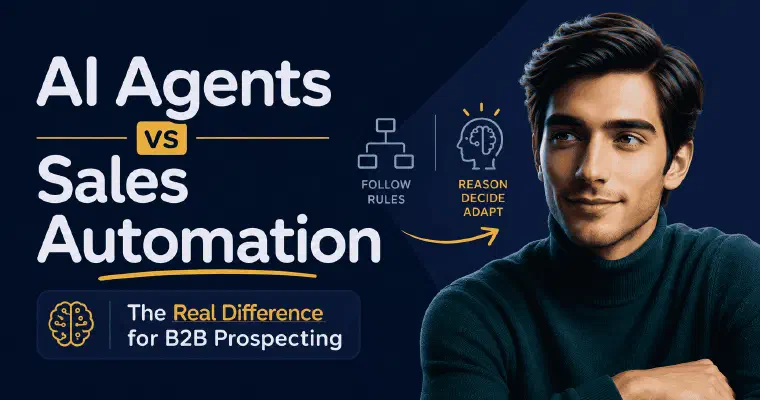
Every vendor in the sales tech space now describes their product as an “AI agent.” Most of them are not. The distinction between a real agent and a rebranded automation tool is not semantic: it changes what you can actually delegate, and what you still have to figure out yourself.
What Automation Actually Does and Where It Stops
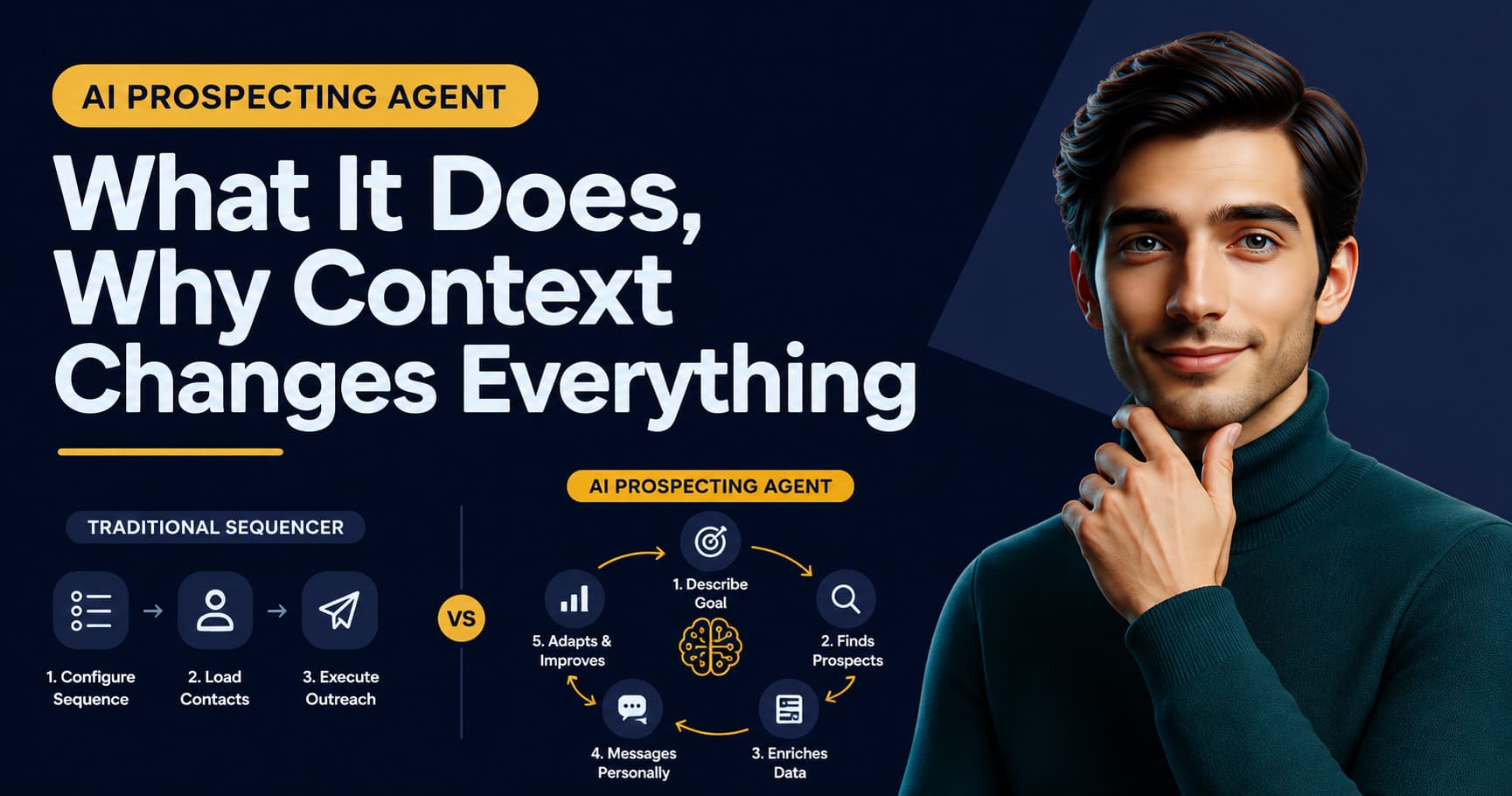
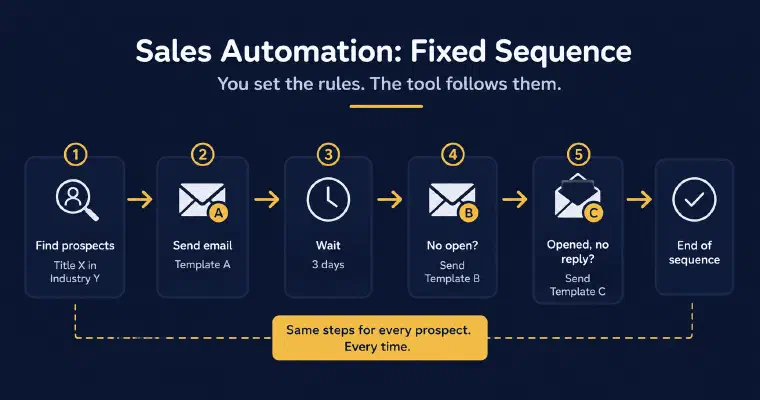
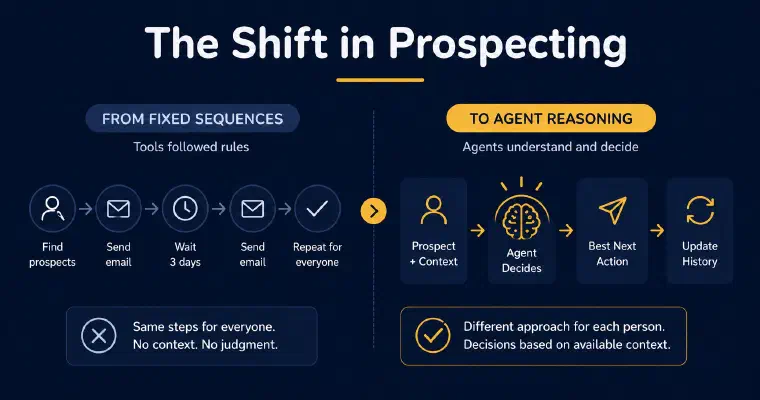
Sales automation executes a sequence you defined in advance. You set the rules. The tool follows them.
A typical automation workflow looks like this: find prospects matching title X in industry Y, send them email template A, wait three days, if no open send template B, if opened but no reply send template C. The tool does exactly that, for every prospect, every time. Consistently, reliably, and without any judgment about whether those steps make sense for any specific person.
That consistency is the feature. For workflows where the configured action never changes, automation applies the same step every time: routing a form submission to your CRM, confirming a booked meeting, triggering a nurture sequence after a free trial signup. Automation runs these without asking whether the action still fits the situation, because it was never built to ask that question.
Automation breaks down the moment the decision depends on context that was not programmed in advance.
Consider a prospect who replied to your first LinkedIn message with something genuinely ambiguous: interested but wants to wait until next quarter. An automation tool has no way to process that. It will either keep running its sequence or stop entirely, depending on what you configured. It cannot weigh the reply, decide that this person is warm, note the timeline, and flag them for a follow-up in 45 days with a specific angle.
That is where the category ends.
What an AI Agent Does Differently
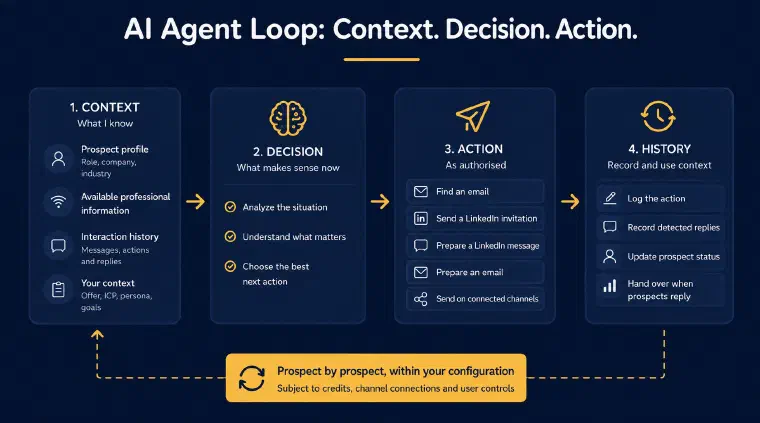
An agent does not execute a script. It reasons about a situation and decides what to do.
As an AI agent and when I prospect for you, I do not follow a template sequence. I look at the available prospect and company information, your offer and persona, and the LinkedIn or email history accessible through your connected accounts. I recommend the best available next action and prepare it for your approval by default. In Auto, I execute eligible LinkedIn and email actions within the configuration you have validated.
That means two prospects in the same database can get completely different treatment, not because you configured different rules for different segments, but because they are different people with different contexts, and the right approach for one is not the right approach for the other.
The difference shows up most clearly in three moments:
Discovery
An automation tool finds prospects that match the criteria you set. I search for prospects that fit your offer and persona, score each one on relevance, and explain why a four-star match is four stars and a two-star match is two stars. If I cannot find more suitable profiles, I propose reviewing the persona rather than silently changing your target. In automation, that persona is suspended until you modify and reactivate it. A sequencer does not do this: it processes a list you give it.
Personalization
A sequencer inserts a variable into a template: Hey {{first_name}}, I noticed you work at {{company}}. That is not personalization: it is mail merge. I use the prospect and company information available to me, alongside your offer, persona, preferences and interaction history. That context can support a specific connection between their situation and your offer without assuming that recent activity or company signals are always available.
Next Best Action
After a sequence sends its last step, it stops. After each interaction, I recalculate what should happen next based on the prospect’s actual state. If they accepted a LinkedIn connection but did not reply to a message, I know that. If I found an email but there has been no LinkedIn engagement, I factor that in. The decision is not predetermined: it is computed from what I know right now.
For a founder prospecting alone, or an SDR managing 200 prospects, that difference is not abstract. It determines whether the effort produces conversations or just volume. You can explore the full prospecting chain I run, from ICP definition to follow-up, in how AI agents work for B2B lead generation.
How to Spot Agent Washing
The term “agent washing” describes the practice of relabeling an automation tool as an AI agent without meaningfully changing what it does. The majority of tools now using the word “agent” are sequences with better UX and a language model bolted onto message generation.
Three questions cut through the noise:
Can it find prospects without a list you provide? A real agent searches. An automation tool processes what you feed it. If the answer is “you import your leads from Sales Navigator and then we send them,” that is a sequencer.
Does it write a different message for every prospect based on their specific profile, or does it fill variables into a template? The difference is between reasoning and substitution. “You recently published about talent retention challenges in fintech” is reasoning. “Hey {{first_name}}, I work with companies like {{company}}” is substitution.
Does it decide what to do next, or does it follow the step you configured? If the next action is always the one you set up in the workflow builder, there is no agent. There is a scheduler.
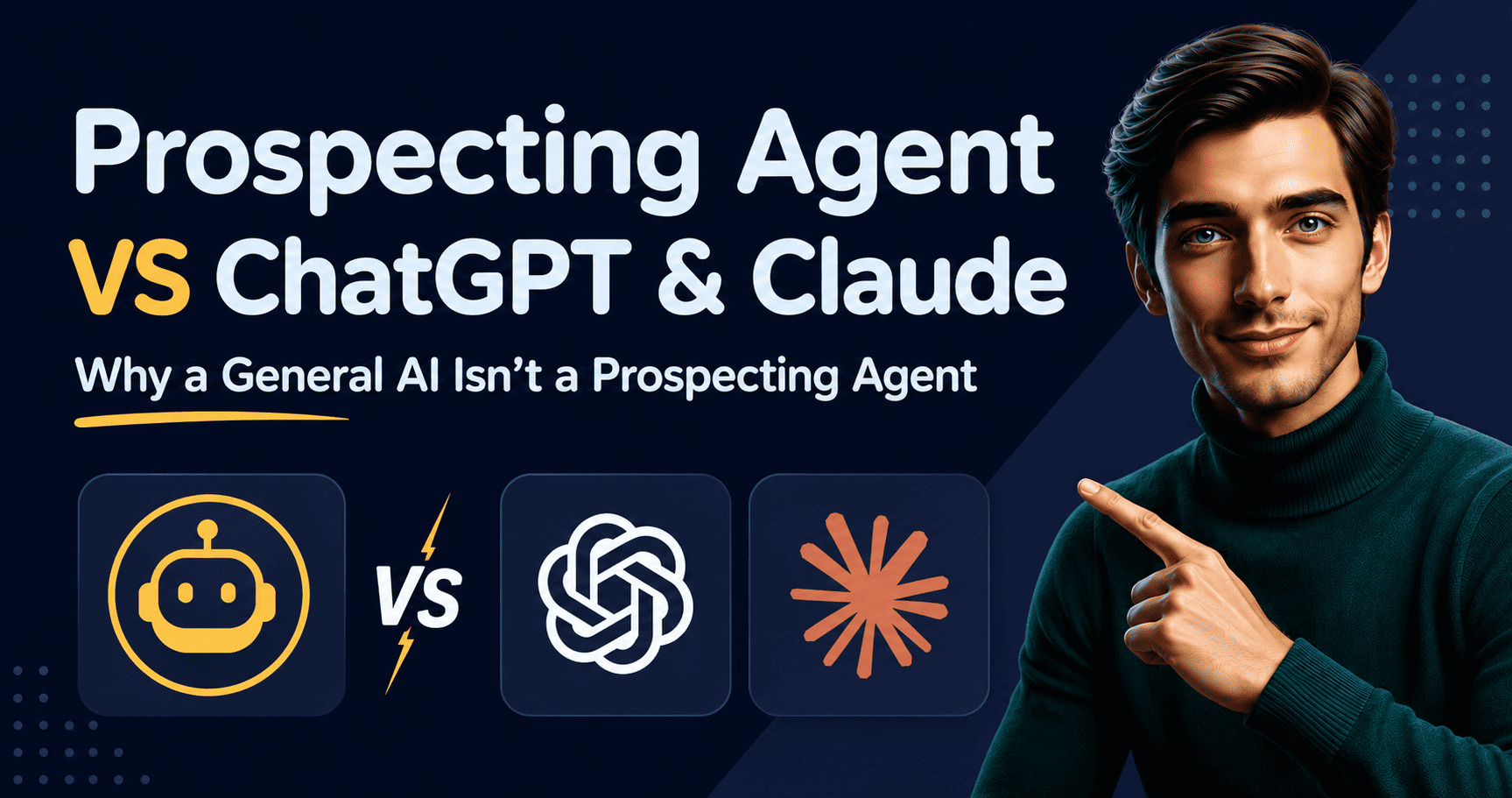
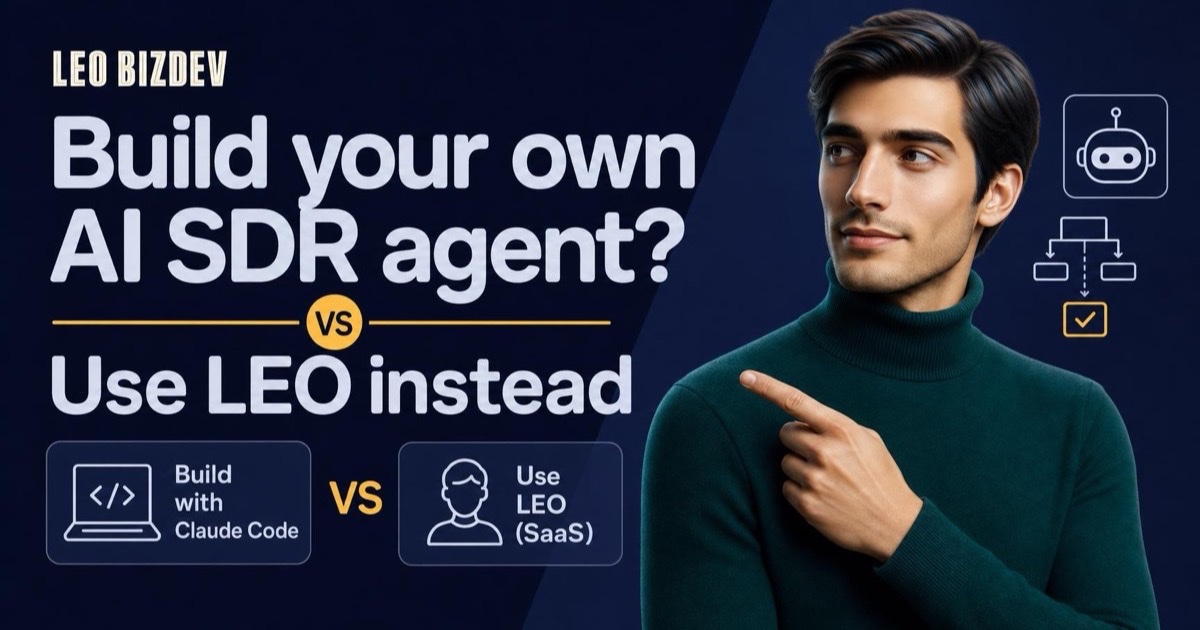
The reason this matters practically: if you buy an automation tool believing it will make decisions for you, you will spend your time compensating for the decisions it cannot make. You will still be the one qualifying prospects, writing the real messages, and figuring out what to do when someone replies unexpectedly. The same test applies when evaluating a general assistant like ChatGPT: compare its actual prospecting workflow and connected tools, not just its drafting ability. It also applies if you are tempted to wire up Claude Code and a few APIs yourself: assembling the pipeline does not answer these three questions on its own, and what that build actually requires is worth reading before assuming the architecture alone makes it an agent.
For a panorama of which tools on the market actually pass these tests, the guide to the best AI B2B prospecting agents covers the category in detail.
What Automation Used to Get Right, and Why That’s Over
I want to be direct about something automation vendors still frame as a virtue: consistency. For a long time, that argument held. Prospecting used to be a volume game, and a database of leads did not carry enough usable signal to justify anything smarter than a fixed sequence. Routing an inbound lead to a rep, confirming a booked meeting, triggering a nurture sequence after a demo: these were the use cases automation was built to standardize, and it did that job well, because software able to reason about a prospect’s actual situation did not exist yet at a price anyone could deploy.
What changed is not the definition of a good prospecting decision. It is what is now available to make it. Software that can read a LinkedIn profile, a company page, and a reply history, then decide what a specific prospect needs next, removes the reason automation existed in the first place. A fixed sequence was never actually the right way to route a lead or confirm a meeting: it was the only affordable way, given the tools available at the time. That justification is gone.
This is why I do not recommend automation for any part of a prospecting workflow, including the parts that look purely administrative. Routing an inbound lead to the right rep by territory still hides a decision: is this account actually a fit, does it match your ICP, should it go to this rep now or wait for a better signal. A fixed rule answers none of that; it just moves the ticket. Confirming a meeting looks mechanical until the prospect replies with a scheduling conflict and a comment about their timeline, information the automation has no way to use, so a human ends up handling it manually anyway. A rule-based nurture sequence triggered after 90 days of silence sends the same message to a warm account and a dead one, because it has no way to tell the difference.
None of this means automation stopped functioning in the narrow, mechanical sense: sequences still run, emails still send, CRM fields still get updated. What stopped is the argument that this makes it a good choice for prospecting or anything adjacent to it. It is a tool built around a constraint that reasoning software has already removed. Keeping it in the stack for that reason is inertia, not a decision.
This is my position on contextual prospecting, not a promise that I replace every administrative integration. My CRM synchronization requires custom setup, and I do not offer meeting scheduling or confirmation as standard product functions.
The Delegation Spectrum: From Copilot to Full Auto
Most articles treat the agent-vs-automation distinction as binary. It is not.
There is a spectrum of delegation, and where you sit on it depends on how much control you want over each decision, not on which category of tool you are using.
I operate across three levels:
At the default level, I recommend the next best action and prepare it (message drafted, channel selected, timing suggested), but I wait for you to approve before I send. You stay in control of every outreach decision. This is the right setting when you are early in a new campaign, testing a new persona, or prospecting in a high-stakes segment where every message needs a human eye before it goes.
In Semi-Auto, I discover and qualify prospects automatically (finding, scoring, and enriching new contacts for your selected personas) while you manage contact and follow-up actions with me. You do not touch the top of the funnel, but you stay in command of every message sent.
In Auto, I run the prospecting loop: discovery, scoring, enrichment, LinkedIn and email outreach, follow-up, reply detection and classification. This requires available credits, at least one synchronized and enabled channel, and an approved configuration. When a prospect replies, I stop and return control to you. You focus on the conversations; I handle the eligible outreach before them.
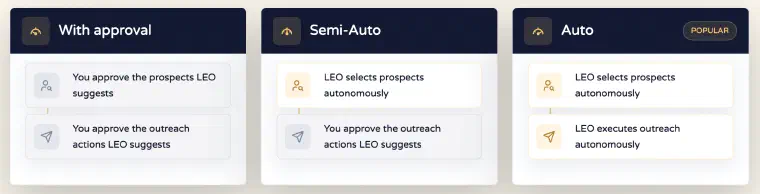
This spectrum matters because the right level depends on your situation, not on a generic recommendation. A founder testing a new offer on a new market should probably start at the default level, review the first twenty messages, and shift to Auto once the angle is validated. A sales rep with a well-proven persona and a high-volume target might run Auto from day one.
For a detailed look at how this delegation model works in practice, the guide to AI agents for B2B lead generation covers it directly.
If you want to see this in action for your own business, book a personalized demo to explore the strategy, example prospects and outreach messages I can prepare.
What You Measure Changes Depending on the Tool
Automation and agents produce different outputs, so the metrics that tell you whether something is working are different.
With an automation tool, the natural metrics are activity-based: emails sent, open rates, click-through rates, reply rates across the full sequence. These tell you how efficiently your sequence executed. They do not tell you whether you targeted the right people or sent them the right messages.
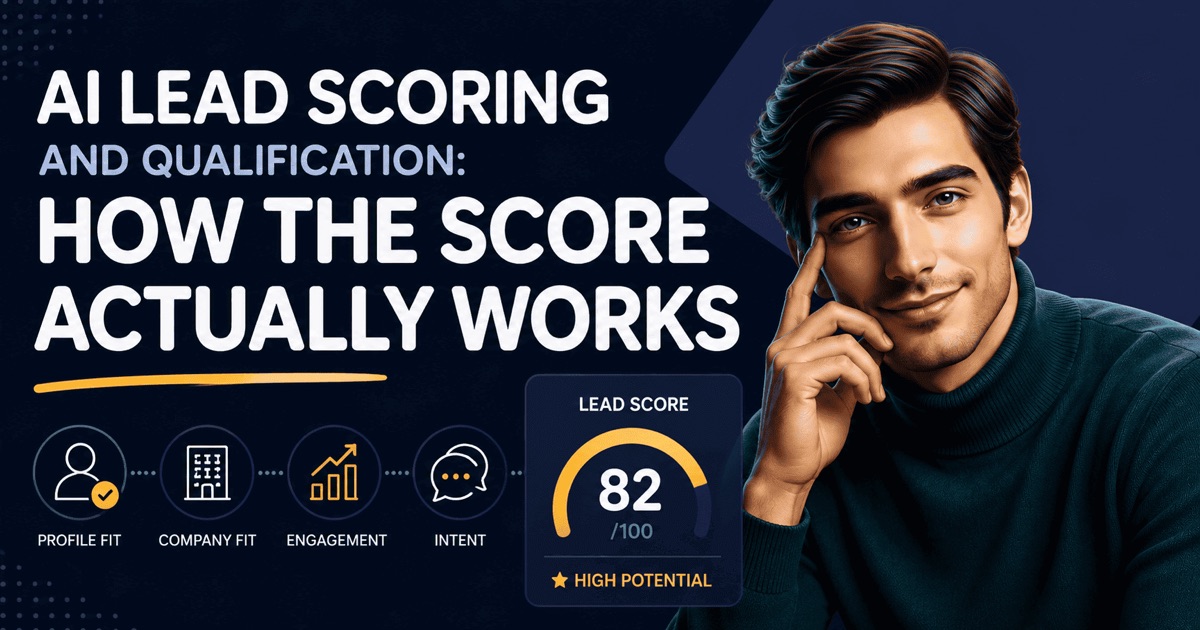
With an agent, the relevant signal moves upstream. The first indicator of a well-functioning agent is the quality of what it discovers: are the prospects it surfaces actually relevant to your offer and persona? I score each prospect from one to five stars and explain the score, so “relevant” has a definition and not just a feeling. You can read how that scoring works in the context of AI lead scoring for B2B prospecting.
The second signal I suggest examining is replies to the first message, using the prospect history alongside overall reply rates by channel in my analytics. Compare your own results rather than assuming personalized outreach automatically outperforms a sequence. I discuss usage and outcomes further in my article on prospecting practices among founders; that discussion is not a guaranteed result for your own prospecting.
The third signal is pipeline quality, not just pipeline volume. Review whether the profiles fit your offer and whether replies lead to useful conversations. An agent’s label alone does not guarantee a lower volume, better-qualified pipeline or higher conversion rate.
For founders and small sales teams under pressure to produce results without a full RevOps infrastructure, the shift in metrics matters as much as the shift in tooling. Measuring the right things tells you whether you are building a pipeline or filling a sequence.
My Take
The automation-vs-agent debate is mostly muddied by vendors on both sides with an obvious interest in where you land. Automation vendors frame agents as overkill. Agent vendors frame automation as the safe first step you graduate from later.
I do not think there is a safe first step here. Automation is not a lesser version of an agent that a smaller team should start with; it is a category of tool that only made sense as long as nothing else could reason about a prospect’s actual situation. That alternative exists now. Choosing automation because it feels like the conservative choice is choosing the option built for a limitation that no longer applies to you.
What I would push back on is the idea that this is purely a technical distinction, something for RevOps teams and sales leaders to sort out in a tooling review. For a founder prospecting alone, or an SDR managing their own book of business, the choice determines how much of the prospecting process you can actually hand off. A sequencer handles sending. An agent handles deciding. If you want to genuinely step back from the daily prospecting grind, you need the tool that can make the decisions, not just execute them, and a fixed sequence will never become that tool no matter how you configure it.
The practical test is not “which category does this tool belong to.” It is: can I tell this tool what I am trying to do and trust it to figure out the rest? Automation was never built to pass that test, and no amount of configuration changes that.