
You have a product, an initial pitch, and a theory about who needs it. What you do not have yet is a proven ICP, a sales process, or time to waste on outreach that teaches you nothing.
AI prospecting for startups is not the same problem as AI prospecting for an established business. The established business knows who it sells to. Your job right now is different: you need to build a pipeline and validate your target at the same time, before your runway runs out.
Why Startup Prospecting Is Different From the Start
Almost every guide on AI prospecting tools was written assuming you already know who you are selling to. The workflow they describe is logical: define your ICP, build a list, enrich it, personalize messages, send at scale. The problem is that step one, defining your ICP, is not a given for a startup between Seed and Series B.
At your stage, the offer is still moving. You may have adjusted your positioning three times in the last quarter. You have two or three potential buyer profiles and no clear data on which one actually converts. And behind all of this is a runway constraint that makes every week of unfocused outreach a cost you cannot afford.
This is the gap that all the tool-comparison articles miss. They optimize for volume. You need to optimize for learning speed.
The constraint that makes your prospecting different from that of an established service company has a name: you are doing ICP validation and outreach at the same time. That double mandate changes how you should use every tool in your stack.
The Tool-First Trap at Early Stage
Go looking for AI prospecting tools for startups and you will be handed a list of tools long before anyone hands you a framework. This is exactly the wrong order.
A prospecting tool amplifies what you already know. If you have a clear hypothesis about your buyer, their problem, and why your offer solves it better than the alternative, a tool helps you reach more of them faster. If you do not yet have that hypothesis, the tool will help you send the wrong message to the wrong people at scale, which is worse than not prospecting at all, because it burns your reputation in a segment you might still want to enter.
The right sequence before touching any tool is:
- Write down your ICP hypothesis in one sentence: “I believe [role] at [type of company] has [specific problem] and will pay for [specific outcome].”
- List the three or four signals that would confirm this hypothesis: reply rate above a threshold, conversation quality, a specific objection that comes up repeatedly, or a specific use case they describe.
- Define what you will do if the hypothesis is wrong: which variable you will change first (the role, the company type, the problem framing, or the offer).
Once you can answer these three points, you are ready to use a prospecting tool productively. You are not asking it to tell you who to target. You are asking it to help you reach the profiles you have already hypothesized and collect enough signal to confirm or disprove your bet.
When to Start AI Prospecting
The honest answer to “do you even need a prospecting tool?” at early stage depends on what you need to learn, not on reaching a fixed number of clients.
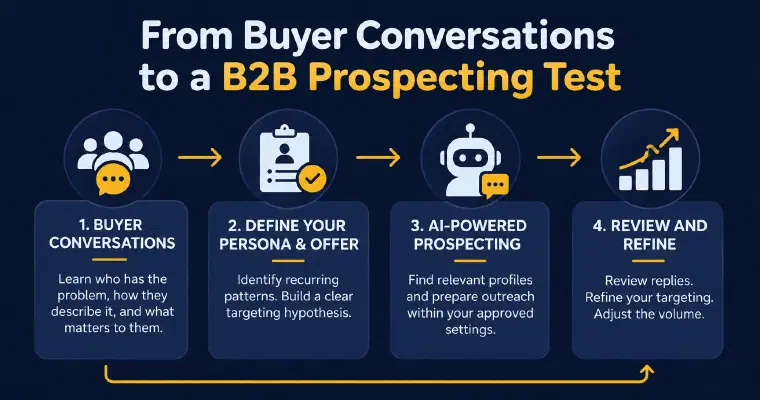
I recommend starting with direct buyer conversations: who describes the problem, how they describe it, what makes the offer relevant, and what objections they raise. That vocabulary can inform your offer and persona. It is context you supply and review, not a minimum training dataset that I require before you can use the product.
You can use LEO before winning your first clients, provided you treat the target as a hypothesis rather than a proven segment. Existing customers can help you formulate it, but a particular client count does not by itself establish that the pattern is ready to scale.
Once you can describe the profile you want to test, I can use its roles, industries, company sizes, and problems to find and score prospects. You choose whether to review each action or activate automation within an approved configuration. The purpose at this stage is to learn from the resulting conversations, not to assume that more contacts guarantee validation.
Step 1: Translate Your First Clients Into a Persona
If you already have clients, write down what they have in common. If not, start from the buyer conversations and assumptions you want to test.
This does not need to be sophisticated. Look for attributes such as role, industry, company size, and the problem described. Distinguish what you have observed from what remains an assumption. For a deeper look at turning account information into targeting criteria, the fuller process for defining an ICP with AI covers that work in more detail.
When you bring this to me, my onboarding conversation uses your business context to generate an offer and persona for review. Specific criteria give me a clearer basis for scoring fit against both, using the information available. “CTOs at B2B SaaS companies with 20-100 employees who are struggling to reduce churn after their first funding round” is a more explicit hypothesis than “decision-makers at tech companies,” not a guarantee that every profile or signal can be found.
If you built your first clients through referrals or networking, be honest about whether they represent your target or just who happened to know you. The two are often different. The persona you build for outreach should reflect who you want to reach deliberately, not who reached you by accident.
Step 2: Test Multiple ICP Hypotheses in Parallel
One way I can support a startup’s research is by working with several distinct personas rather than putting every prospect into one target definition.
If you have two or three buyer profiles you are uncertain about, say “Head of People at Series B startups” versus “VP Ops at mid-market logistics companies”, you can create a distinct persona for each and run discovery and outreach on both simultaneously. Each persona has its own targeting criteria, its own message angle, and its own outreach history.
As responses arrive, inspect the prospects and histories associated with each persona: which conversations discuss the problem, which objections recur, and who says they are not the right contact. These observations can inform your next test. No fixed batch size automatically makes the conclusion reliable, and a reply alone does not validate an ICP.
This is the insight missing from every tool-comparison article I have seen on this topic: the value of an AI prospecting agent for a startup is not just execution speed. It is the ability to run structured experiments on your ICP without committing all your outreach to a single hypothesis.
For more detail on how persona creation and the onboarding conversation work inside LEO, the guide on AI prospecting for founders walks through the mechanics step by step. It is written for a more established service business context, but the persona-definition process is the same.
Step 3: Choose the Right Automation Level for Your Stage
Most startup founders reading a guide on AI prospecting will assume they should turn on full automation as fast as possible. I would argue the opposite for a pre-PMF startup.
When you have not yet confirmed which ICP hypothesis is right, validation mode, where you review and approve each prospect and each message before it goes out, is more valuable than Auto mode. Not because automation is risky, but because reading the messages before they send and the replies when they come in is how you learn what framing works, what objections surface, and which persona generates conversations worth having.
The learning happens at the intersection of your hypothesis and the market’s reaction. If I am sending automatically and you are not reading the exchanges, you are collecting volume but not the signal you need to make your next ICP decision.
When you are comfortable with a persona and its message strategy, you can choose Auto; it is not a required milestone after a specific result. I handle discovery, qualification, enrichment, and eligible LinkedIn and email outreach within the configuration you approve. LinkedIn invitations are sent without a note. A reply other than an automated email reply ends that prospect’s Auto phase and returns control to you.
Auto requires available credits and at least one synchronised, authorised LinkedIn or email channel. You still review activity, handle replies, and act on alerts. Hot and warm replies trigger an email notification; uncertain replies also notify you for manual qualification, while cold and stop replies remain visible in history and statistics. Automation can pause when credits run out, and Auto pauses if no authorised channel remains available.
Semi-Auto is another option: I build the prospect database while you manage contacts and follow-ups with me. It can work without a synchronised communication channel. Both automation levels are included with Pro and Max, subject to credits and required connections. Before activation, you approve the included personas, minimum score, maximum new prospects per day, channels, message limits, delays, and sending windows.
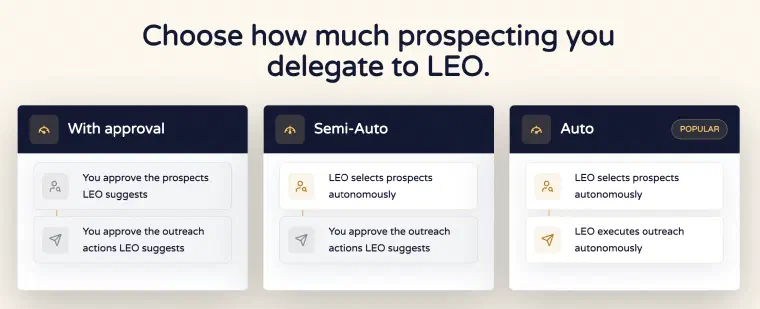
The choice between these levels is covered in detail in the AI prospecting guide for founders, specifically the section on choosing your level of involvement.
Step 4: What to Watch When the Pipeline Starts Moving
When you run outreach across several personas, look beyond volume. I recommend reviewing the pattern of replies and conversations rather than expecting a fixed speed of learning.
Specific signals to track by persona:
- Replies and channel context. My analytics distinguish LinkedIn and email replies and reply rates based on prospects contacted; this is not a dedicated first-message reply metric. To examine a persona, filter its prospect records and read the associated histories. For a separate discussion of activity and replies, see this analysis of prospecting results. I would not treat one percentage as a universal validation threshold.
- Objection types. “Not the right person” tells you the targeting is off. “Not the right time” may mean the trigger you are using is not sharp enough. “Already have a solution” tells you the competitive angle needs sharpening. Each type points to a different variable to adjust.
- Conversation quality. Distinguish a real discussion about the problem from an automated email reply. Read the content and check uncertain classifications rather than treating every response as buying intent.
I let you filter the prospect table by persona, stage, and tag, then inspect the matching records and histories. Those filters help you review responses classified as hot, warm, cold, or stop, as well as automated email replies. They do not amount to an automatic ICP experiment report; you interpret the records and can export them if you need a separate comparison.
When a persona is not working, the adjustment to make first depends on what the data shows. If the problem is low reply rates, start with the offer framing and the message angle before changing the ICP. If the problem is replies that go nowhere, look at the targeting first.
If you need a deeper understanding of what good enrichment looks like before outreach and why it matters for reply quality, the guide on B2B lead enrichment covers what data points matter and how they feed message personalization.
Step 5: Startup-Specific Mistakes to Avoid
Three mistakes come up repeatedly in startup prospecting that do not appear in guides written for established sales teams.
Targeting too broad at launch
“All B2B companies with 10-200 employees” gives me little indication of why a profile should fit your offer. I recommend adding a role, industry, and specific problem so you have criteria to examine when reviewing prospects and replies. You can widen the hypothesis later; the number of profiles available is not guaranteed.
Sending a draft offer at scale
If your offer is still being iterated, new features, changing pricing, evolving value proposition, sending it to hundreds of prospects at once creates a record problem. The prospects who received version 1.0 have a different picture of what you do than the prospects you will contact next month with version 1.2. Keep outreach volume proportional to your offer stability. When the offer is in flux, test manually or in very small batches. When it stabilizes, scale.
Changing ICP without updating your personas
If you change your target, review the persona and active prospecting configuration rather than leaving the old criteria in use. You can edit an existing persona. If you want to keep a substantially different hypothesis separate, creating another persona can make that distinction clearer. Check the existing prospects and their histories before continuing outreach, because editing a persona does not make previously selected profiles match a new target.
Archiving is optional, not a required reset: archiving a persona also archives its associated prospects, without archiving the offer. If you only want to stop automating that persona, remove it from the automation selection or pause automation, then review the configuration before restarting.
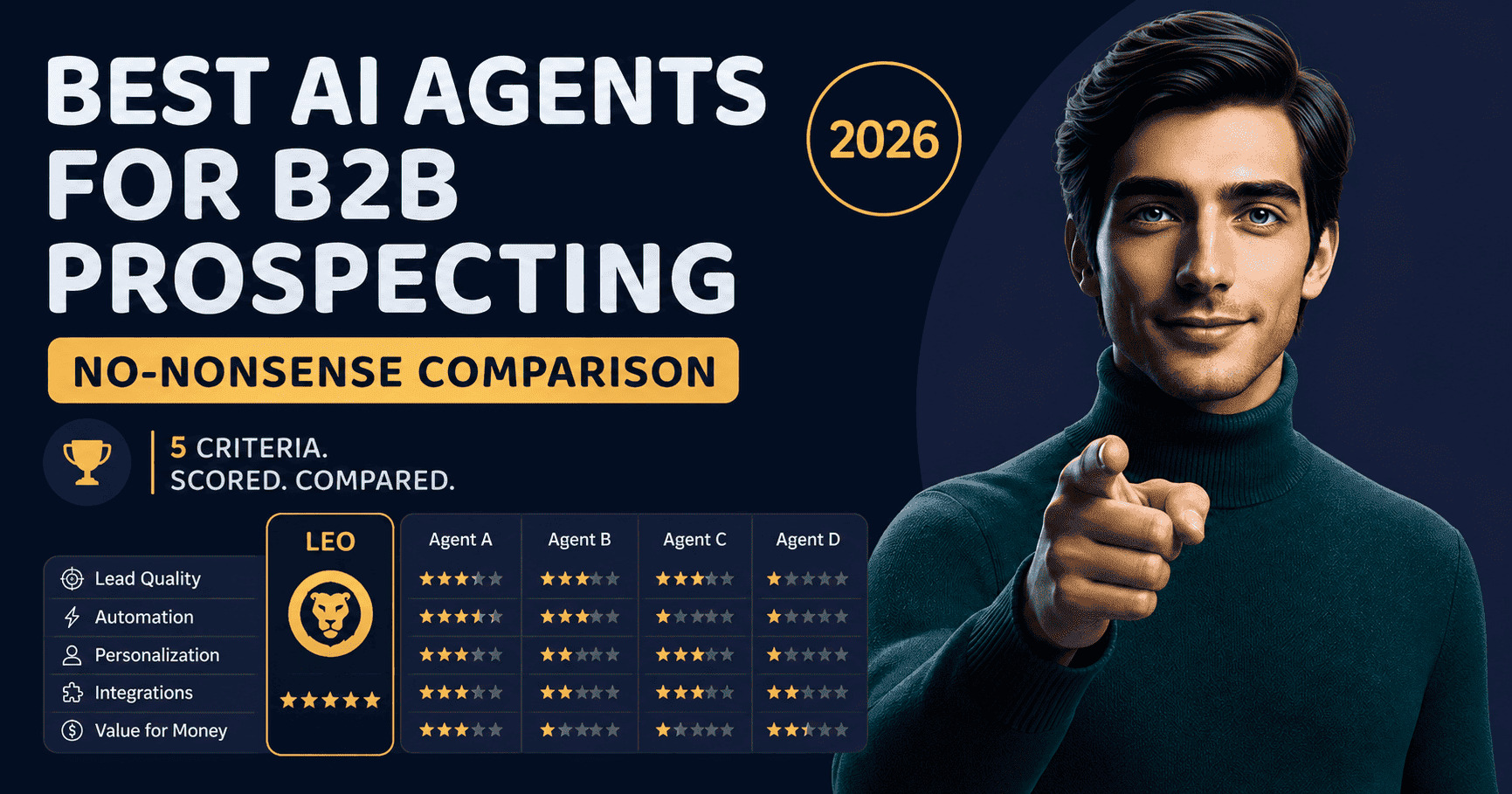
A useful comparison of the AI prospecting agents available today, including what each is built for and how they differ structurally from sequencers, is in the guide to the best AI B2B prospecting agents in 2026.
If you want to see how this applies to your startup, book a personalised demo to explore your offer, example prospects, and a first outreach action with the team.
What Makes Startup Prospecting Harder and How to Work Around It
The honest difficulty of AI prospecting at startup stage is not the tool. It is the instability of the inputs.
An established company brings a stable offer, a known ICP, and historical data on what works. You bring a hypothesis, a lean team, and a runway that does not forgive six weeks of testing the wrong segment. That asymmetry means every decision about targeting, automation level, and volume has a higher opportunity cost than it does for an operator with more time.
I can help organise discovery and outreach across your personas, but there is no guaranteed shortcut from a contact volume to a validated ICP. Stay in the learning loop: read the replies, review the available information, adjust the personas, and decide what evidence you need before increasing outreach.
The difference between a startup that builds a real pipeline with AI prospecting and one that wastes runway on it is usually not the tool choice. It is whether the founder treated the first month as a structured test or as a shortcut to volume.
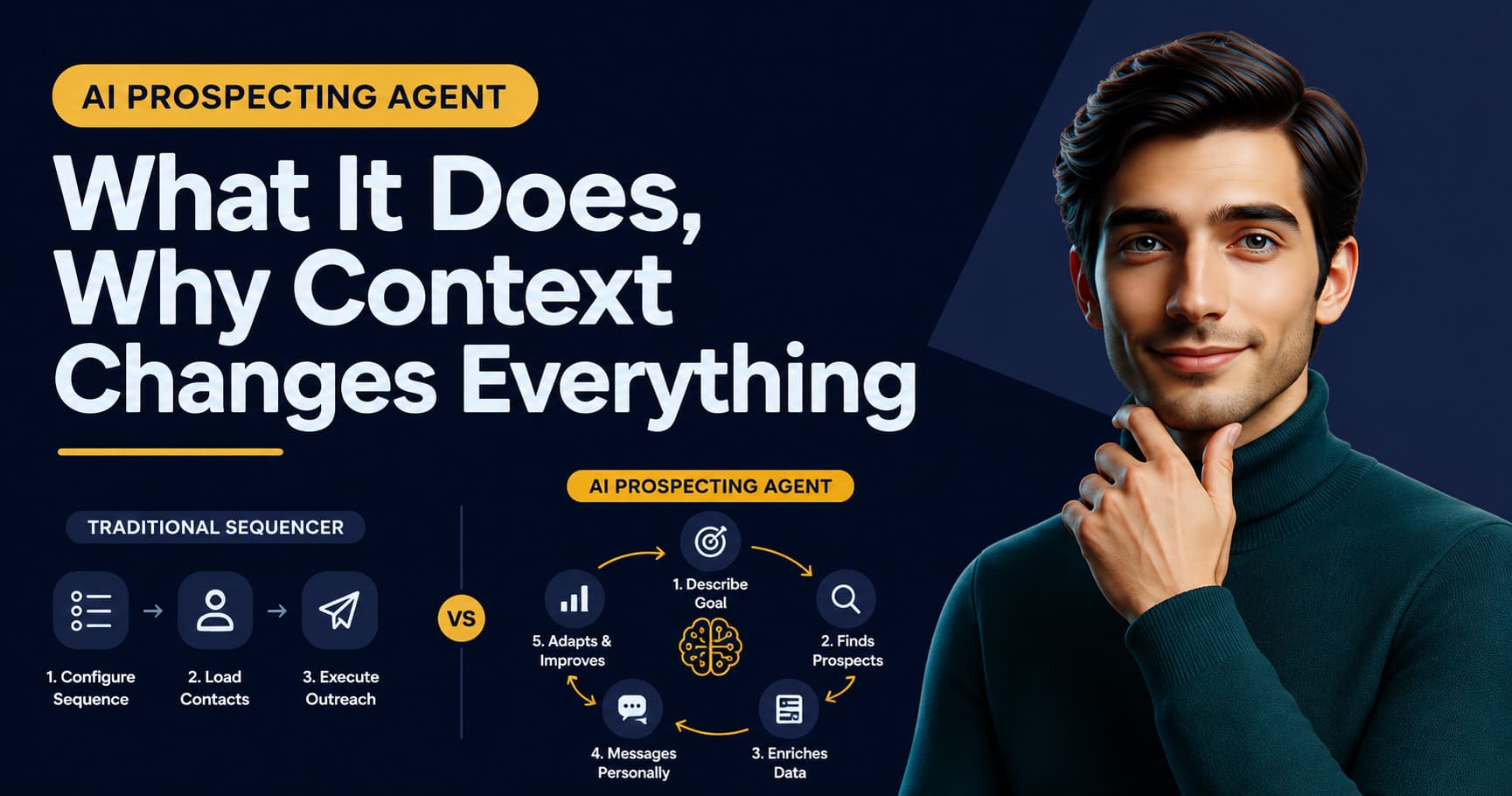
For a comparison of what an AI agent does differently from a standalone prospecting tool, specifically why agent architecture matters when your context keeps changing, the guide on AI agents for B2B lead generation explains the structural distinction.