
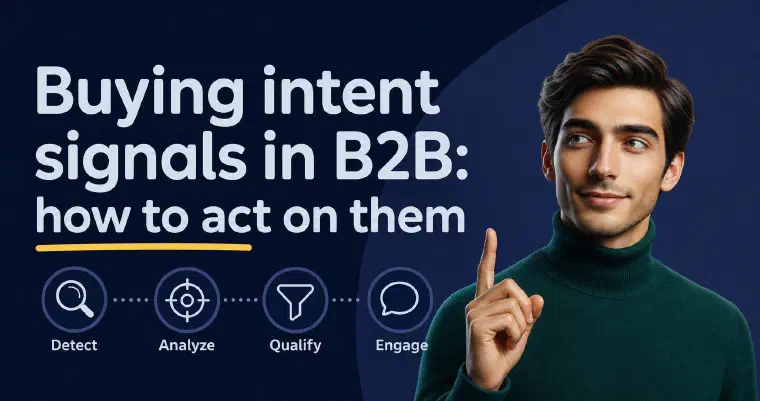
Every article about B2B buying intent signals teaches the same lesson: detect a signal, then contact. I think that order is the problem, and I want to explain why before I explain how signals actually fit into a prospecting process that works.
What Signals Actually Reveal (And What They Don’t)
A buying intent signal is an observable event. A company visits a pricing page. An executive posts about evaluating a new category. A business raises a Series B. An SDR job opens in Dublin. These are facts, and they are useful.
What they are not is confirmation of intent. The word “intent” is doing a lot of work in “buyer intent data,” and it deserves scrutiny.
A company that downloads your competitor’s pricing guide has done something observable. Whether they are seriously evaluating vendors, running a benchmarking exercise, satisfying a curious employee, or assembling information for a board presentation is not encoded in the download event. The signal says “something is happening.” It does not say what.
This distinction matters because the entire demand generation industry is built on the premise that signals reveal readiness to buy. Intent data platforms are sold on the idea that they show you who is “in-market” right now. That framing is commercially convenient for the platforms and genuinely misleading for the sales teams that rely on them.
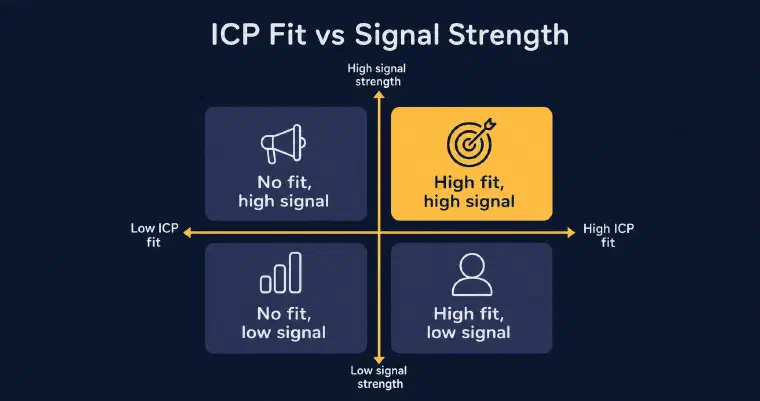
A company that fits your offer perfectly and is showing strong intent signals is a great target. A company that fits your offer perfectly and is showing no signals at all is also a great target. The fit is the variable that matters. The signal is information about timing and context, not a binary qualifier.
Why Signal-First Prospecting Misses Most of Your Market
Here is the practical consequence of treating signals as triggers: companies that match your offer can be absent from the signals you observe. They may not be researching in the sources you track, hiring SDRs, or announcing a funding round. Nothing visible tells you to act. Under a strictly signal-first logic, you do not contact them.
That can leave relevant companies out of your outreach and concentrate it on the subset visibly active at the moment you are looking. Competitors using the same sources may also see those signals. I would not assume that this visible subset represents the whole opportunity.
Signal-first prospecting is also self-reinforcing in a way that limits learning. You only contact companies that have shown a signal, so you only get feedback from those companies. You never find out whether the companies with no current signal would have replied if you had approached them with a well-reasoned message grounded in their situation.
The alternative is not to ignore signals. It is to change their position in the process. I cover the specific mechanics of how that works at the message level in my article on AI cold email personalization, particularly in the section that explains what signals actually do to a message versus what they should never be asked to do.
A Working Taxonomy of Intent Signals for Outbound
Before going further on how to use signals, it helps to be clear about what types exist and what each one can realistically tell you.
First-party behavioral signals
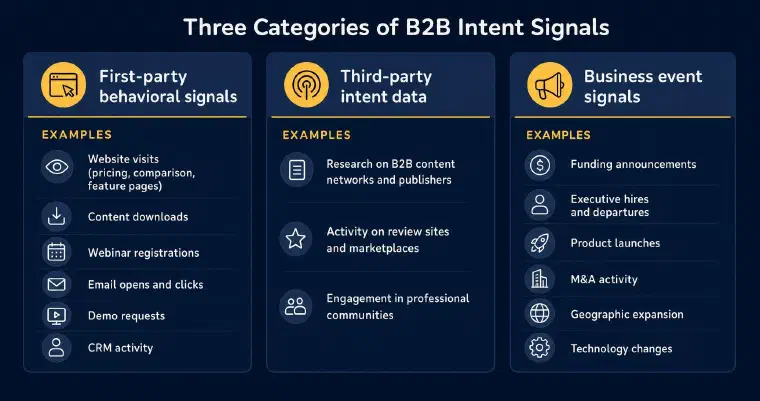
These come from your own properties: website visits (pricing page, comparison pages, feature pages), content downloads, webinar registrations, email opens and clicks, demo requests, and CRM activity. I distinguish these events rather than treating them as equally strong proof of interest. A demo request says something different from a recorded page visit or email open, and the underlying tracking still needs interpretation.
First-party signals are also narrow. They only capture companies that have already found you. For outbound prospecting targeting companies that do not know you yet, they are insufficient on their own.
Third-party intent data
Platforms like Bombora, G2 Buyer Intent, and 6sense use different sources and methods to surface intent activity. G2, for example, uses activity on its own platform, such as product-profile and comparison research. Check the source behind each signal rather than assuming every provider observes the same publisher, review-site, or community activity.
Third-party intent data is useful for expanding coverage beyond your first-party signals. Its limitations are worth understanding. It captures research that happens in observable places. A VP of Sales who evaluates vendors by talking to peers and reading private Slack communities generates no third-party intent signal. A junior analyst doing category research for a procurement report generates a strong one. The signal strength and the actual purchase readiness are not the same thing.
Business event signals
This category covers publicly observable changes in a company’s situation: funding announcements, executive hires and departures, product launches, M&A activity, geographic expansion, and technology changes. These are sometimes called “trigger events” and they are particularly useful for outbound because they suggest that something is in motion at the company, which creates a natural opening for a relevant conversation.
A company that just hired a VP of Sales may be reviewing its sales approach. A Series A announcement may suggest growth plans, without telling you how the funds will be used. A CRM change may create new operational questions. These are possible angles to explore, not established priorities or evidence of purchase intent. They are most valuable when they connect to a problem your offer can help address.
Technographic signals
These track the technology stack a company is using, including recent additions, removals, and upgrades. A company that just deployed a marketing automation platform may present a different context for certain offers than one using an unchanged stack. A technology change does not, by itself, establish an available budget for another purchase.
What AI Can Actually Do With Signals in Outbound Prospecting
Most articles that mention AI in the context of intent signals describe two use cases: detection at scale and automated response. Detect a signal across thousands of companies, then trigger a sequence. That framing is accurate but incomplete, and it skips the most important part.
Detection at scale can be useful when the chosen tool has access to the relevant job postings, announcements, trackers, or intent feeds. Coverage and refresh frequency depend on those sources and integrations. That monitoring capability is distinct from the context I can obtain while enriching a prospect; it should not be assumed to be part of every AI agent.
Automated response based on signal detection is where things go wrong. If the system logic is “signal detected, sequence triggered,” then all the problems of signal-first prospecting get automated at higher velocity. You are now automatically contacting everyone who generates a signal, regardless of whether they are actually a good fit, and your messages are structured around the signal event rather than the company’s situation.
The more valuable application of AI is interpretation: understanding what a specific signal means for a specific company, given everything else known about that company and the person being contacted.
This is how I approach a prospect. After validation or import, I enrich the record with available company information, such as size, estimated revenue, industry, activities, and relevant news. I also gather available professional context about the individual, such as role, responsibilities, and identified challenges. Not every field or signal will be obtainable, and an inferred challenge is not a confirmed need. That enrichment layer is the foundation to review.
Signals enter on top of that foundation. When a relevant signal is available for a prospect I have qualified and enriched, I can consider it in context. For example, a funding announcement at a company that fits your offer may provide an opening to discuss growth plans. It does not prove that outbound is a problem or that budget is available for your solution. The signal can sharpen an angle to explore; it does not establish the prospect’s need.
When I calculate the Next Best Action for a prospect, I use the offer and persona, available company and individual profiles, contact options, and action and conversation history. Relevant signals can contribute through that context. I recommend one action and explain it. For example, the explanation might connect fit with the offer, an eligible channel, and the absence of a previous contact. A funding announcement alone is not a reason to contact someone.
That kind of interpretation is not possible without the prior enrichment. A signal attached to a company you know nothing about is just noise. A signal attached to a company you understand deeply is a piece of information you can act on intelligently.
How to Integrate Signals Into a Prospecting Process Without Letting Them Drive It
The practical question is where signals should enter the workflow. Here is how I recommend structuring it.
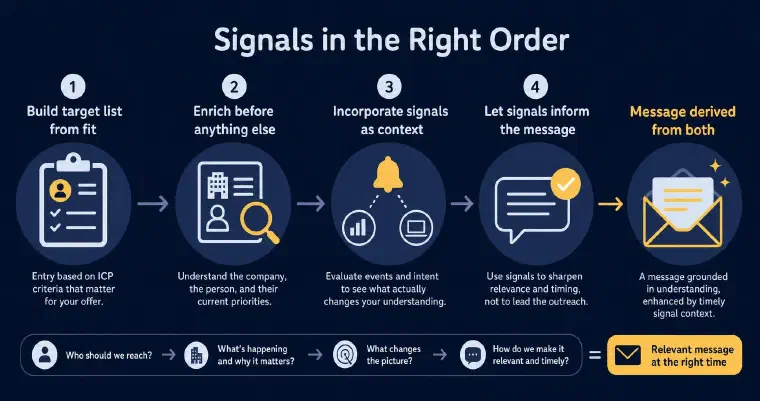
Step 1: Build the target list from fit, not from signal
The entry condition for a prospect should be that they match your ICP on the criteria that matter for your offer. Industry, size, role, stage, relevant challenges. This list is built from your fit-based scoring criteria, not from who is currently showing intent. You are identifying who would benefit from your offer, not who happens to be visibly researching right now.
This step is where most of the real filtering happens. A prospect that does not fit your ICP is not made relevant by a strong intent signal. They are a distraction.
Step 2: Enrich before anything else
Once a company clears the fit threshold, enrich your understanding before deciding how or whether to contact them. What is the company actually doing? What are its current priorities? What is the person’s actual role and what problems are they likely carrying? This is the layer that makes the outreach intelligent. Without it, you are sending messages based on surface criteria and hoping for relevance.
Step 3: Incorporate signals as context
After enrichment, review any signal data available to you. Look for business events, third-party intent activity, and technographic changes that are relevant to what you have already learned about the company. This is a recommendation for your process, not a claim that I connect to all of those feeds. Not all signals will be relevant. A company that is hiring marketing coordinators while your offer targets sales operations is not a stronger target because of that hiring activity.
The question to ask for each signal is: does this event change what I know about this company’s situation in a way that matters for my offer? If yes, it is useful context for shaping the message and potentially for adjusting the timing. If no, set it aside.
Step 4: Let signals inform the message, not originate it
The message to a prospect should be grounded in a genuine understanding of their situation. Signals can sharpen that understanding and fix the timing. They can provide a specific, current reference point that makes the outreach feel timely rather than random. What they should not do is carry the full weight of the opening. “I saw you just raised Series A, so I thought I’d reach out” is signal-driven outreach. It tells the prospect only that you noticed a public announcement, not that you understand their business.
Step 5: Do not ignore companies without current signals
This is the step a strictly signal-first process skips. Companies that fit your offer but show no detectable signal are still worth considering. Contact them with a message grounded in what you know about their situation, without presenting an inferred problem as a fact. Fit does not guarantee a reply, but the absence of a visible signal does not rule one out either.
The Companies That Generate No Signal Are Often the Best Targets
A company that has been running the same sales process for three years, uses a tool stack that was configured when they were half their current size, and has not publicly announced anything in recent memory is not generating intent signals. Under signal-first logic, they are invisible.
They may also be the company that most urgently needs what you sell, has the budget to act on it, and has not yet been contacted by every other vendor in your category. The silence is not evidence of disinterest. It is evidence that their research has not yet surfaced in observable places, or that it has not started yet.
Systematic outreach to well-qualified companies that have not yet surfaced in intent data feeds is one of the most consistently underexploited advantages in outbound prospecting. The reach and the timing are yours to control, as long as your targeting is grounded in genuine fit rather than in who is currently raising their hand.
A complete view of how this logic fits into a full prospecting workflow, from ICP definition through execution and follow-up, is in my guide on prospecting with AI.
Intent signals are real, useful, and worth tracking. The error is not in using them. The error is in making them the condition of engagement rather than one input among many. Fix that order, and signals become genuinely powerful: they land on top of a foundation that already justifies the outreach. See how I use prospect context in an immersive demo for your activity.