
Many B2B salespeople and founders treat ICP definition as a one-time strategy exercise. They fill in a template, decide they target “mid-market SaaS companies,” and move on to writing outreach. Then they wonder why replies are scarce.
The problem isn’t the outreach. It’s what the outreach is built on.
A vague ICP produces vague targeting. Vague targeting means contacting people who aren’t the right fit, which means messages that don’t resonate, which means silence. The ICP definition is the first constraint that makes everything downstream either precise or pointless.
Why a Vague ICP Breaks Prospecting Before You Send Anything
Here is what a vague ICP actually looks like in practice: “B2B companies between 10 and 500 employees, any industry, looking to grow their pipeline.” That leaves very different businesses in the same target. It gives you little guidance for scoring fit, choosing a message angle, or interpreting results.
The cost shows up in three places.
First, prospect scoring loses useful distinctions. If headcount is your only criterion, a recruitment firm in California and a SaaS startup in London can both pass the filter despite different problems, buying contexts, and decision-making structures. I would not treat them as equivalent leads on that basis alone.
Second, message personalization collapses. When the targeting criteria are too broad, there’s no shared problem to write to. The message becomes generic: “I help B2B companies improve their prospecting.” That’s a description of a category, not a reason to reply.
Third, aggregate results can hide the useful patterns. A single reply rate across unrelated segments does not show which segment replied, which did not, or why. You need to examine the underlying profiles and conversations.
The ICP is not an administrative document. It is the instruction set that determines whether every subsequent step in prospecting produces useful signal or noise.
Step 1: Start with Closed-Won Accounts, Not a Blank Canvas
Every article on ICP definition tells you to “analyze your best customers.” Almost none of them tell you how to do it in a way that produces exploitable targeting criteria.
If you have customers, start with a manageable group of closed-won accounts, for example the last five to ten. That is a practical review batch, not a required sample size. They converted, so their company profile, individual role, and purchase context are worth examining. If you have no customers yet, use your offer and market conversations to form the first hypothesis, then test it through outreach.
For each one, answer four questions:
What is the company? Industry, headcount, geography, funding stage or revenue range, tech stack if relevant.
Who signed? Not the champion who loves the product, but the person who wrote the contract or gave final approval. Title, seniority, decision-making context.
What was happening for them at the time? The event or situation that made the purchase feel urgent. A new fiscal year, a departure in the sales team, a failed tool, a missed target, a new investor pushing for growth.
What problem did they articulate? Not the problem you solved, but the problem they described to you in their own words. That phrasing is what will appear in your outreach and make it feel written specifically for them.
Patterns across those accounts can suggest an initial ICP. They do not establish that the same pattern will generalise to the next prospect.
The corollary is equally important: run the same exercise on churned accounts and lost deals. Look for possible anti-ICP criteria, while separating poor fit from factors such as timing, delivery, or the sales process. Use the evidence to define disqualifiers rather than assuming every lost deal proves that a company type will never buy.
Step 2: Separate the ICP from the Persona
This distinction is absent or confused in most of the guides currently ranking on this topic, and it matters enough to be explicit about it.
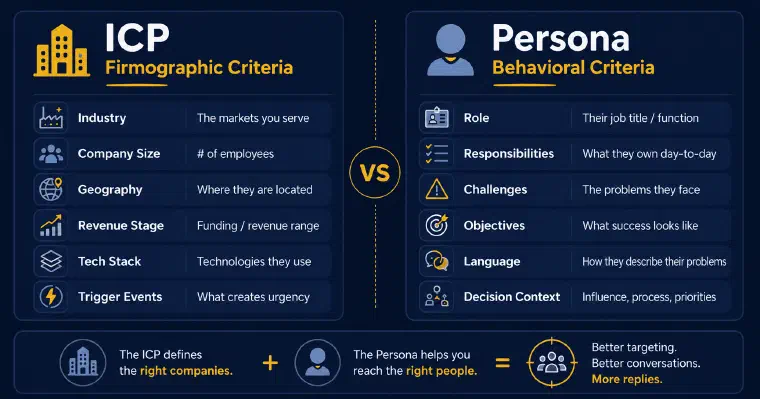
The ICP describes the company you are targeting. It is firmographic: industry, size, geography, revenue stage, tech stack, trigger events. The ICP answers “which organizations are worth reaching out to?”
The persona describes the individual inside that company you are contacting. It is behavioral and situational: role, responsibilities, challenges, objectives, the language they use to describe their problems, and the decision-making context they operate in. The persona answers “who do I contact, and what do I say?”
Both are necessary. Neither replaces the other.
In practice, a founder targeting HR directors at mid-size consulting firms is working with one ICP (mid-size consulting firm, 50 to 200 employees, generalist or specialist, US/Canada/UK) and one persona (HR Director or Head of People, managing hiring for billable consultants, responsible for recruitment targets, under pressure to reduce time-to-hire). The ICP tells me which companies to find. The persona tells me who to contact inside each one and what the opening message should say.
When the ICP and persona are collapsed into a single vague description such as “HR professionals at consulting firms,” neither the company filter nor the individual message can be made precise. The result is prospecting that hits volume but misses relevance.
Step 3: Build the ICP Components an Agent Can Actually Use
A useful ICP for an AI prospecting agent is not a paragraph describing your ideal customer. It is a structured set of scoring criteria that can be applied to a LinkedIn profile and a company page to produce a relevance score.
Here are the components that drive scoring in a prospecting agent:
Target roles. Not just titles, but actual functions. “VP Sales” and “Head of Revenue” and “Directeur Commercial” all describe roughly the same role across different company types and geographies. The agent needs to recognize all of them.
Company profile. Industry (specific, not “professional services”), headcount range (tight, not “SMB”), geography (specific countries or regions), and when relevant, revenue range or funding stage.
Triggering situation. An observable event that may add relevant context: hiring for sales roles, a funding round, a product launch, or an executive change. Availability varies, and an event does not prove buying intent. Keep clear why that trigger sharpens timing instead of deciding who belongs on the list in the first place.
Observable problem. What challenge is visible from the outside, on the company’s LinkedIn page, in job postings, in recent content, that maps to what you solve?
Objective. What outcome is the persona trying to achieve? Growth, efficiency, risk reduction, a specific KPI? This feeds directly into what the message should promise.
The more specific each component, the more precise the scoring. “Any technology company” produces noise. “B2B SaaS companies, 20 to 150 employees, France, hiring their first SDR or BDR” produces a score that means something.
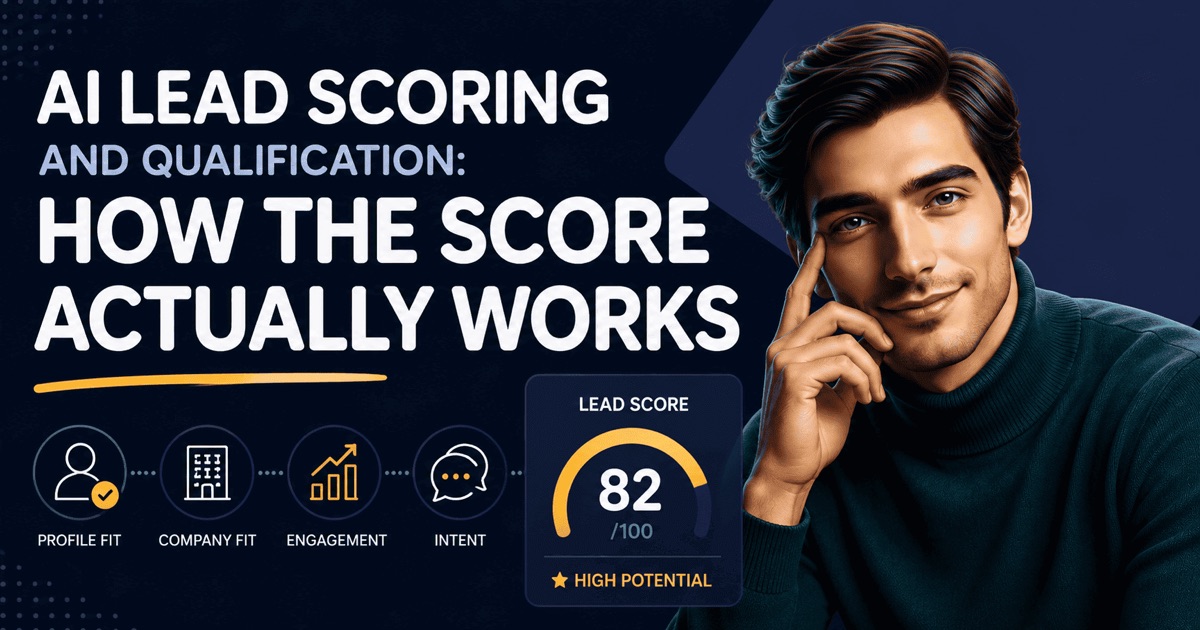
Here’s how I structure a persona: I build a first version from your business context, drawing on your company website, personal and company LinkedIn profiles, sales documents and presentations, and free-form notes. The persona includes target roles, geography, industries, company sizes, objectives, challenges, and prospecting preferences, attached to an offer. Not every research idea above is a dedicated field or a guaranteed data source. I score discovered profiles from 1 to 5 stars against both the offer and persona and explain the fit using available information. Review that explanation rather than treating a high score as proof of purchase intent. For the role of the score and the configurable automation threshold, see how AI lead scoring works.
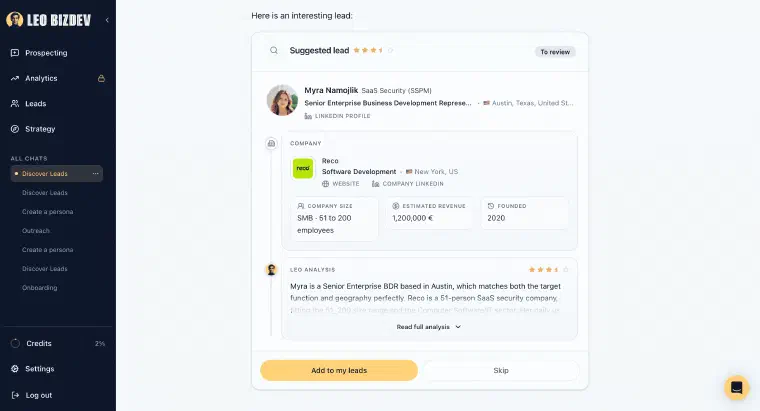
For founders still building their first persona, the guide on AI prospecting for founders explains how I help turn business context into a first targeting hypothesis during setup.
Step 4: Use AI to Validate and Refine in Real Time
The ICP you define before your first prospecting cycle is a hypothesis, not a fact. Every article that describes ICP definition as a strategy exercise and stops there misses the most important part: the feedback loop.
The validation mechanism is a review of prospecting outcomes. You might choose an initial batch of 30 to 50 contacts as a practical checkpoint, not a statistically conclusive test. Three kinds of evidence are worth examining:
Reply rate by persona. If you compare two personas, work from the underlying contacted prospects and replies under comparable conditions. Differences may come from targeting, but also from the message, channel, timing, or a small sample. Investigate the cause before deciding to concentrate on one segment.
Objection patterns. A recurring objection can suggest a targeting mismatch, but it can also concern the offer, timing, or message. Read the conversations before deciding what to change. Common objections to watch: “we already have someone for that,” “not the right moment,” “we don’t do outbound.”
Profile distribution of converted leads. Among the prospects who replied positively, what do they have in common that wasn’t in your original ICP? A specific industry you hadn’t prioritized? A company size that converts better than the middle of your range? Those patterns become your next iteration.
If you’re pre-PMF and still testing whether the ICP hypothesis holds before you have a pattern of closed-won accounts, the approach is slightly different. The article on AI prospecting for startups covers how to run that validation cycle with a smaller contact volume.
You can automate prospecting actions, not the decision to validate or change your ICP. After you review and validate the configuration, Auto can find, qualify, contact, and follow up with prospects on eligible LinkedIn and email channels without individual approval. It requires sufficient credits and at least one synchronised, enabled channel; it pauses if those requirements are no longer met. You supervise the activity and take over when a prospect replies, except for automated email replies, which are recorded while prospecting continues. Replies I cannot classify confidently are left for your qualification.
Analytics shows channel reply metrics and a summary I write to interpret recent results, strengths, weaknesses, and immediate priorities. For a persona comparison, filter the prospect list, review profiles and conversation histories, and export available prospect data if useful for your analysis. A positive reply is not itself a won customer. You decide what the evidence supports and edit the persona or its preferences accordingly.
The data supports your review; it does not automatically rewrite or statistically validate the ICP.
Step 5: From ICP to First Prospecting Action
Once the ICP is defined and the persona is configured, the next question is practical: what happens now?
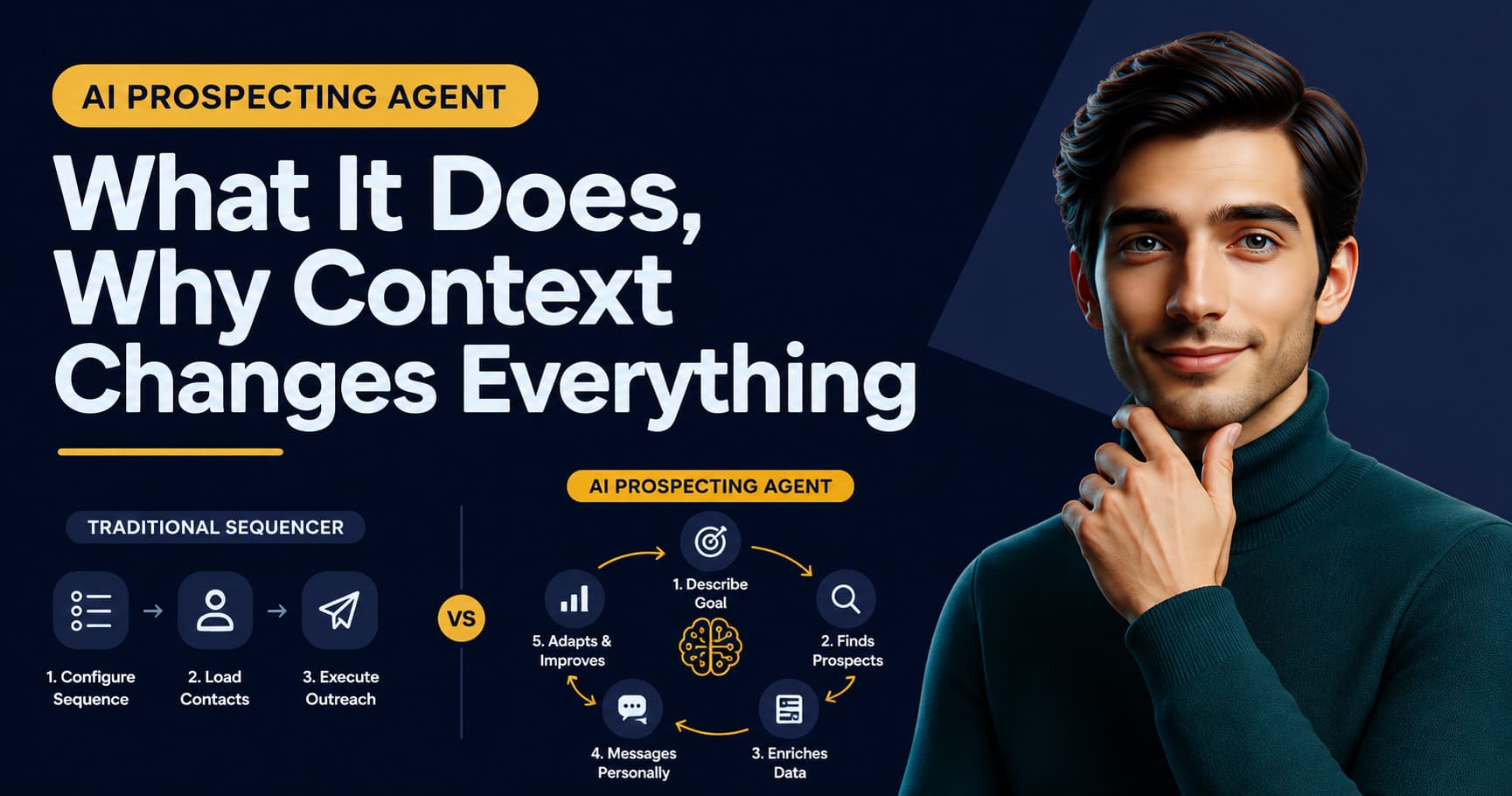
In most workflows, the answer is: manually search LinkedIn, build a list, write messages one by one, track responses in a spreadsheet. That’s where most prospecting efforts stall. Not because the ICP was wrong, but because the execution step is slow enough to kill momentum before the first learning cycle completes.
I use the offer and persona to search for and score profiles one by one, with an explanation. In guided discovery, profiles at 3 stars or above await your validation before enrichment and addition to the prospect list. Lower-scoring profiles remain visible and can be rescued while the search continues. Semi-Auto and Auto use the minimum score you configure. For a full breakdown of that discovery and scoring step, see how an AI agent finds and qualifies B2B leads.
Once a prospect is validated or imported, I enrich it with available information: role, responsibilities, identified challenges, company profile, and relevant signals when obtainable. The offer, persona, prospect context, and history inform the message and its objective. By default, you review and approve it. LinkedIn sending requires a synchronised account and an eligible relationship; email requires a usable address and a synchronised email account. Without the connection, you can send the generated message manually. In active Auto, eligible actions are sent within the configured limits and sending windows.
Specific targeting gives the first message a clearer starting point. You still need to review the available data and the message; precision in the ICP does not guarantee complete enrichment or a reply.
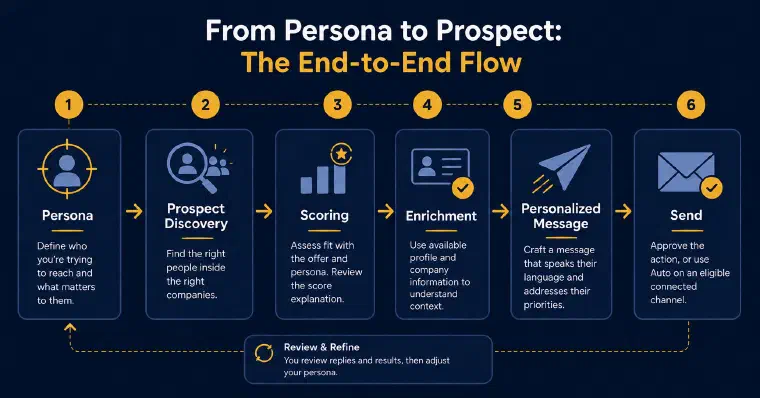
For a complete picture of how this chain works from ICP to lead, the article on AI agents for B2B lead generation covers the full prospecting loop. And if you want to see how prospect enrichment fills in the gaps between what the ICP defines and what the profile actually reveals, the article on B2B lead enrichment goes into that in detail. If you want the full walkthrough of everything downstream of this step, brief, scoring, enrichment, message, send, and reply, in one continuous pass, I lay it out in how to prospect with AI, step by step.
If you want to see how business context becomes a persona, scored prospects, and a first action, book an immersive demo for your activity.
Common Mistakes to Avoid
ICP defined by company size alone. “50 to 500 employees” is a filter, not an ICP. Two companies with 150 employees, one a generalist consulting firm and one a SaaS startup, have almost nothing in common from a prospecting standpoint. Size is one criterion among five or six and it cannot carry the whole weight of targeting.
Persona confused with a job title. “I target sales directors” is a job title. A persona is the sales director at a 50-person B2B services company who manages a team of three, is responsible for hitting a revenue target set by a founder-CEO, and has no SDR support, meaning they prospect themselves when their pipeline runs dry. That context determines what message to write.
No disqualifiers. Define evidence-based reasons a superficially similar company may not fit: a known budget freeze, a policy incompatible with your offer, or the wrong decision-making role. Do not assume those facts are always observable. In LEO, use the workspace blacklist for companies you must exclude and review scoring explanations for the other criteria; a targeting description alone is not a guarantee against every poor-fit profile.
ICP defined once and never revisited. Markets and buyer situations change. Treat the ICP as a working hypothesis and choose a regular review point that suits your volume. Repeated objections or mismatched profiles can justify an earlier review; neither a fixed number of contacts nor the passage of six months proves that the targeting needs changing.
Starting with too many personas. Spreading a small outreach volume across several segments can make patterns harder to interpret. I recommend starting with one focused hypothesis, reviewing the results, then deciding whether to refine it or add another persona. That is a methodological choice, not a product limit or a fixed sample-size rule.
The ICP Is the Instruction Set, Not the Paperwork
A vague ICP never looked like a targeting problem from the inside. It looked reasonable: a plausible industry, a believable headcount range, a persona that sounded like a real job title. The failure only became visible downstream, in reply rates that stayed flat no matter how much the messaging was rewritten. That’s the pattern this article started with, and it’s worth restating plainly: the ICP is the instruction set that determines whether everything after it, scoring, personalization, learning, produces something usable or produces noise.
Start from closed-won evidence when you have it, or from your offer and market conversations when you do not. Separate the company target from the person you contact, make the criteria explicit, and review what the first outreach cycle teaches you without treating a small batch as proof. Then decide what to keep or edit. If you want to see how I support that work, explore your targeting and first prospecting action in an immersive demo.