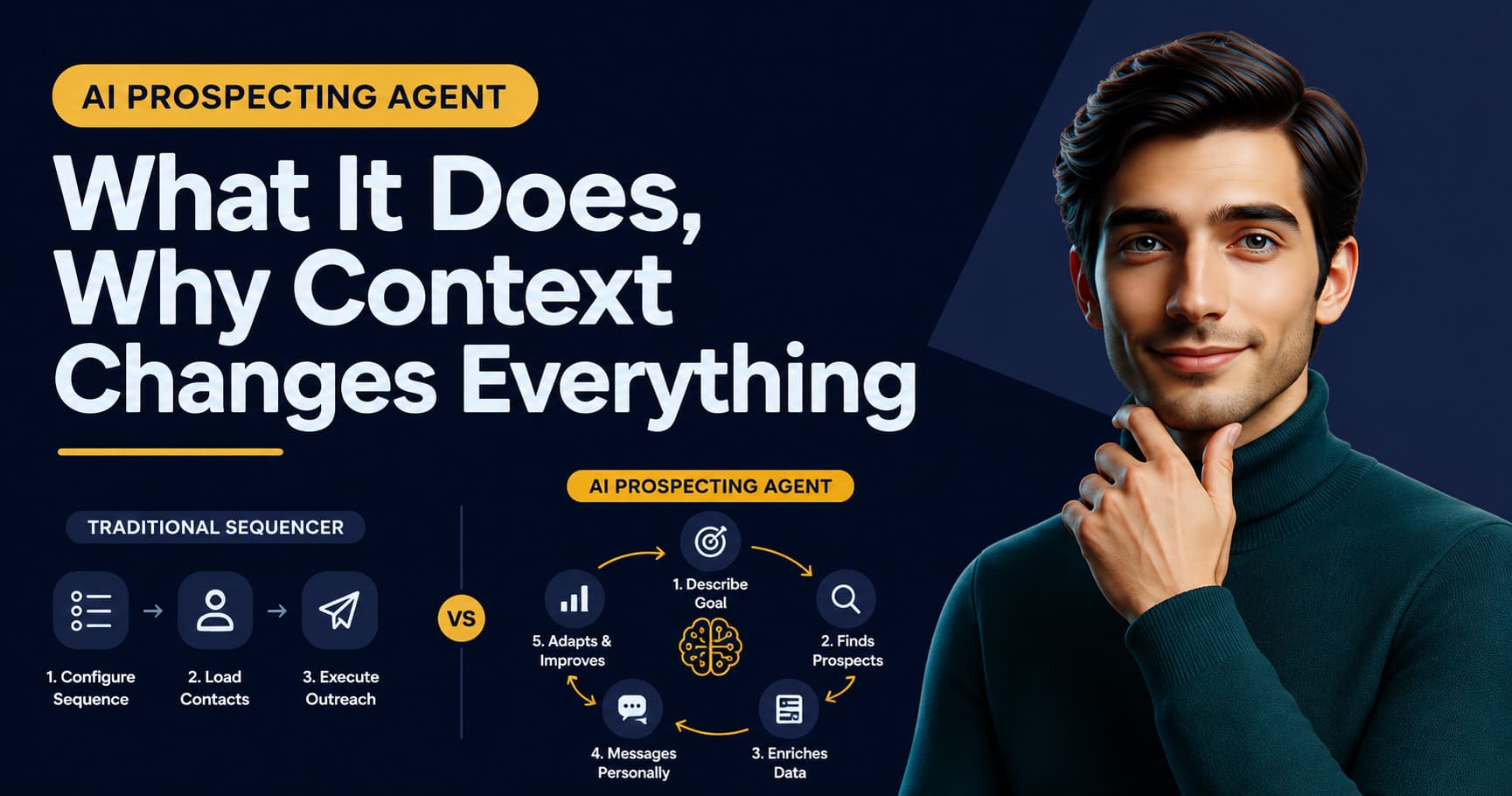

Most guides on finding B2B leads with AI describe the same thing: pick a data provider, filter by industry and company size, export a list, and hand it to a sequencer. That is database querying with an AI label on it. It is not what an AI agent does.
An AI agent starts from your offer. You describe what you sell and who needs it. The agent uses that description to search for profiles and explain how they fit. The output is a scored pipeline built from your brief, with explanations and available data for you to review.
The difference matters in practice. A query that returns “VP Sales, 50-200 employees, SaaS” gives you everyone who fits the filter. A brief that describes “I help Series A SaaS companies reduce churn by redesigning their onboarding flow” gives the agent grounds to distinguish a VP Sales who owns onboarding from one who does not, and to explain the difference. That reasoning is what turns a database search into a lead list worth acting on.
Step 1: Write a Brief the Agent Can Reason From
The quality of your lead list is determined before the agent runs a single search. It is determined by the quality of your brief.
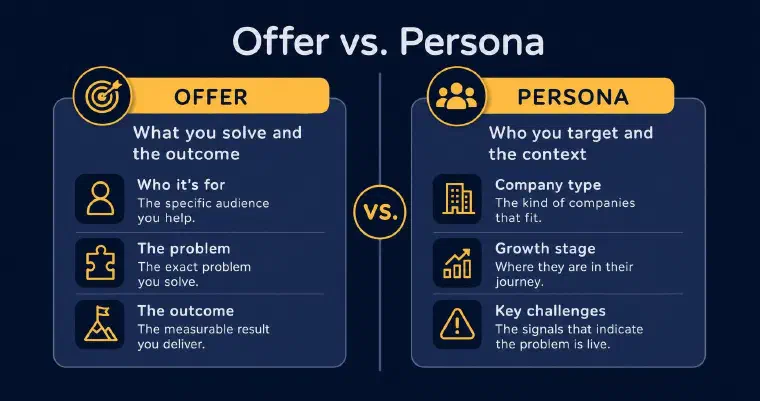
A brief has two parts: the offer and the persona.
The offer is not your company description. It is the specific problem you solve, for whom, and what the outcome looks like. “B2B consulting” is a category, not a brief. “I help HR directors at companies going through a merger restructure their management layer before headcount decisions are made” is something an agent can match against a profile. The more specific the problem, the more useful the scoring will be.
The persona defines your target beyond job title. Title is the starting point, but it is not the filter. Two HR directors at structurally identical companies can be at completely different points in their decision cycle. The persona captures the signals that distinguish a relevant profile from a technically matching but useless one: the type of company, the growth stage, the challenges that indicate the problem you solve is live.
If your ICP is not fully defined yet, work through it before running discovery. My guide on how to define your ICP with AI covers the process in detail. Running discovery with a vague brief is not faster than running it with a precise one. It just produces a list you will have to filter by hand, which removes the point of using an agent.
Step 2: Let the Agent Source and Score Profiles
With a brief in place, the agent starts searching. This is where the behavior diverges sharply from a database export.
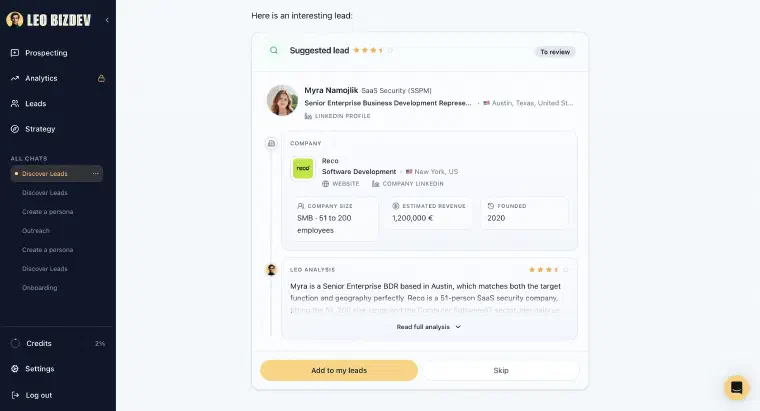
A database filter selects records that match specified fields. I assess available job titles, responsibilities, missions, and company context against your offer and persona, then assign a score from 1 to 5 with an explanation. That assessment can still miss context or make mistakes; it does not replace your review.
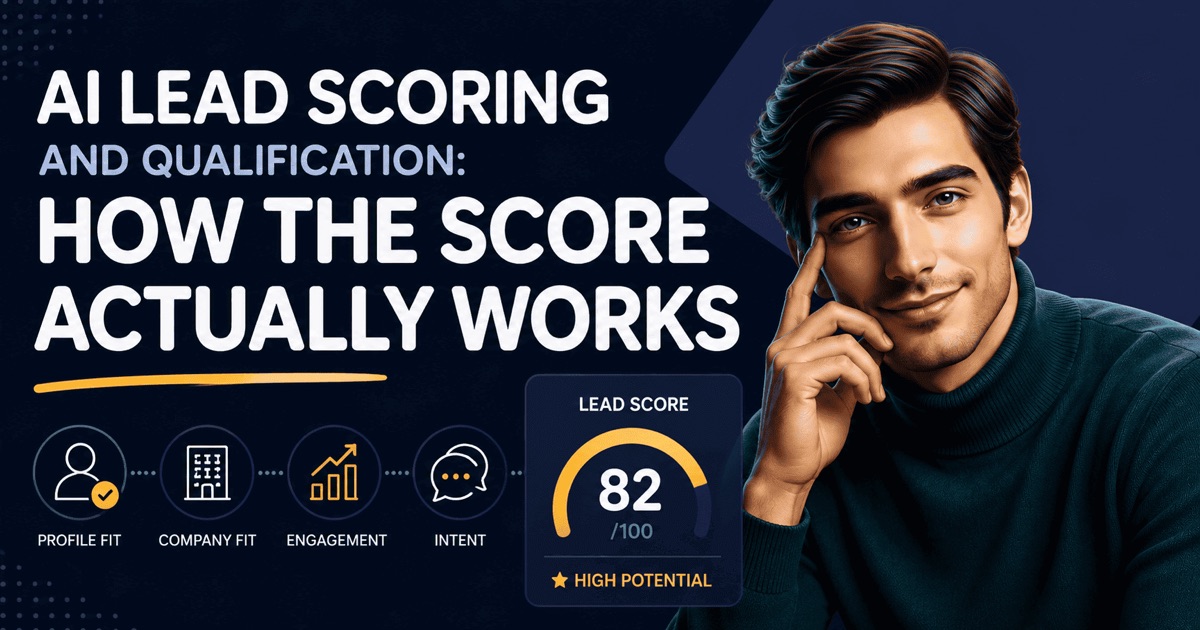
The score means something specific. A 5-star profile matches both your offer and your persona criteria closely. A 3-star profile meets the threshold but with notable gaps (perhaps the role fits but the company is outside your target sector). A 2-star profile does not qualify, but the agent surfaces it anyway so you can override manually if you see something it missed.
The justification is as important as the score. Reading “3/5: relevant role, but company too early-stage for the offer” tells you something a filter never could: this profile was considered, not skipped.
In guided discovery, I search and analyse profiles one by one against your offer and persona. Profiles scoring 3/5 or above await your validation before enrichment and addition to the prospect list. A rejected profile is archived so it is not proposed automatically again. Lower-scoring profiles remain visible and can be rescued. Semi-Auto adds profiles that meet the minimum score you configure, rather than a fixed threshold for every user. In automation, a persona with no remaining qualified prospects is suspended until you review and explicitly reactivate it.
After you validate its configuration, Semi-Auto handles sourcing in the background, subject to available credits and profiles. It applies your scoring threshold and builds the prospect list, without contacting or following up with anyone automatically. It can work without a synchronised communication channel; you manage contact actions with me. For the full prospect cycle, my guide How to Prospect with AI: A Step-by-Step Process covers each stage.
Step 3: Read the Score, Not Just the Number
A scored list is only useful if you know how to interpret it.
The most common mistake is treating the score as a pass/fail gate. A 3/5 prospect that happens to be a warm referral from a mutual connection is more valuable than a 5/5 cold contact you have no route into. The score reflects fit against your brief. It does not factor in context you hold but the agent does not.
Two things to check when reviewing a scored list. First, look at the score distribution and explanations together. Many profiles near the retention threshold may justify reviewing the brief, but they can also reflect limited available data or a narrow market. Tightening the brief does not guarantee higher scores. Second, read the explanations on lower-scoring profiles before discarding them. A gap may not matter for your outreach angle; use the explanation to assess whether it is material.
For a deeper look at interpreting scores and adjusting the automation threshold, see the guide on AI lead scoring for B2B.
Step 4: Enrich Before You Contact
A qualified lead is not a contactable lead. Before the agent generates a message, it needs to know enough about the prospect to make that message relevant.
Enrichment is not about collecting data for its own sake. It provides context for a message beyond a job title and company name. Review what is actually available rather than filling gaps with assumed challenges or a signal that has not been observed.
After validation or import, I enrich the prospect with available identity, role, responsibilities, expertise, interests, challenges, and company context such as size, estimated revenue, and relevant news. Not every field can be obtained. Detailed enrichment consumes no credits. Email and phone searches are separate actions: 1 credit for a usable email, 5 for a usable phone number, and none if the search is unsuccessful. Auto may search for email, but never for phone numbers and never places calls.
My recommendation is straightforward: review context before contacting. A larger list is not a substitute for information that helps you choose a relevant action. Enrichment supports that decision without guaranteeing better results from a particular list size.
For the full method on what to enrich and how to use enrichment data in message generation, my guide on B2B lead enrichment goes into that detail. The point here is that enrichment is a prerequisite, not an optional extra.
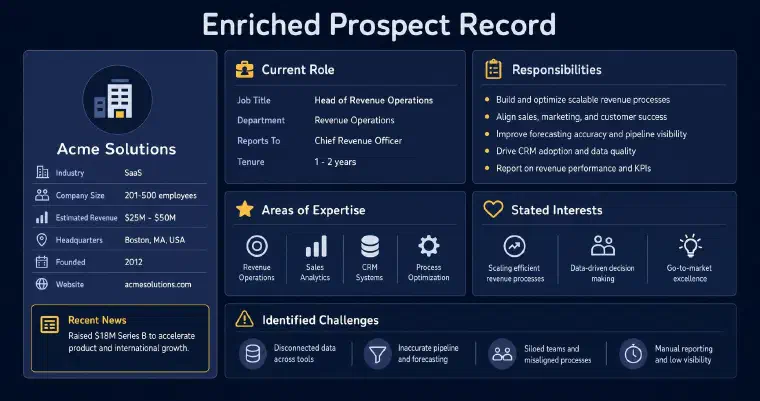
Illustrative example with fictional data. It is not a LEO screenshot, and available fields vary by prospect.
Step 5: Detect When the List Is Off-Target
A well-configured agent still needs review. You might inspect the first 20 to 30 discovered prospects as a practical checkpoint, not a statistically sufficient sample or proof that the brief works.
Three signals indicate the list is too broad or mis-calibrated.
First: score distribution skewed low. Read why profiles are landing near the threshold. Broad criteria, missing information, or limited available matches may call for different responses; the score alone does not identify the cause.
Second: consistent sector or role drift. If you target VP Operations at logistics companies but see Operations Managers at SaaS companies, review both the persona wording and the score explanations. Clarify ambiguous criteria or reject unsuitable profiles instead of assuming the selected list matches your intent.
Third: explanations that repeat the same gap. If company stage, industry, or seniority repeatedly differs from your target, decide whether that criterion is genuinely important and edit the persona accordingly. Clarify which requirements matter to your offer before the next search.
You can edit the offer or persona without starting over. You can also change the minimum score in the automation configuration, for example from 3 to 4. Review the following results: a stricter threshold may reduce the number retained without fixing an unclear brief or missing information. The goal is a useful list, not a higher score distribution for its own sake.
If you are running discovery across several personas simultaneously, read calibration signals at the persona level, not the account level. A drift in sector fit or a low-score concentration that looks minor in aggregate can point to one specific persona that is too broadly defined. Correcting it individually keeps the other personas unaffected.
Step 6: Measure Lead Quality, Not List Size
List size is a lagging indicator. It tells you the agent ran, not whether it found the right people.
I would examine score explanations and actual responses together. LEO Analytics provides reply metrics by channel. If you want a first-contact-only reply rate, review message histories and calculate that separately; the channel metric does not isolate first messages from follow-ups.
If few profiles score highly, investigate the explanations before changing the target. If replies are scarce, check targeting alongside messaging, channel conditions, timing, and follow-up. There is no universal 5% threshold that identifies a bad brief, and a fit score is not a reply-probability score.
A clearer brief gives you a better basis for reviewing fit and choosing message angles. It does not guarantee that scores and reply rates rise together. Use the actual conversations to decide what to refine rather than treating the agent’s rating as proof of market demand.
For a full breakdown of which metrics to track across the prospecting cycle and how to interpret them in context, my guide on B2B AI lead generation covers the measurement layer in detail.
If you want to see this process applied to your activity, book an immersive demo. We can explore the strategy, prospect examples, and a first prospecting action before you choose an offer.
Common Mistakes to Avoid
Starting discovery before the offer is specific enough
The most frequent calibration failure is not a configuration problem. It is a brief problem. If the offer description describes a category rather than a problem, the agent cannot discriminate. Fix the brief first.
Reading only the score, skipping the justification
The justification is where the diagnostic information lives. A consistent gap in low-scoring profiles is a signal about your brief, not a noise to dismiss.
Skipping enrichment to contact faster
I would rather review useful context before contact than chase list volume alone. A small enriched list does not automatically outperform a large one, but skipping context can leave you without a relevant reason to write.
Treating list size as success
A large pipeline with no replies calls for investigation, not an automatic conclusion that discovery is wrong. Ask which profiles were contacted, what was sent, whether the channel worked, and what the conversations show. List size and star ratings are only part of that review.
Activating automated outreach before validating the first manual cycle
Reviewing an initial group of scored profiles is a useful check before automation, not proof that the brief is calibrated. Validate the configuration and continue supervising the results. Auto requires credits and at least one synchronised, enabled channel; it sends only eligible LinkedIn and email actions. A reply ends the prospect’s Auto phase and returns control to you, except for automated email replies, which are recorded while prospecting continues.