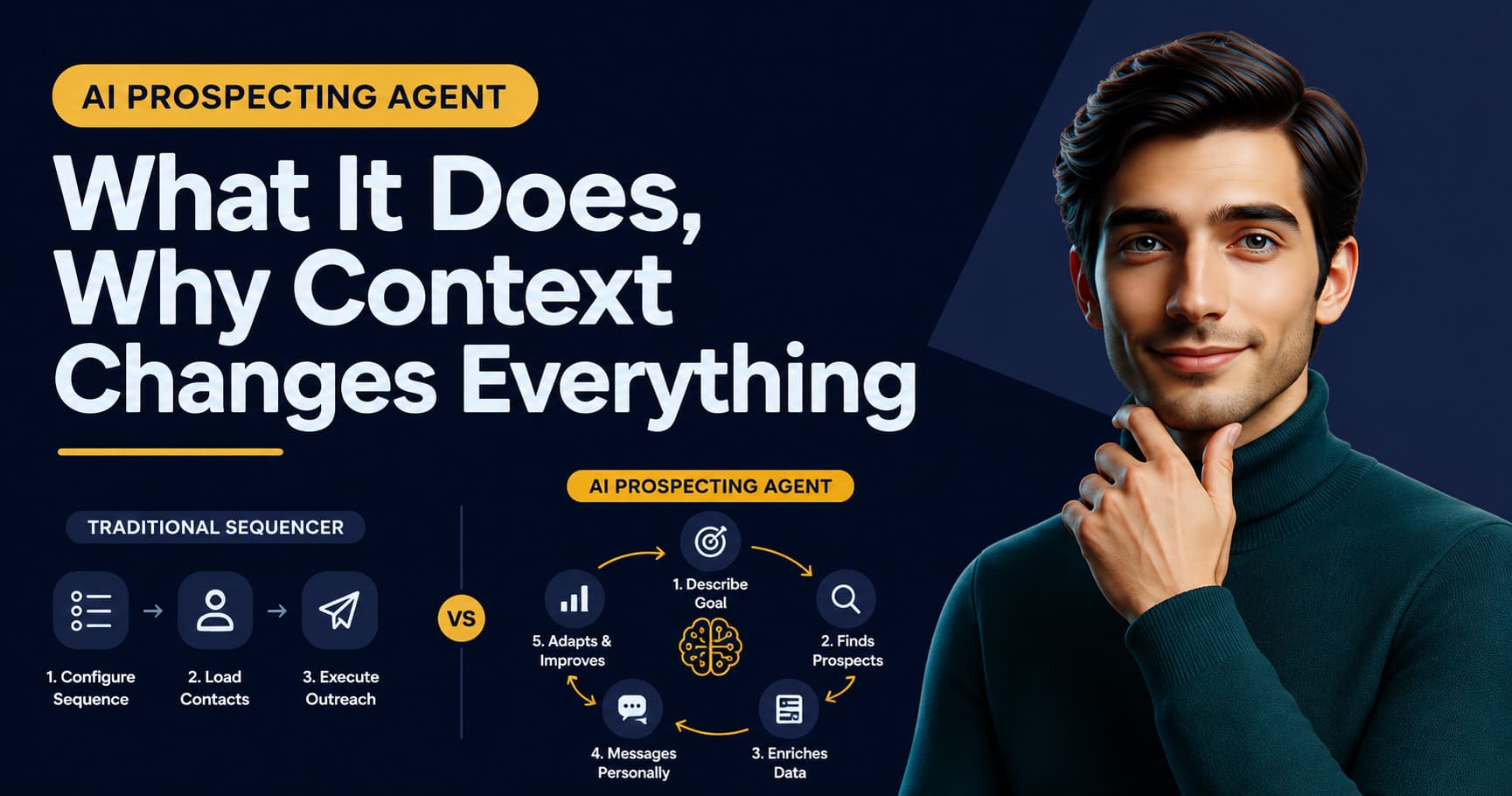

 The competitive advantage in B2B prospecting has never stayed in one place for long. What made a seller effective in one era became table stakes in the next, and the companies that failed to adapt didn’t lose because they ignored new tools. They lost because they kept optimizing for the previous advantage after it had already moved.
I read that history through eight shifts in how sellers reach and understand buyers. This is a selective view of commerce over millennia, not a claim that modern B2B prospecting existed unchanged throughout that period.
Eight Shifts, One Pattern
The long view starts with commerce and record-keeping: early cuneiform accounting predates 3200 BC. A later tablet from around 1750 BC records Nanni’s complaint to Ea-nasir about copper quality. It is an example of written accountability between buyer and seller, not a modern prospecting playbook. Physical marketplaces, relationships, and reputation mattered alongside trade conducted across distances.
Medieval trading centres and fairs, including Champagne and Bruges, expanded opportunities to meet buyers beyond a seller’s immediate surroundings. The traveling merchant who covered more ground could reach different buyers. In this reading of the history, reach becomes a useful next lens, not an invention that suddenly replaced all earlier forms of trade.
The industrial era made planned sales routes and remote ordering increasingly visible parts of selling. Montgomery Ward issued its first catalogue in 1872. That illustrates reaching buyers systematically with a replicable offer. The lens shifts from presence toward reach.
The telephone widened remote contact again, with call volumes, scripts, and follow-up becoming part of sales operations. ACT!, launched in 1987, is an early contact-management example. Data management adds another layer: who you’d called, what they’d said, when to follow up.
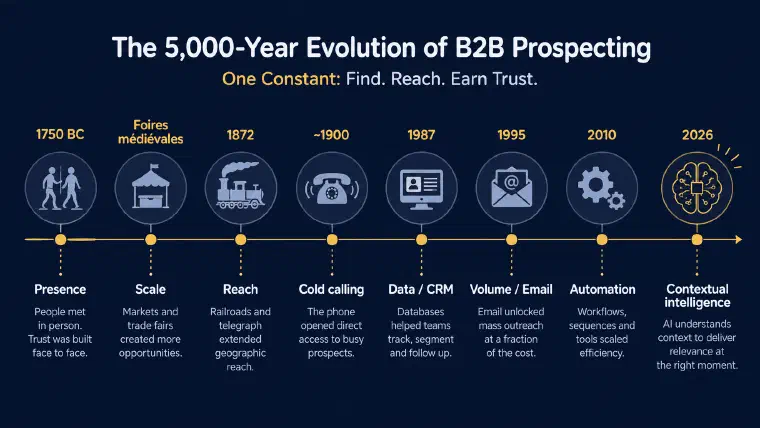
A selective timeline, not an exhaustive history. Dates mark illustrative milestones, not proof that each approach was invented then or exclusively defined its era.
Email made reaching many recipients easier to scale, while attention remained limited. HubSpot, founded in 2006, developed its inbound approach around changing buying behaviour. I see this as another shift in emphasis: earning attention rather than relying only on outbound reach.
The automation era of 2010–2020 tried to resolve this by adding precision to volume. Sales Navigator, Apollo, multi-channel sequences, the model was: better data plus automated execution plus enough touchpoints. ABM extended this to high-value accounts. The standard playbook became a three-to-five touch sequence across email and LinkedIn, personalized at the campaign level, optimized for open rates.
When Every Edge Becomes Table Stakes
That model isn’t wrong. It’s table stakes. Every serious B2B sales team runs some version of it, which is precisely the problem. When the advantage is universally accessible, it stops being an advantage. The specific failure mode this creates for individual outreach, where campaign-level personalization stops working, is what outreach templates can’t fix.
The AI era shifts the variable again. But it doesn’t shift it where most people expect.
What Actually Changes with AI
The common assumption is that AI makes the automation-era model faster, more messages, better copy, higher volume with less effort. That reading misses the actual displacement. What changes with AI isn’t the speed of execution. It’s the level at which targeting and relevance operate.
A sequencer can personalize at the campaign level: this message goes to CTOs at Series A SaaS companies in France. An AI prospecting agent operating from your business context can also use available information about a specific person and company to suggest a relevant angle. For example, a role and a public funding announcement may raise a question worth exploring, not establish the person’s needs or budget. Several agents now claim that shift; I scored the ones actually worth comparing on the same criteria rather than take the marketing at face value.
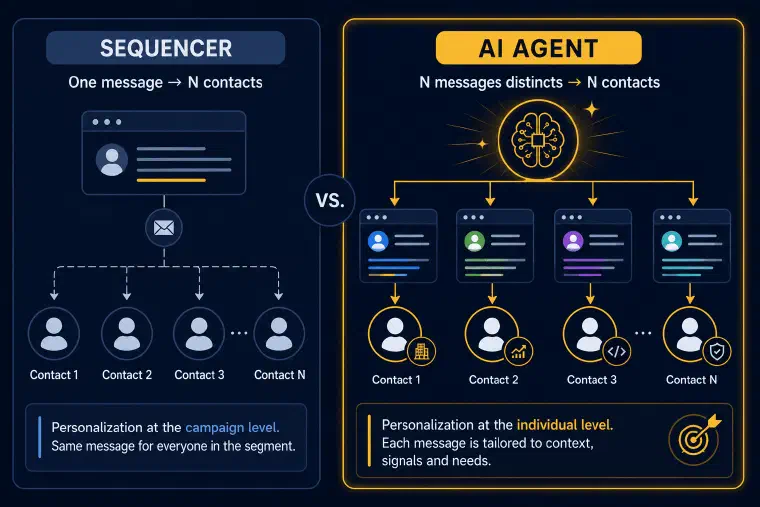
This compares two approaches, not every sequencer or AI product. Individual context and signals depend on the information available and still require review.
That’s the loop I support. Give me your business context in a conversation, the offer and target, and I build from there: ICP definition, an offer and persona you can review, prospect scores from 1 to 5 stars against both, and messages using available context and history. A signal can contribute when obtainable, but it is not proof of buying intent. By default, you review the proposed action before execution. The distinction I value is a prospecting cycle that carries context from your brief to each individual contact.
That’s the shift. The competitive advantage has moved from scale and reach, to data, to volume, to contextual intelligence, the ability to identify the right signal in the right person at the right moment and respond to it specifically. The prospecting problem is the same as it was in Babylon: identify who has a need and communicate that you can solve it. What changes is how precisely and at what scale that can be done.
I see an opportunity to test a more contextual approach, not a guaranteed window of advantage. Access to AI alone does not establish that your pipeline will outperform a competitor’s, or for how long. The useful question is what the workflow changes for your own targeting and conversations. Explore that workflow for your activity in an immersive demo.