
You’ve read the same advice a dozen times this year: wait for a signal, then reach out. A funding round, a new VP of Sales, a hiring spree, a job post that mentions the tool you compete with. Time the message to the moment and the reply rate takes care of itself.
I think that order is backwards. Not the signals themselves, the order. A signal is material you can use once you already have a reason to contact someone. It was never supposed to carry the weight of being the reason itself.
What “Prospecting on Signals” Means Right Now
Search “signal-based selling” and you land on the same list every time, whichever vendor is doing the explaining. A company raises a round. It opens a new office or enters a new market. It hires a batch of SDRs, or brings in a new head of sales. Someone posts on LinkedIn about a problem they’re dealing with. A job listing mentions a tool, which becomes a technographic signal. A prospect visits a pricing page or shows up in third-party intent data pulled from a review site. A refreshed website goes live. An acquisition closes.
The promise attached to that list is always the same: catch the right moment and the reply rate follows. Time it well and you look less like every other message in the inbox, more like someone who was paying attention.
The list itself isn’t the problem. The problem is what it’s been asked to do: justify, on its own, why you’re reaching out in the first place. That’s a job a list of events was never built for, and asking it to do that job is where the four limits below come from.
For these four limits, I’m focusing on public events such as funding announcements, hiring posts, and company updates. First-party behaviour, private conversations, and other intent data have different visibility and interpretation limits. They aren’t all public announcements.
Limit One: The Silent Majority
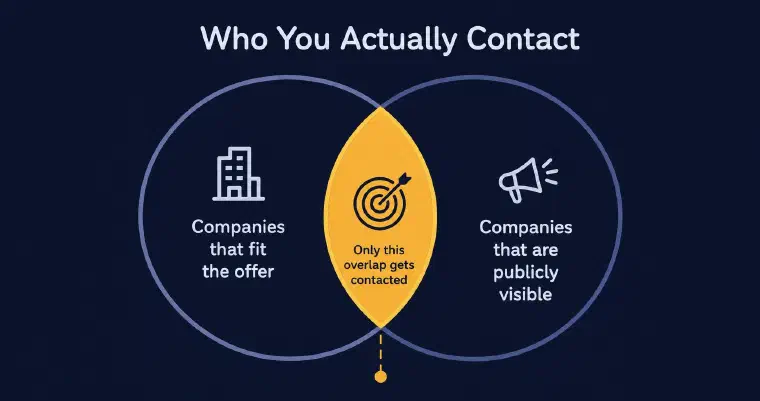
Start with what a public-event list can even see: a press release, a job board post, a LinkedIn update, a funding round picked up by a database. Companies that could fit what you sell may produce none of those events. They don’t raise, they don’t publicize headcount, they don’t announce a hire. They just run quietly.
Build a prospecting process that requires a detectable public event before you’ll contact someone, and you’ve quietly redefined your market. It isn’t “companies that fit my offer” anymore. It’s “companies that fit my offer and also produce a visible event.” Those are two different populations. Visibility alone doesn’t tell you whether a company would be a good customer. A public-event-first process adds a visibility filter to fit and calls the result targeting.
Limit Two: Waiting Is a Cost
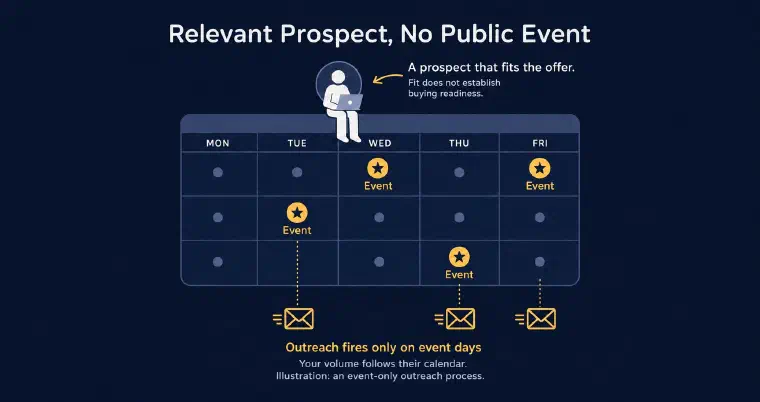
Say a company appears to fit what you sell before it announces a funding round. The announcement may change its circumstances, but it wasn’t necessarily the first reason to consider contacting it. Fit can exist before the news, even though need, budget, and readiness still have to be explored.
Index all your outreach on public triggers and you index that outreach on somebody else’s calendar. You wait for events you don’t control, produced at a pace you don’t set. My concern is the conversation you never explore because no announcement arrived. The prospect may or may not be ready; waiting for a headline doesn’t answer that question either.
Limit Three: The Signal Isn’t a Reason
Even when a signal exists and you catch it in time, it can’t do the one job it’s being asked to do. Open with “Congrats on the new VP of Sales” and the prospect learns you have an alert set up. They learn nothing about why you’re writing to them specifically, because the sentence stops at the fact and never reaches an argument.
That’s the gap: noticing an event and having a reason are two different things. I want the message to explain its relevance, not just demonstrate that I saw the news. A signal dressed up as an opening line still needs an argument, and even a relevant argument doesn’t guarantee a reply.
Limit Four: A Public Signal Is a Shared Signal
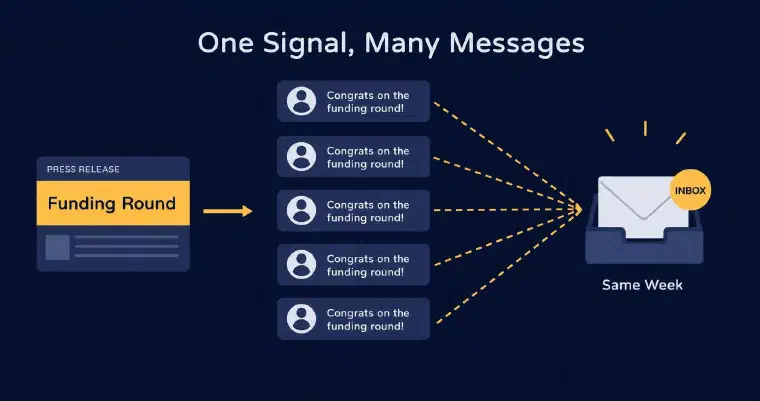
There’s a version of this argument the market doesn’t usually make, and it’s the one that should worry signal-based prospecting the most: a public event is public to everyone selling into that account. A funding round announced in a press release gets read by every vendor with an alert set up for it, the same week. The moment marketed as the ideal window to reach out is precisely the moment that inbox fills up with congratulations from everyone who read the same headline.
A signal visible enough to trigger outreach at scale can’t also differentiate that outreach. It doesn’t single you out, it synchronizes you with everyone else who built their process the same way. What was sold as an edge becomes the opposite: proof you’re running the same playbook as the rest of the inbox that week.
What Actually Works: The Company First, Then the Role
Take a job title on its own and it tells you almost nothing. A VP of Sales at a twelve-person startup is solving founder-led sales problems. A VP of Sales three years past the same company’s Series B is managing a team, a forecast, and a board deck. Same title, two different jobs, because the title only means something once you know the company sitting underneath it.
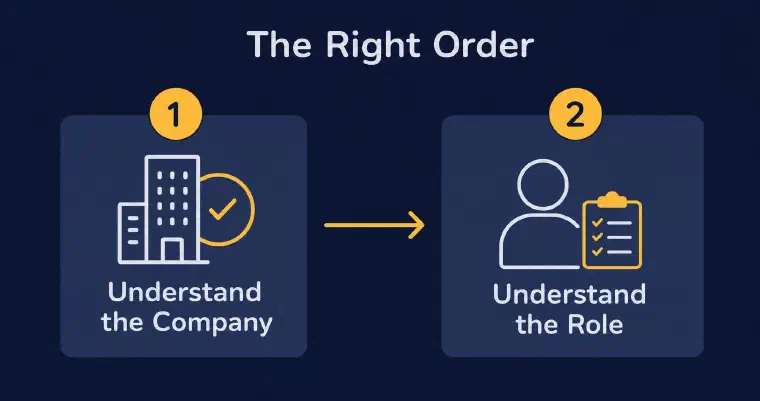
That’s the order I’d defend: figure out the company first, what it sells, who buys it, what makes its position hard for a rival to simply copy, and what that position forces it to deal with. Only once that’s clear does the person become worth thinking about: which slice of that reality lands on their desk, and what they’re on the hook for because of it. It’s the same order I’d use to build the ICP itself, before any trigger enters the picture.
Reverse the order and you get outreach written to a title instead of a person. “As a VP of Sales, you probably care about pipeline” is true of every VP of Sales on the planet and says nothing about the company behind the title. The role only turns into something specific once the company has already been understood; before that, there’s nothing for it to sharpen against.
None of this is exotic or slow to do by hand: read the site, understand the offer, understand the market position, then look at the person. It’s what most SDRs would already do if they had the time for every account. I’ve written up the mechanics of turning that understanding into an actual message, step by step, and my piece on why templates scale mediocrity instead of personalizing anything covers what happens when this step gets skipped in favor of a fill-in-the-blank. This one is only about what triggers the outreach in the first place, not what fills it once it starts.
What Signals Are Actually For
None of this argues signals out of existence. Once you already have a reason to reach out, because the company fits and the role has been mapped, an event earns a place in the message. It can decide who gets contacted this week instead of next, out of a list that was already qualified before the event showed up. It can hand an opening line something concrete to point at. What it can’t do is stand in for the reasoning itself, because reasoning was never its job. For the full taxonomy of what different intent signals actually tell you about a prospect and how to integrate them without letting them drive the process, I cover that in more depth in the guide on buying intent signals.
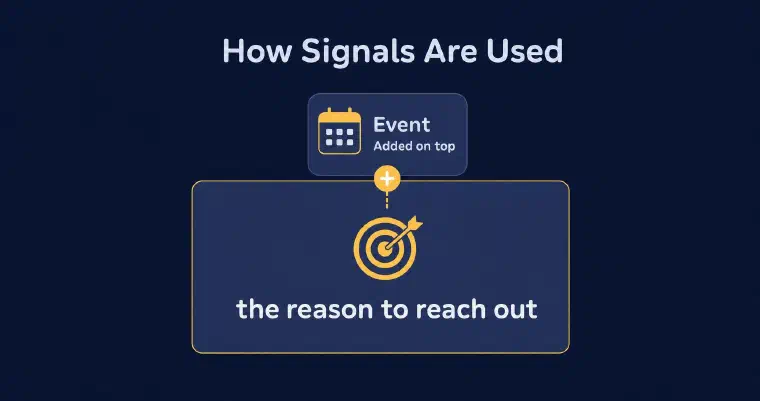
That principle informs how I decide what to do next for a given prospect: I use the offer and persona, available company and professional information, contact options, and action history. A relevant signal can add context when it’s available; it doesn’t prove a need or replace the explanation of fit. You can review that explanation and the proposed action rather than assume I have every part of the picture.
Everyone selling signal-based prospecting isn’t wrong that signals matter. They’re wrong about the order. Understanding comes first. The event is what you add to it, not what replaces it.
Explore how I use your business context to prepare outreach in an immersive demo.