
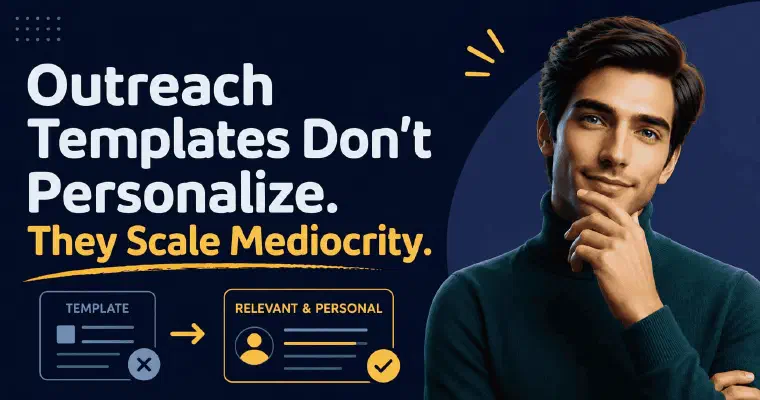
 A template is a decision. It says: this message is worth sending to a hundred different people. That decision is wrong, and it’s been wrong since the first sales team started copying it.
The problem I’m interested in here is relevance. Delivery, subject lines, and follow-up timing also matter, but they don’t answer why this person should care about this offer. Swapping fields in a template doesn’t answer that question either.
What “Personalization” Actually Means in Most Sequencers
The model I’m criticizing is campaign-level variable substitution, not every capability of every sequencer. You configure segments: CTOs at Series B SaaS companies get version A, Head of Sales profiles get version B. Each version gets a first name, a company name, sometimes a job title. I don’t consider those substitutions, on their own, meaningful personalization.
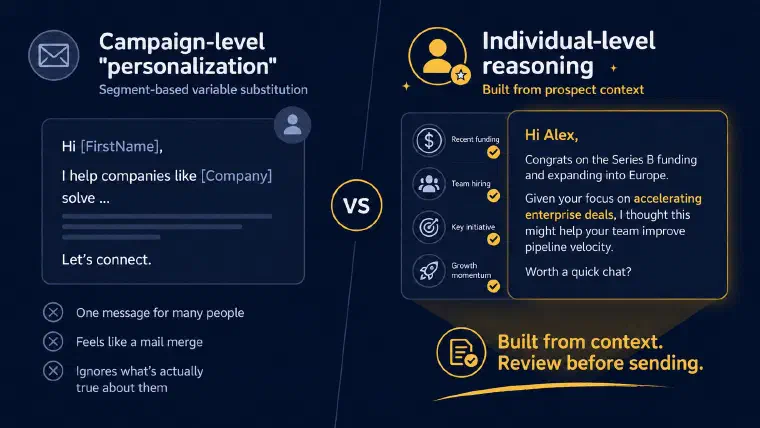
What you’ve built is a message written for a category of people and addressed to individuals within it. The recipient reads it and immediately understands this. The “Hi [First Name], I help companies like [Company]” construction isn’t read as personal outreach, it’s read as a mail merge with extra steps. The people you’re trying to reach have been receiving versions of this message for years. They know what it is before they finish the first sentence.
The deeper problem is structural. A template by definition encodes a fixed logic: this pain point, this offer, this call to action, for this segment. It cannot account for what’s actually true about the specific person receiving it: what they’re dealing with right now, what their company is going through, why this moment might be the right one to reach out. That information doesn’t fit in a [Variable] field.
Why Templates Won When They Shouldn’t Have
The appeal of the template model is easy to understand: it makes volume manageable. Writing one message and adapting fields takes less manual drafting than preparing a message for each of 500 prospects. When efficiency becomes the main goal, that trade-off can look sensible. My objection is what happens when the convenience of reuse replaces the work of finding a relevant argument.
A reused structure, cadence, and formulation can become recognizable to recipients. The tool may be doing exactly what it was configured to do. My concern is that efficient repetition is being mistaken for relevance, not that every template or sequence has stopped working.
What Genuine Personalization Actually Requires
Real personalization requires reasoning, not substitution. It requires understanding what this specific person does, what their company context is, what problem they likely have given what I can observe about them, and what about the offer I’m running on behalf of a specific business is actually relevant to their situation right now.
That’s not just a formatting problem. It’s an understanding problem. A variable or conditional block, on its own, doesn’t establish the argument. I want to use the prospect context available to prepare a message that responds to it, rather than only fill in the blanks of a structure written in advance.
For founders and sales teams defining a brief, I recommend making the offer and target specific before drafting. Whether AI fills campaign-level fields or adapts tone to a predicted communication style, I would still ask the same question: could this argument have been sent unchanged to anyone in the same role? That’s a review criterion, not evidence of a measured difference in reply rates.
The mechanics work like this. I score fit from 1 to 5 stars against the offer and persona, then use available prospect and company information, history, and prospecting preferences to prepare a message. A signal can contribute context; it isn’t the basis of every high score or proof of an internal need. A CTO at a recently-funded SaaS company and a Head of Sales at a mid-market firm may call for different angles. The offer, commercial objective, and persona preferences still guide the content, and you can review, edit, or regenerate it.
I walk through that exact chain step by step, from enrichment to the finished email body and subject line, in how AI cold email personalization actually works.
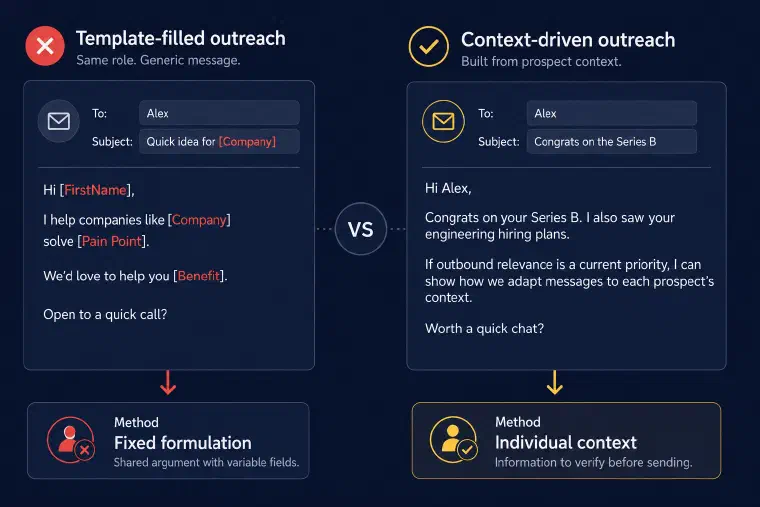
Fictional examples comparing message construction. The individual context still needs checking; no observed or guaranteed outcome is shown.
The comparison worth making isn’t “generic template vs. personalized template.” It’s “template vs. reasoning from context.” The first is a formatting question. The second is the question of whether the message was actually written for this person, or just sent to them. If you want the distinction between those two approaches explained in sharper terms, my breakdown of what separates an agent from a sequencer covers it directly.
Why B2B Outreach Is Shifting Away from Templates
The change I’m arguing for isn’t a promised lift in reply rates. It’s a different starting point for outreach: a relevant argument to explore with the prospect, rather than a reusable message looking for recipients.
Templates didn’t fail because people wrote them poorly. They failed because they were the right answer to the wrong prospecting problem: how do I send a lot of messages efficiently? The right question has always been different: how do I send the right message to the right person at the right moment? That question doesn’t have a template answer. The moment itself is a separate question, and I’ve argued elsewhere that a signal is material for that moment, not the reason for the message itself. For a deeper look at how an AI prospecting agent handles the full cycle from business context to executed outreach, my guide on AI agents for B2B lead generation covers the complete approach. Explore how I prepare context-informed outreach for your activity in an immersive demo.