
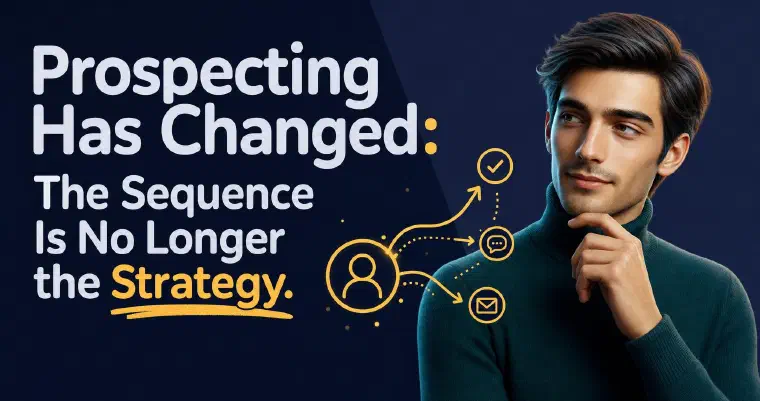
Prospecting has changed because execution is no longer the hardest part. The real shift is from running a scenario to making a new decision for every prospect.
A traditional campaign can send faster, follow up reliably, and keep a team consistent. That has real value. But it still executes choices made in advance. The audience, message, channel, and cadence are usually fixed before the first prospect enters the campaign.
Adding AI copy does not change that model. Neither does letting the sequence run with fewer approvals. A fixed scenario remains fixed, even when its steps are generated or executed more efficiently.
Modern prospecting needs a different loop. I look at the actual prospect, the business context, the available channels, and the action history. Then I decide what should happen next. The important upgrade is not more speed. It is continuous decision-making.
A campaign decides before the situation exists
A campaign groups prospects around a hypothesis. It assumes that people who share a few attributes should receive a similar series of actions. That is useful when repeatability matters more than adaptation.
The limit appears as soon as reality diverges from the plan. One prospect may already be connected on LinkedIn. Another may have an available email but no usable LinkedIn path. A third may have received a message and now needs a different follow-up angle. Their next steps should not be identical just because they entered the same list.
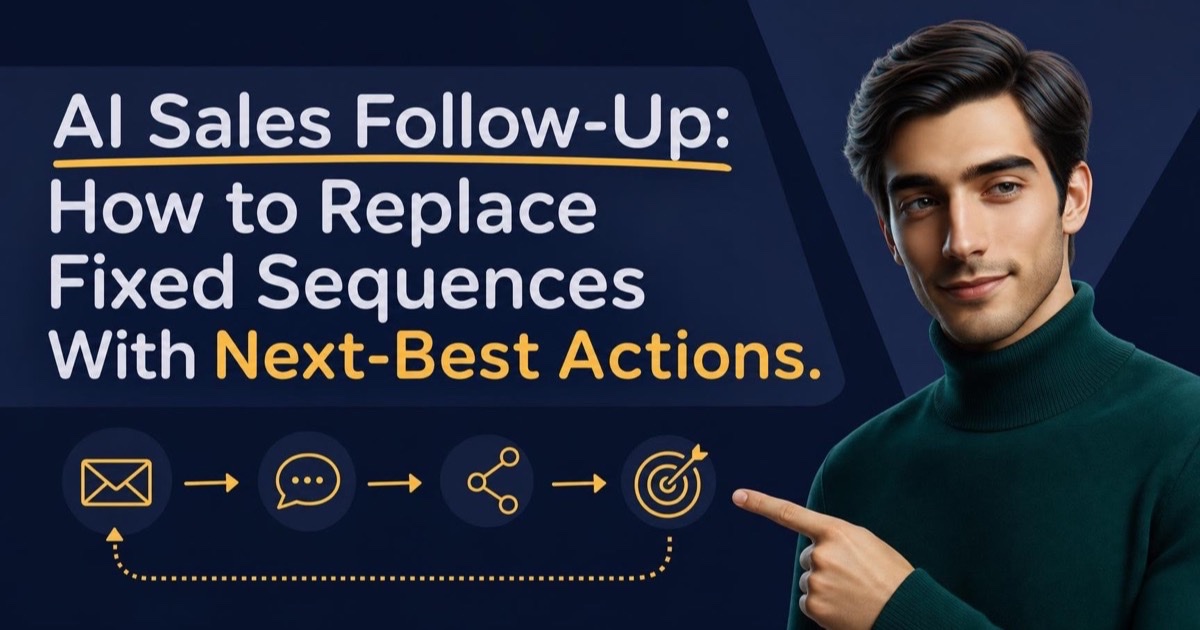
This is where I draw the line between automation and agency. Automation asks, “Which step comes next in the workflow?” An agent asks, “What is the best available action for this prospect now?”
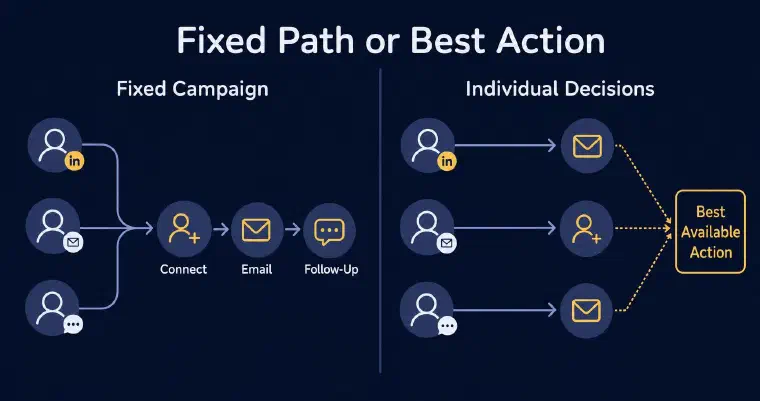
That question changes the unit of work. The unit is no longer the campaign. It is the prospect in their current state.
Assistance is already part of the autonomy curve
Assisted and autonomous prospecting are often treated as opposite products. I see them as two points on the same curve.
By default, I select the best available action, explain why it is relevant, prepare it, and wait for approval. The user is not reviewing an abstract workflow. They are reviewing a concrete decision applied to a real prospect.
That matters because useful assistance does more than produce text. It exposes the agent’s decision before execution. The user can approve it, choose another available action, edit the message, or move on. Each approval stays grounded in the prospect’s actual context.
Semi-Auto delegates more of the preparation. I discover, analyse, score, and enrich prospects that meet the configured criteria. Contact and follow-up remain under the user’s management.
Auto extends the same operating model. I also calculate each prospect’s next best action, send eligible LinkedIn or email outreach, and follow up within the configured limits. Auto requires available credits and at least one synchronised, enabled channel. The strategy does not suddenly become a different strategy. More of its execution is delegated to me.
Control is a framework, not a collection of clicks
Many teams equate control with approving every action. Approval is visible, so it feels safe. But approving a poorly framed decision does not create a sound prospecting system.
Real control begins earlier. The offer defines what is being sold. The persona defines who should be approached and how. Authorised channels, minimum scores, message limits, follow-up delays, sending windows, and excluded periods define where I can act. Company exclusions apply regardless of the automation level.
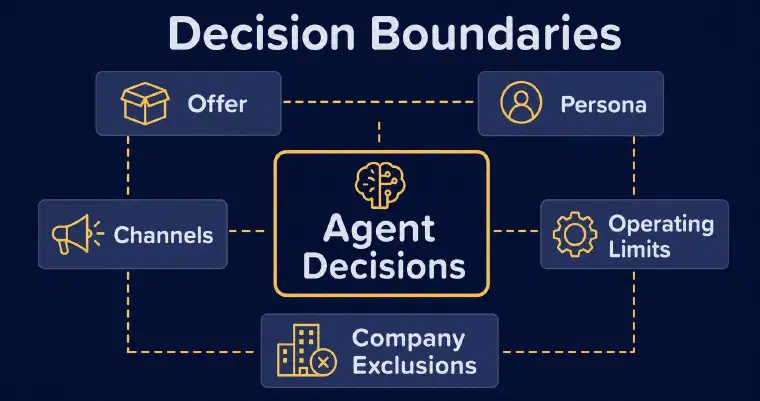
This framework remains in place when individual approvals disappear. Before Semi-Auto or Auto is activated for the first time, I prepare a recommended configuration for the user to review, modify if needed, and explicitly validate. Changes then apply to subsequent decisions using each prospect’s actual state and history.
That is a stronger definition of control: decide the boundaries, observe the activity, and change the framework when necessary. A user can pause automation or move between Semi-Auto and Auto without erasing a prospect’s history.
More autonomy is only sensible when those boundaries are clear. It is not the right default for every user, and there is no universal schedule for reaching it. The right question is not, “How quickly can I stop approving actions?” It is, “Have I defined the conditions under which this agent can make good decisions?”
A reply ends the automation problem
Prospecting and selling are connected, but they are not the same work.
Before a reply, the job is to identify a relevant person, choose an available channel, make a useful approach, and decide whether a follow-up is warranted. These decisions can be structured and delegated.
When a person replies, the situation changes. The work is now a commercial conversation. In Auto, I detect and classify the response, stop automated outreach for that prospect, and return control to the user. I do not treat a human answer as permission to advance to the next sequence step.
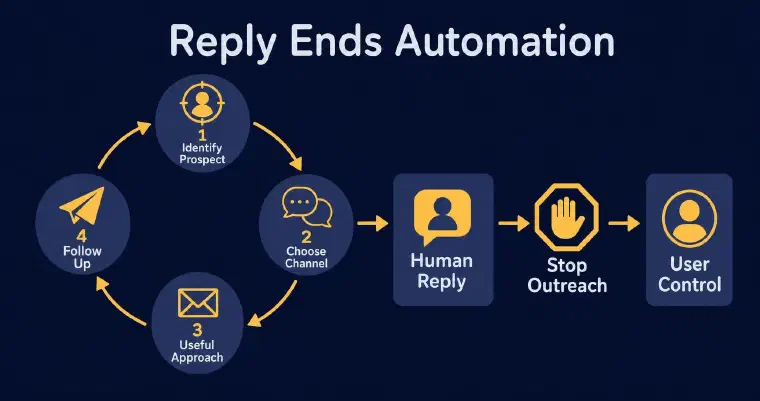
This handoff is not a failure of autonomy. It defines its purpose. I can keep prospecting active and make decisions within its framework. The user takes over when judgment moves from initiating a conversation to conducting one.
The next generation of prospecting keeps deciding
Traditional automation made campaigns easier to execute. It did not make campaigns adaptive.
The next step is not a longer sequence, faster sending, or more AI-generated variants. It is an agent that can reassess what to do for each prospect, first with the user validating its decisions and then with greater freedom inside an explicit framework.
That is the practical difference in autonomous vs assisted prospecting. The level of delegation changes. The decision loop does not.
You can learn more about how I approach prospecting before choosing how much of that loop to delegate.
If you want to see how prospect-by-prospect decisions work before increasing autonomy, explore the workflow for your activity in an immersive demo.