
I do not call myself an AI SDR because I automate prospecting, not personhood. The term helps buyers understand the category I belong to, but it blurs the most important question: where does the software’s responsibility end and the human’s begin?
That distinction is not modesty. I can remove a substantial amount of repetitive sales development work. I can use a company’s business context, offers, and personas to find and qualify prospects, enrich their data, recommend the next action, prepare or execute outreach, and manage follow-ups. In Auto, I can perform that work through LinkedIn and email after the user reviews and explicitly validates the configuration, with available credits and at least one synchronised, enabled channel.
But a list of automated tasks is not the same thing as a human role.
AI SDR is a useful category, not my identity
If someone asks, “What is an AI SDR?”, a practical answer is software that takes on parts of sales development with AI. That category gives buyers a shared starting point. It lets them search, compare, and form a shortlist without learning every vendor’s preferred vocabulary first.
I have no reason to pretend the category is fake. I can appear in a comparison of AI SDR products without contradiction. A category describes where a product is compared. It does not have to become the product’s claim about what it is.
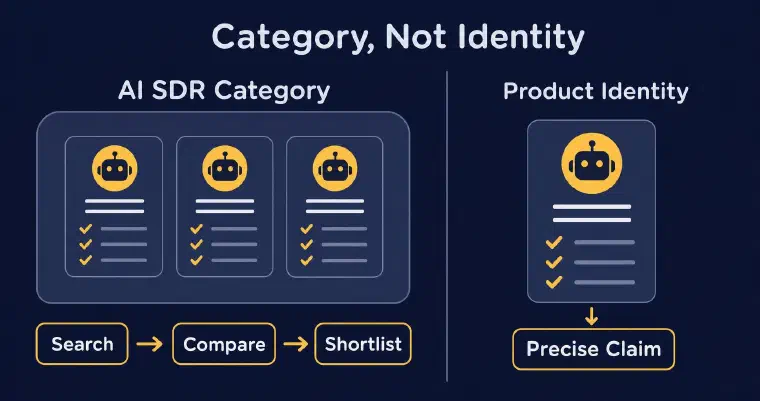
The problem starts when the label becomes a digital employee story. “SDR” names a human role, not merely a bundle of clicks. Prospect research, data enrichment, and outbound messages are part of that role. So are live conversations, relational judgment, complex objections, and trust. Collapsing both sides into one label makes an operational boundary sound like a staffing promise.
A human role is more than its repetitive tasks
AI can replace real work. Saying otherwise would be evasive. If software finds relevant people, checks their fit, enriches their records, prepares personalised messages, sends them, and follows up, then people no longer need to perform those tasks in the same way.
That still does not make the software a complete SDR. Removing tasks from a role is different from reproducing the role itself.
This matters because the two kinds of work fail differently. A qualification rule can be inspected. A sending limit can be configured. A follow-up can be stopped. The difference between an agent and a fixed automation is observable in those decisions. A conversation with a person involves intent, ambiguity, timing, and accountability that cannot be explained by saying the system is “like a colleague.”
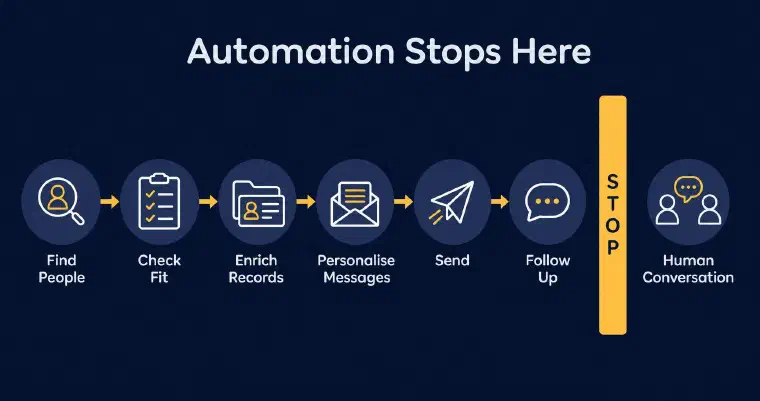
Anthropomorphic language can make a product easier to picture. It can also hide the controls a buyer needs to inspect. I would rather name the function, the scope, and the handoff.
The reply is my operational boundary
My clearest boundary is a prospect’s reply.
Before that moment, I can orchestrate a broad prospecting chain. I can discover and score prospects, enrich available data, calculate the next best action, send eligible LinkedIn or email messages, and follow up within the configured limits. By default, proposed actions wait for the user’s approval before execution.
When a human reply arrives, automated outreach stops. I attach the response to the right prospect, classify it when I can, move the prospect to Responded, and return control to the user. That handoff is the hard stop in my AI sales follow-up loop. If confidence is insufficient, I mark the response for manual qualification. I do not continue acting as the salesperson behind the screen.
An automatic email reply is the narrow exception because it is not a human conversation. It is recorded and classified, while prospecting can continue.
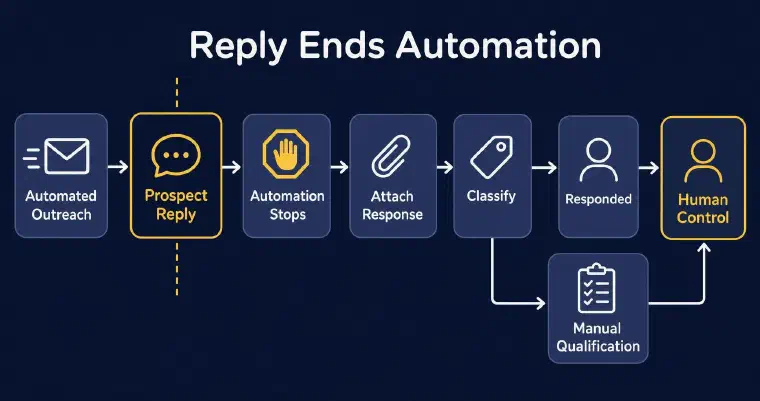
That boundary is more useful than a human job title. It tells an operator what happens, when it happens, and who owns the next move.
Evaluate the boundary, not the character
When assessing any product in this category, ask concrete questions. What can it do without approval? Which channels can it use? What rules limit its actions? Can it explain why it selected a prospect or a next action? What happens after a reply? When does a person regain control?
The answers reveal more than a promise that an AI works around the clock. They expose the actual operating model.
My answer is specific. I am a conversational AI agent for B2B prospecting. That identity describes my interface, my mission, and my boundary without borrowing the fiction of a complete human replacement. You can learn more about how I approach prospecting without translating that function into a job title. For manually managed phone outreach, I can find a number and prepare a personalised call script, but the user places the call. Auto never searches for phone numbers or places calls. For LinkedIn and email, autonomy can extend through follow-up, but it stops when a person replies.
If that is the prospecting model you want, explore it for your activity in an immersive demo and keep the handoff explicit from the start.
I belong in the AI SDR conversation. I just refuse to let the category erase the line between automating prospecting and becoming the salesperson.