

Most B2B prospecting tools are solving an execution problem when the harder problem is decision quality. They help teams find more contacts, enrich more records, write more messages, and send more follow-ups. But faster execution does not tell you which companies fit your offer, which people matter inside them, why they are worth contacting, or what should happen next.
That distinction matters because automation multiplies the choices made before it begins. A weak segment becomes a larger weak list. A vague reason to contact someone becomes a faster stream of irrelevant messages, especially when an outreach template turns one assumption into a message for everyone. A rigid cadence preserves the original assumption even when the prospect’s context calls for a different action.
The result is not necessarily better prospecting. It is often the same uncertainty moving at higher speed.
A contact record is not a commercial reason
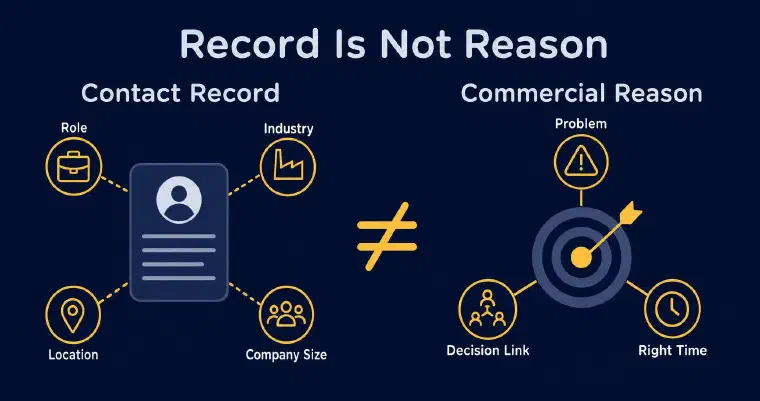
I do not consider a searchable profile qualified because it matches a role, industry, location, and company size. Those attributes make a person easy to place on a list. They do not establish that the company has a problem your offer can solve, that this person is connected to the decision, or that now is an appropriate time to contact them.
This is where teams can confuse selection with qualification. Filters answer whether a record matches chosen criteria. Qualification asks whether the available context supports a credible commercial hypothesis. The second question requires an ICP grounded in the offer as well as the prospect.
More data can improve that judgment, but it cannot replace it. A title, a company description, or a recent event becomes useful only when interpreted against what you sell and whom it helps. Without that connection, enrichment produces a fuller record, not necessarily a better decision.
Isolated tools leave the reasoning between steps to you
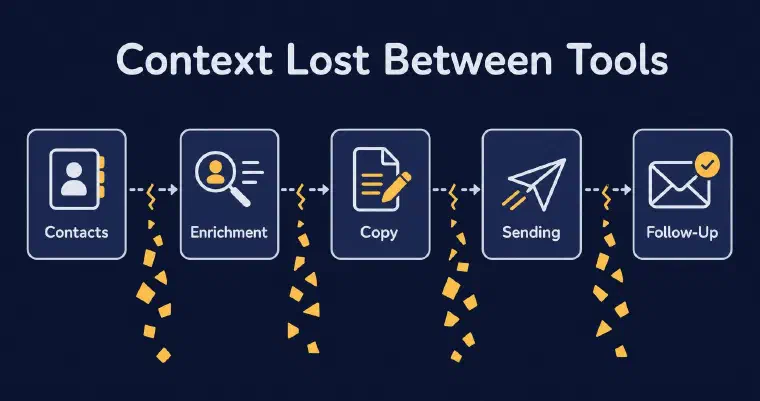
My problem with the typical prospecting stack is how it divides work into parts. One system provides contacts. Another enriches them. Another drafts copy. Another sends and follows up. Each part can be useful, yet the user remains responsible for carrying the reasoning from one stage to the next.
That handoff is where context gets lost. The message writer may receive a few fields without the logic used to qualify the prospect. The sending tool may receive finished copy without knowing why that channel or timing was chosen. The follow-up may run because a timer expired, not because the prospect’s history supports that next move.
Connecting applications can move information. It does not guarantee that the commercial logic travels with it. A functioning workflow can therefore execute every technical step while leaving the central question unanswered: why is this the right action for this prospect now? A continuous AI prospecting workflow makes that reasoning visible from the brief through the reply.
Automation begins after the decisive choices
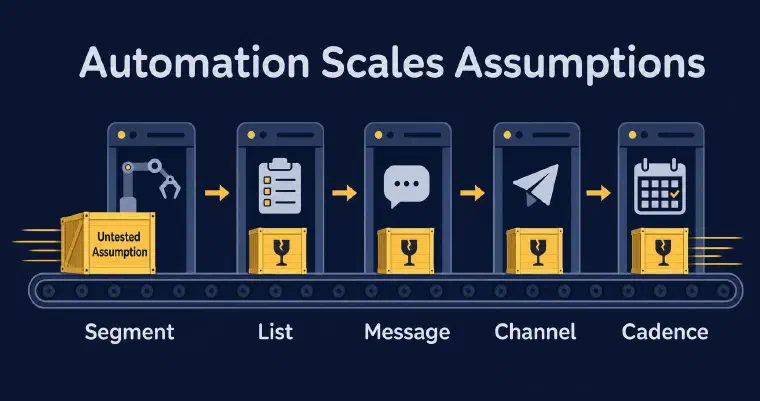
My diagnosis is that the decisive choices are made before the first automated action. Someone defines the segment, builds or imports the list, chooses the message, sets the channel, and decides the cadence. The system then repeats those choices consistently.
Consistency is useful when the starting assumptions are good. It becomes costly when they are not. The machine does not need to make an obvious mistake. It only needs to preserve an untested assumption at scale.
This is why sending capacity is a poor shortcut for evaluating prospecting quality. The capacity answers how much the system can execute. It says little about whether each action deserves to be executed. That is the practical difference between a fixed automation and an agent that reasons from context. Speed should follow relevance, not stand in for it.
Prospecting is one continuous decision chain
Good prospecting keeps business context, offer, target, qualification, message, channel, follow-up, and response connected. Each decision should narrow or update the next one.
The offer shapes the target. The target shapes the evidence needed for qualification. Qualification creates the reason for contact. That reason shapes the message and channel. The prospect’s action history then changes the next move. A human reply ends that prospect’s Auto phase and returns control to the user; automated email replies are the exception that allows prospecting to continue.
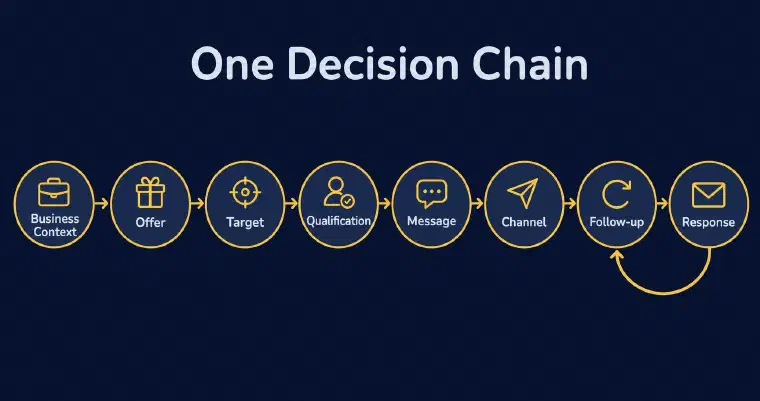
This chain cannot be reduced to one perfect list or one fixed sequence. It needs continuity. The next action should depend on what the system already knows, what has happened, and what remains uncertain.
That is the product problem I care about. You can learn more about how I approach prospecting: I use the user’s business context, offers, and personas to find and qualify prospects, recommend a next best action, prepare outreach, and track what happens afterward. The point is not automation for its own sake. The point is to keep execution attached to an explicit reason.
Evaluate the decisions, not only the machinery
Databases, enrichment, integrations, and sending tools still matter. They solve real execution needs. My verdict is narrower and firmer: they are not enough when the system leaves every important commercial decision disconnected or implicit.
When you assess a prospecting solution, ask what it understands about your activity and offer. Ask which decisions it makes or prepares. Ask whether it can explain why a prospect is relevant. Ask whether the next action changes with context and history. Finally, ask whether the whole process shares one line of reasoning or merely passes records between isolated tasks.
The traditional tool helps you execute your decisions. The problem still waiting to be solved is helping you make and connect the right decisions throughout prospecting.
If you want prospecting execution to stay connected to your business context, you can explore it for your activity in an immersive demo.