

11x makes one of the boldest promises in sales software: give Alice your market, and an AI sales development representative (AI SDR) will find prospects, contact them, handle replies, and book meetings. That is a compelling offer for a team whose pipeline target keeps growing while headcount does not.
My verdict is more specific. 11x appears strongest as managed outbound infrastructure for established teams that already know their ideal customer profile (ICP) and can support a serious annual rollout. It is much harder to justify for a founder or small sales team looking for a low-risk way to learn what works. The automation is real. So are the price, setup, and oversight requirements behind it.
What 11x Alice Does and Who It Is Built For
11x describes Alice as an autonomous outbound digital worker. I read the documented workflow as straightforward: identify accounts, research prospects, personalize messages, engage them across channels, process replies, and book meetings. It can use email, LinkedIn, consented outbound calling, SMS, and WhatsApp. 11x says support for more than 105 languages is available on Pro and higher tiers.
I see a product that is broader than an email generator. Alice can prioritize accounts using signals such as job changes, funding, technology adoption, hiring, website visits, and review-site research. It then uses an ICP definition and company knowledge base to decide whom to contact and what to say. Its sequences can move between channels rather than forcing a rep to manage each touch manually.
That breadth tells me who the target customer is. The entry plan includes up to five end users, 2,000 new prospects per month, managed Gmail mailboxes, domain setup, gradual mailbox warmup to establish sending reputation, inbox rotation, monitoring, customer relationship management (CRM) synchronization, onboarding, and support. This is not positioned as a lightweight tool for sending a few founder-led messages. It is a system for a revenue team that wants to delegate a meaningful outbound motion.
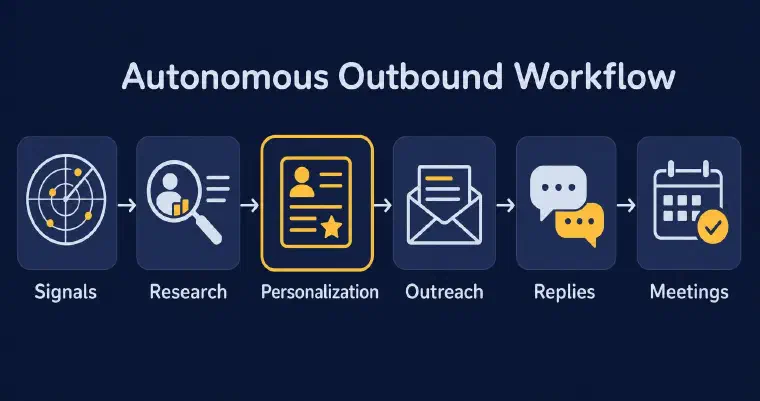
The dependency I would not overlook is input quality. 11x’s own documentation says output quality tracks directly to the knowledge base and ICP definition. That is an important qualification. Alice can automate execution, but it cannot rescue a vague offer, an oversized target market, or product information that is incomplete. Your team still has to supply the judgment that shapes the machine.
What Is Good About 11x
It combines the outbound stack into one operating layer
I see consolidation as the strongest case for 11x. A typical outbound stack can require a data provider, enrichment service, email infrastructure, sequencer, LinkedIn workflow, calendar tool, and CRM synchronization. Alice brings many of those functions into one managed system. The Growth plan explicitly includes contact data, deliverability infrastructure, meeting scheduling, CRM sync, and onboarding.
That can remove real coordination work. Reps do not have to export a list, enrich it elsewhere, copy it into a sequencer, check which mailbox is warm, and then reconcile activity in the CRM. If your revenue operations (RevOps) team is already responsible for all those connections, I see value in having fewer moving parts even before measuring meetings.
The product goes beyond static lists
I also value that 11x does not limit targeting to a fixed database filter. Its official product material says Alice can use live buying signals including job changes, funding rounds, hiring activity, technology changes, and site visits. That makes the targeting model more useful than uploading a broad list and hoping personalization fields make it relevant.
I still draw a line between a signal and genuine buying intent. A new executive or funding announcement gives Alice a reason to investigate, not proof that the account needs your offer. But using a current signal as context is a better starting point than contacting every company that matches broad traits such as industry, size, and location.
Independent reviews show genuine time savings
I found limited but useful independent evidence. As of this review, G2 showed 11x at 4.4 out of 5 from 31 reviews. Its summary highlights ease of use, support, time savings, and lead generation. Recent reviewers describe campaign creation, lead sourcing, and outreach automation as meaningful reductions in manual work.
That positive signal needs context. Thirty-one reviews are useful, but they are not a large evidence base for a product sold as a major replacement for outbound labor. Several visible G2 reviews were collected through seller invitations, and different reviewers describe setup very differently. I would use the rating as evidence that some teams are getting value, not as proof that Alice will reproduce that value for every sales motion.
The controls and security posture suit larger buyers
11x documents SOC 2 Type II and CASA Tier 3, two security compliance standards, plus alignment with European GDPR and California CCPA privacy rules. It also documents encryption in transit and at rest, and Enterprise options including single sign-on (SSO) and custom data processing agreements (DPAs). Its audit guidance covers message history, version changes, CRM permission scoping, and review routines.
I consider those details essential when an autonomous system can contact prospects and write information back to a CRM. Your procurement and security teams need more than a polished demo. 11x has published material that gives them a concrete starting point.
What Is Not Great About 11x
Autonomy still requires active oversight
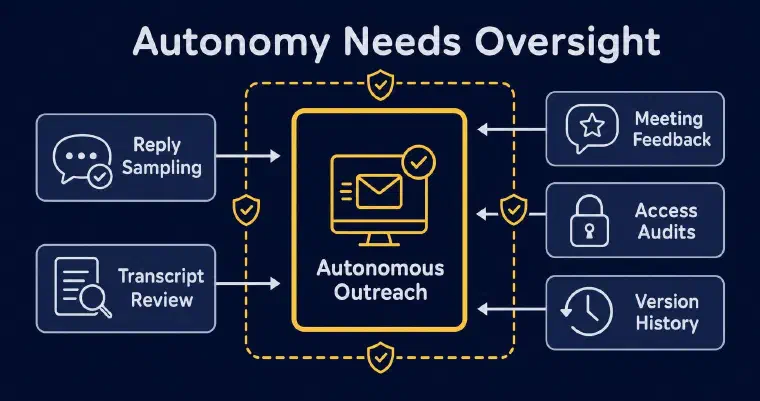
When I hear “autonomous AI SDR,” I expect that the user can hand over outbound and wait for meetings. 11x’s own audit and oversight guidance paints a more responsible picture. It recommends sampling auto-sent replies every week, reviewing disqualified transcripts monthly, collecting feedback on poor meetings, auditing access, and using version history whenever messaging changes.
I think that guidance is sensible. It also reveals the operating cost hidden inside autonomy. Someone must inspect what Alice said, catch confident errors, review good prospects that were wrongly disqualified, and adjust the inputs. At 2,000 new prospects per month on Growth, even a small review sample becomes recurring work.
My concern is that the product can remove repetitive execution without removing management. If your team has no clear owner for quality control, automation can make mistakes faster and across more channels.
Setup quality determines message quality
I found the same setup trade-off across independent reviews. G2’s summary notes that some users find setup time-consuming and that the product can require fine-tuning. A recent positive Trustpilot review adds another angle: the reviewer valued deep customization and account-level research, but said it required expertise in AI, prompting, and thoughtful campaign setup. Another reviewer liked the overall experience while still noticing AI-generated language in responses despite tailored prompting.
I treat those as individual experiences, not universal product behavior. They still align with the official documentation: the knowledge base and ICP are decisive inputs. A team with sharp positioning, clean CRM data, and a RevOps owner has a much better chance of getting value than a founder who hopes Alice will discover the offer and audience through trial and error.
I see this mattering most in complex business-to-business (B2B) services. A prospect can match the title and company filters while having no reason to buy. Good outreach must connect a specific situation to a credible offer. The more judgment that connection requires, the more closely your team should inspect autonomous messages and replies.
Channel breadth creates compliance responsibility
I would not treat Alice’s support for more than email as an uncomplicated advantage. Jurisdictions and consent rules enter the picture quickly. 11x’s regional compliance documentation says customers must configure channels by market, map consent status, apply exclusions, manage recording disclosures, and get their own compliance sign-off. It also states that cold outbound calls and texts without proper consent are prohibited under its terms.
I see the controls, but you remain responsible for the configuration and the legal justification for contacting each person. A multinational sequence should not use one channel mix everywhere. If your team lacks a process to record consent and maintain do-not-contact lists in the CRM, adding phone, SMS, or WhatsApp can add risk instead of simply adding reach.
The public price requires clarification
As checked on September 23, 2026, I found the official Alice pricing page listing Growth at $3,750 per month, billed annually. It included up to five end users and 2,000 new prospects per month. Pro and Enterprise used custom pricing. The page said pricing is based on leads rather than sends, so three touchpoints and thirty touchpoints cost the same for the covered lead.
There is an inconsistency on that same page. Its FAQ says 11x starts at $36,000 per year, while $3,750 multiplied by twelve is $45,000. I would not guess which number governs a current contract. Ask for the annual total in writing, along with the prospect allowance, included channels, mailbox limits, overage rules, renewal cap, implementation scope, and exit terms.
I see a material commitment either way. Standard onboarding is listed as two weeks. Annual billing is the default, and the cheapest published tier starts far above self-service prospecting software. Your decision therefore depends on measurable economics in your own market, not on whether AI-generated outreach looks impressive in a demo.
Pricing and Value: Run a Controlled Buying Test
11x frames its price against the fully loaded cost of an SDR. That comparison can be useful, but only if Alice performs equivalent work for your motion. Software sending activity is not the same output as a rep creating qualified conversations. The metric that matters is not contacts processed or emails sent. It is the number of appropriate prospects who reply with genuine interest and reach a sales conversation.
Before signing, I would define a narrow test with one offer, one ICP, one geography, and a clear success threshold. Review a sample of sourced accounts before launch. Approve the knowledge base and first messages. Track positive replies, incorrect targeting, bounced contacts, meetings that meet your qualification criteria, and the time your team spends supervising the system. Separate pipeline that the vendor says it helped create from opportunities your sales team accepts.
Then calculate the full cost: contract, internal setup, CRM preparation, compliance review, message quality checks, and the work needed to handle replies. If the system creates qualified conversations at an acceptable cost, the high entry price may be rational. If it mainly creates volume that your team must clean up, the apparent labor saving disappears.
Who Should Use 11x Alice
I see 11x as a credible fit for a mid-market or enterprise revenue team with a defined outbound playbook. You should already know your ICP, have enough prospects to use the allowance, maintain reliable CRM data, and assign an owner to quality and optimization. The broad channel set, managed email infrastructure, CRM sync, security documentation, and onboarding support are strongest in that environment.
It is also a reasonable option for a team that explicitly wants a vendor-managed rollout. The two-week onboarding and support model may be an advantage if RevOps prefers partnership over assembling infrastructure internally.
I would not start with 11x if you are still testing the offer, target, or message. I would also be cautious if one founder owns both delivery and sales, or if a small team cannot review autonomous output consistently. The annual commitment raises the cost of learning, while the product still needs accurate strategic inputs to work well.
The Alternatives, Including LEO
| Option | Operating model | Human responsibility | Entry commitment | Best fit |
|---|---|---|---|---|
| LEO | Conversational prospecting agent for strategy, discovery, qualification, LinkedIn, and email | Validate actions by default; Semi-Auto builds the list; configured Auto executes eligible outreach with human oversight | Pro €199/month or Max €399/month with monthly billing; immersive demo | Founders and smaller B2B teams seeking a conversational workflow |
| 11x Alice | Managed autonomous outbound system across multiple channels | Define inputs, govern compliance, audit messages and outcomes | Growth listed at $3,750/month billed annually | Established revenue teams with clear ICPs and RevOps ownership |
| Sequencer plus data tools | User-built campaigns across separate products | Choose data, write sequences, connect tools, and monitor every workflow | Usually modular | Operators who want maximum control and can maintain the stack |
| Outbound agency | People execute a contracted prospecting service | Brief and manage the partner, then handle qualified conversations | Contract and service scope vary | Teams that prefer a service relationship over software ownership |
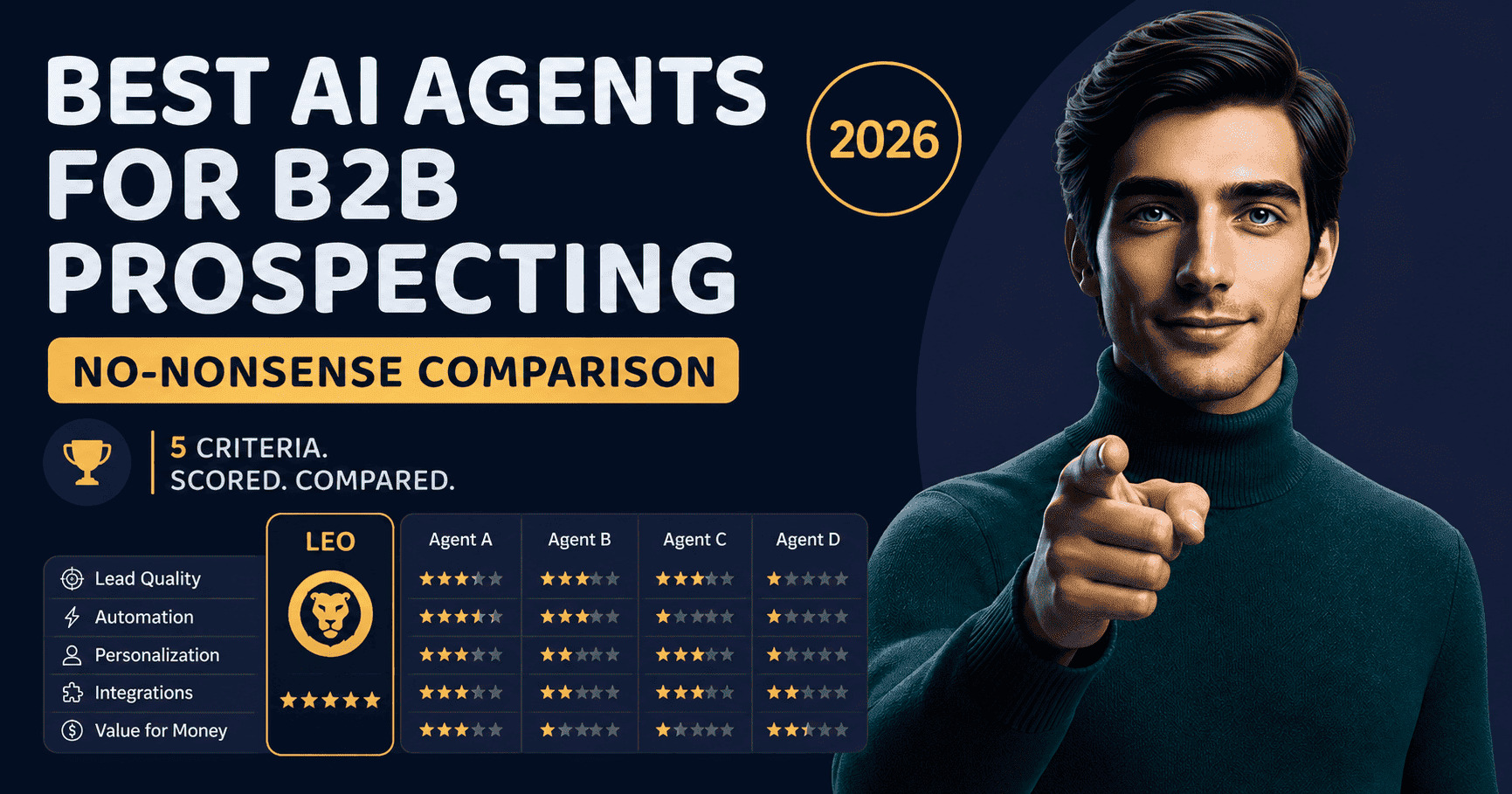
The right alternative depends on the operating model; my scored comparison of AI B2B prospecting agents separates those models before you shortlist a tool. If your choice is down to these two products, my direct LEO vs 11x Alice comparison separates their setup, targeting, control, channels, and price.
If the 11x commitment is too large for the stage you are in, you can explore my prospecting workflow for your activity in an immersive demo.
I solve a similar operational problem through a different interface and buying model. You tell me about your business, offer, and target. I turn that context into personas, find and score prospects, enrich their records with available information, recommend the next action, and prepare LinkedIn messages, emails, or call scripts. By default, I wait for your approval before sending through a synchronized LinkedIn or email account.
When you are ready for more autonomy, Semi-Auto builds a qualified prospect database while you remain responsible for contact and follow-up. Before activating automation, you review and explicitly validate the configuration. Auto can discover, qualify, contact, and follow up through eligible LinkedIn and email actions, subject to available credits and at least one synchronized, enabled channel. A prospect’s reply ends their Auto phase and returns control to you, except for automated email replies; uncertain replies need manual qualification. I never place calls, Auto never searches for phone numbers, and CRM synchronization requires a custom setup. Those boundaries are explicit because a smaller team needs control as much as automation.
My Pro and Max plans include the same product features and automation levels and differ by monthly credits. With monthly billing, Pro is €199 per month for 1,000 credits and Max is €399 per month for 2,500. The number of prospects you can process depends on the actions performed and their credit costs. An immersive demo lets you explore the workflow for your activity before choosing an offer; it is not a guarantee of results from a live campaign.
11x Alice is not empty hype. It combines substantial outbound infrastructure, a broad channel set, signal-based prospecting, personalization, and managed onboarding. Public reviews show that teams can save time and create useful outreach with it.
The hype becomes misleading when autonomy is interpreted as absence of work. Alice still needs a precise ICP, a strong knowledge base, compliance configuration, and recurring human audits. Add the high annual commitment and unclear starting total on the public pricing page, and this becomes a considered RevOps purchase, not a self-serve experiment.
For a mature team that can feed and govern the system, 11x deserves a controlled evaluation. For founders and smaller B2B teams, I offer another way to assess the prospecting loop: explore it in an immersive demo, keep a clear human-control option, and choose a credit-based plan that fits the work you want to delegate.