
Apollo has 9,000+ G2 reviews, $150M ARR, and a database of 275M contacts. It is the most reviewed sales intelligence platform on the market. This review is for anyone evaluating Apollo in 2026 who wants to understand what it actually delivers, and where it falls short before committing to a plan.
What Apollo Does : And Who It’s Built For
Apollo is a full-stack outbound platform: contact database, email sequencing, phone dialer, LinkedIn task prompting, AI writing tools, CRM sync, and analytics, all in one interface.
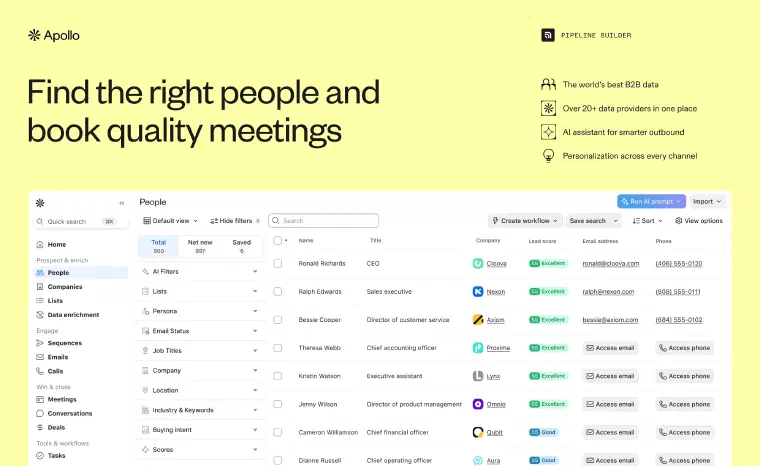
The workflow is linear. You build a prospect list using Apollo’s database (275M+ contacts, 60M+ companies, 65+ filters), enrich contacts to get emails and phone numbers, build an email sequence using the drag-and-drop builder, write outreach copy with Apollo’s AI Email Writer (powered by Claude 3.5 Haiku), and execute, sequences run automatically, call tasks appear in your queue, LinkedIn steps prompt manual action.
Apollo is designed for sales teams that need a database, a sequencer, and a dialer in one place without paying for ZoomInfo, Outreach, and Salesloft separately. That’s a real and specific value proposition, and it explains why Apollo has grown to $150M ARR and 500,000+ companies on the platform.
Who Apollo is built for: SDR and BDR teams at B2B SaaS companies, sales managers at growth-stage startups who need consolidated outbound infrastructure, and RevOps teams building enrichment workflows. It assumes someone owns the platform, a dedicated SDR manager, a RevOps lead, or a technical founder who wants to run the tool themselves.
What’s Good About Apollo
A database that actually replaces three tools
275M contacts. 60M+ companies. 65+ filters including technology stack, job title, headcount, funding stage, intent signals, and more. For US-focused B2B teams, Apollo’s database is genuinely one of the most accessible in the market, at a fraction of what ZoomInfo charges.
The Chrome extension makes LinkedIn-to-Apollo fast: visit a profile, click the extension, get the email and phone if available. For reps who build lists manually from LinkedIn searches, this removes the copy-paste loop entirely.
Before Apollo, a typical SMB sales stack was Hunter for email finding, Sales Navigator for list building, and Mailshake for sequences. Apollo collapses all three into one platform at roughly the same price as Sales Navigator alone. That consolidation is not a small thing.
A sequencer that works : and is genuinely learnable
Apollo’s sequence builder is drag-and-drop, supports multi-step multi-channel campaigns (email, call tasks, LinkedIn manual tasks, manual tasks), and includes A/B testing on email subject lines and copy variants. G2 rates ease of use at 9.1/10, unusually high for a platform this deep.
The AI Email Writer generates personalized copy from prospect data: company, role, recent news, intent signals. The AI Research Agent generates talking points and personalization context automatically per contact. These are real AI features, not marketing labels, they meaningfully reduce the time it takes to write outreach at scale.
For sequence-based email outreach, Apollo is among the most accessible tools in the category. It’s not best-in-class for deliverability or hyper-personalization, but it works, and most reps can build their first sequence in under two hours.
Pricing that undercuts the competition significantly
At the May 2026 prices reviewed here, Apollo’s Organization plan was $119/user/month and Basic was $49/user/month with annual billing. Bundling data and sequencing can be attractive compared with buying separate products. The actual saving depends on which tools, users, and capabilities it replaces.
For growth-stage startups that need real outbound infrastructure without a six-figure contract, Apollo’s pricing is one of the most compelling offers in the market.
What’s Not Great About Apollo
Data quality deserves a test on your own market
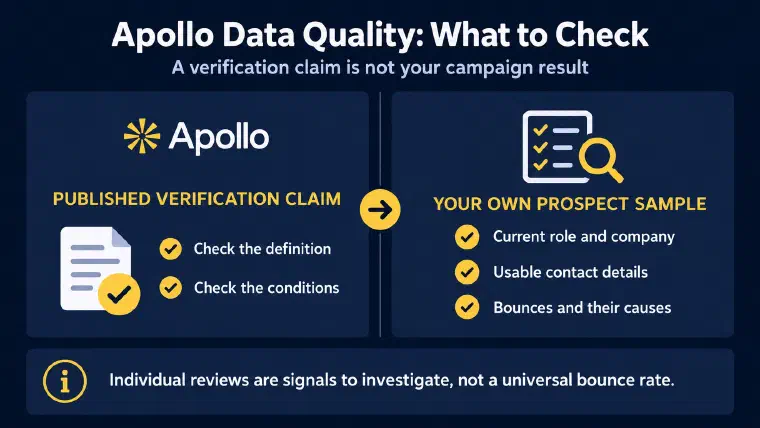
Apollo’s email verification documentation, checked on September 29, 2026, claims 91% accuracy. I would treat that as a vendor claim, not a delivery guarantee. Verification accuracy and the bounce rate of a specific campaign are different measures and cannot simply be subtracted from one another.
Trustpilot, checked on September 29, 2026, includes OM’s September 24 review describing data that needed rechecking and Bradley’s September 25 review reporting wrong numbers, alongside positive experiences. These are individual reports, not a typical bounce rate across Apollo users. The useful test is whether the roles, companies, and contact details in a sample of your target market are current and usable.
The practical concern is contact quality and sender reputation. Apollo itself notes that bounces can involve invalid addresses, full mailboxes, blocking, or sender reputation. A bounced email isn’t automatically proof of one data-provider error, and a verification label doesn’t remove the need to monitor delivery. I would inspect both the records and actual sending outcomes before scaling.
For international outreach, test the countries and roles you actually target rather than assume a global database performs uniformly. That applies to EMEA, APAC, and North America alike.
The credit system is more expensive than it looks
Apollo’s pricing pages advertise “unlimited email credits” on paid plans. This is a marketing framing. The real constraints are export credits (how many contacts you can pull into your CRM or sequences) and mobile phone reveal credits.
| Plan | Export credits/month | Mobile reveals/month | Annual data enrichment credits |
|---|---|---|---|
| Free | 10 | 5 | 1,200 |
| Basic | 1,000 | 75 | 5,000 |
| Professional | 2,000 | 100 | 10,000 |
| Organization | 4,000 | 200 | 15,000 |
Mobile phone reveals cost 8× more than email reveals. For teams doing significant cold calling, the 75–200 mobile reveals on standard plans exhaust quickly. The final cost depends on the plan, users, usage, and any extra credits or add-ons, including the parallel dialer. Check those charges for your intended workflow rather than rely on a universal monthly estimate.
Credits are non-rollover. Any unused credits at the end of the month are lost. For teams that don’t use Apollo at consistent volume every month, the effective cost per contact can be significantly higher than the per-credit rate suggests.
This is not unique to Apollo, credit systems are common across the category. But Apollo’s marketing of “unlimited” email credits creates a specific expectation mismatch that shows up consistently in user complaints.
Setup and operational overhead : this is not a plug-and-play tool
Apollo requires time before it starts producing results.
Email domain warmup is a prerequisite for any serious sequence volume, sending cold email from a cold domain at scale triggers spam filters. Sequence configuration (steps, timing, conditions, A/B variants) takes planning. Credit management requires active monitoring to avoid running out mid-month. CRM sync configuration, Salesforce, HubSpot, Pipedrive, requires mapping, testing, and ongoing maintenance. Analytics interpretation requires someone who knows what to look for.
None of this is technically complex. But it takes time. Teams without a dedicated platform owner, someone whose job includes knowing how Apollo works and keeping it running, typically see the tool underperform. For a founder or solo SDR who wants to start prospecting today, Apollo’s onboarding curve is a real friction point.
LinkedIn execution is another gap. Apollo includes LinkedIn as a sequence step type, but execution is manual, the platform prompts you to take the LinkedIn action yourself, in a separate tab. For teams where LinkedIn is the primary outreach channel, this means the “multi-channel” sequencer has a channel that is, in practice, semi-automated at best. For a tool where LinkedIn steps execute natively, with the account-ban caveats that come with it, my lemlist review covers what that automation actually delivers.
Pricing : Is It Worth It?
As of May 2026 (apollo.io/pricing):
| Plan | Annual ($/user/mo) | Monthly ($/user/mo) | Export credits/mo | Mobile reveals/mo |
|---|---|---|---|---|
| Free | $0 | $0 | 10 | 5 |
| Basic | $49 | $59 | 1,000 | 75 |
| Professional | $79 | $99 | 2,000 | 100 |
| Organization | $119 (min. 3 users) | $149 | 4,000 | 200 |
For a solo SDR or founder, the Basic plan at $49/month is a reasonable entry point, assuming US-focused outreach, acceptable bounce rates, and willingness to invest in setup. For teams of 3+, the Organization plan with its minimum user commitment adds up fast.
The real cost question is whether Apollo replaces tools you’re already paying for. If you’re currently running Hunter + Mailshake + a LinkedIn subscription, Apollo likely saves money and reduces tool fragmentation. If you’re buying Apollo on top of an existing stack, the value calculation changes.
Who Should Use Apollo
Apollo’s real sweet spot is narrow: SDR and BDR teams at US-focused B2B SaaS companies, 10–100 employees, where someone on the team owns the outbound stack. Sales managers who want consolidated infrastructure, database, sequencer, dialer, CRM sync, at a price point that doesn’t require a procurement process. RevOps leads building enrichment workflows or ABM lists at scale.
Three profiles where Apollo is genuinely the right call: a four-person SDR team replacing a stack of three separate tools with a single platform; a sales operations lead needing reliable Salesforce and HubSpot sync with waterfall enrichment; a startup scaling from 5 to 20 SDRs who needs a sequencer with admin controls, analytics dashboards, and team-level reporting.
I would be cautious with Apollo when you’re a founder or solo seller who wants little setup work, your primary outreach channel is LinkedIn rather than email, a sample fails your own data-quality checks, or your sender reputation already needs attention. Native LinkedIn execution versus manual task prompts is another important distinction.
Most independent B2B professionals, founders, consultants, solo SDRs, sit outside Apollo’s true sweet spot. They need something that starts working in one session, not one week. For a founder still validating who to target before committing to any tool, my guide on AI prospecting for startups covers how to sequence that validation before scaling outreach.
The Alternatives : Including LEO
| Apollo | LEO | Sales Navigator | Clay | |
|---|---|---|---|---|
| Type | Sales intelligence + sequencer | AI prospecting agent | LinkedIn database | Data enrichment platform |
| Setup time | Days to weeks | Guided setup, review, and channel connections | Hours | Days |
| Database size | 275M+ contacts | Enrichment per prospect | LinkedIn native | Multi-source |
| Email accuracy | Vendor verification claim; test delivery on your own data | Usable addresses searched when available; no accuracy guarantee | N/A (no email) | Varies by source |
| LinkedIn execution | Manual steps prompted | Eligible invitations and messages with a synchronized account | Native browsing only | None |
| Personalization | AI writer at campaign scale | Per-prospect, conversational | None | Template-based |
| Strategy building | Not included | Built in | Not included | Not included |
| Price (solo user) | $0–$79/mo + overages | Pro €199/mo or Max €399/mo with monthly billing | $99/mo | $149/mo+ |
| Requires operator | Yes | Yes: strategy, configuration, supervision, and replies | Partial | Yes |
If you want to explore a conversational approach to prospecting, see how I work on your activity in an immersive demo.
Apollo is a database with a sequencer bolted on. To use it, you operate it, you build lists, configure sequences, warm domains, manage credits, interpret analytics, and monitor deliverability. That operational model works well when someone owns it full-time.
I work differently. You describe your business and who you’re trying to reach. I structure an offer and persona for review, find and score prospects against both, and prepare messages using available professional and company information, preferences, and history. By default, you approve actions before execution. Semi-Auto builds the prospect database while you manage contact and follow-up. Auto executes eligible LinkedIn and email actions after you review and explicitly validate its configuration, with available credits and at least one synchronized, enabled channel. A reply ends that prospect’s Auto phase and returns control to you, except for automated email replies; uncertain replies need manual qualification. I never place calls, and Auto never searches for phone numbers.
With monthly billing, Pro is €199 for 1,000 monthly credits and Max is €399 for 2,500. Both provide the same product features and automation levels. Detailed prospect and company enrichment does not consume credits, but contact searches and other actions have their own costs: finding a usable email costs one credit, and a usable phone number five. The number of prospects depends on the actions performed. A connected email account still requires attention to sending reputation and deliverability; I don’t remove that responsibility.
The difference is where the intelligence sits. In Apollo, the intelligence is the database and the workflow engine, you supply the strategy. With me, the strategy is where we start.
For a detailed head-to-head on LinkedIn-specific prospecting, see my comparison of LEO vs. Sales Navigator. For a direct side-by-side on pricing, LinkedIn execution, and setup overhead, see my LEO vs. Apollo comparison.
Apollo is genuinely one of the best outbound platforms available for the team it was designed for: a dedicated SDR function at a US-focused B2B SaaS company with an operations lead who owns the stack. At that use case, the database depth, the sequencer breadth, the CRM integrations, and the pricing all make sense. I would still test data quality and monitor sending outcomes rather than infer them from the size of the database. And the platform’s assumption that someone owns it, that there’s a person whose job is to keep Apollo running and improving, means that for founders and solo operators, the tool can sit underused.
If that’s you, a founder or solo seller, I offer another operating model: guided strategy, recommendations using prospect history, and eligible LinkedIn actions executed through your connected account. There is no fixed sequence to build, but you still review the strategy, monitor credits and activity, and handle conversations. For the full side-by-side on setup, pricing, and LinkedIn execution, see my LEO vs Apollo breakdown.