
Artisan Ava is a serious AI business development representative (BDR), not a thin email-writing assistant. It can take a defined outbound sales process and automate much of its execution. My verdict is equally direct: it is worth considering for mature teams that already know their market, but it is a heavy first step for founders or reps who still need to refine whom they target and what they say.
What Artisan Ava Does and Who It Is Built For
I read Artisan’s positioning as an autonomous BDR that works alongside a revenue team. According to the official Ava 2.0 launch announcement, the agent identifies and researches prospects, writes individual outreach, runs email sequences, handles replies, and books meetings. The platform also queues warm prospects for calls instead of pretending the AI can replace the human conversation that follows.
That distinction matters. Ava automates the early steps of finding and contacting prospects. It does not close the sale.
The current product is broader than its early reputation as an automated cold-email tool. Artisan documents a database of more than 250 million verified B2B contacts, synchronization with Salesforce and HubSpot customer relationship management (CRM) systems, approval gates, exclusion lists, reply handling, meeting booking, and systems for sending email while protecting sender reputation. Its pricing page packages those capabilities for Team, Scale, and Enterprise deployments, with roughly 2,500 prospects contacted per month shown for Team and roughly 6,000 for Scale.
In my view, the best-fit buyer is not simply “anyone who hates prospecting.” It is a sales team with a defined ideal customer profile, established messaging, enough volume to justify infrastructure, and someone accountable for campaign quality. If your proactive sales process already works but consumes too much rep time, Ava can remove a substantial amount of repetitive execution.
If your target is still vague, automation magnifies the problem. More researched contacts and more messages do not repair an unclear offer. They move the mistake faster.
What Artisan Gets Right
It joins the outbound workflow into one operating system
The strongest case for Artisan is consolidation. Ava can find contacts, add useful information about them, draft outreach, send, monitor replies, and book meetings without forcing a rep to rebuild the workflow across a database, sequencer, email-delivery tool that protects sender reputation, and spreadsheet.
That is more valuable than another AI copy feature. The hidden cost of outbound is often operational: transferring records, checking exclusions, assigning accounts, updating a CRM, and deciding when a human should step in. Artisan’s current product addresses that chain rather than one isolated task.
It offers real control around autonomy
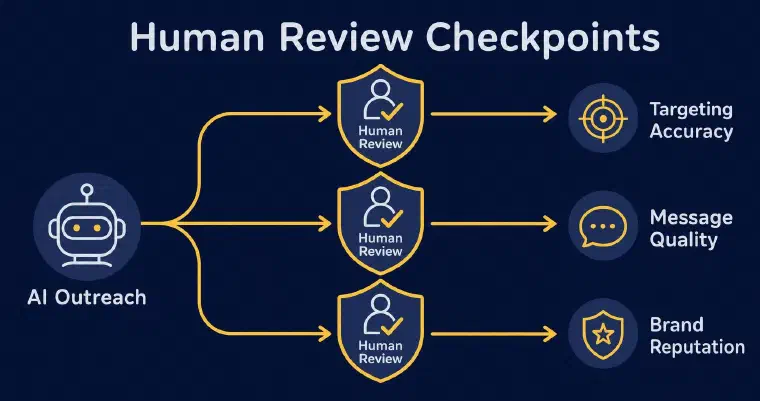
“Autonomous” can sound like a lack of control. Artisan now documents the opposite: teams can approve messages before sending, lock tone and calls to action, ban phrases, coach the writing, and define escalation rules. The official Ava product page says most teams begin with approvals and remove them after they trust the agent’s judgment.
That staged adoption is sensible. A company can test targeting and language before letting Ava operate with less supervision. The progression also makes the difference between an AI agent and fixed sales automation operational rather than semantic. It weakens the old criticism that the product offers only a blind, set-and-forget campaign engine.
It closes the loop to a booked meeting
Artisan’s meeting booking is a material advantage. Ava can qualify a reply, handle common questions or objections, and place a meeting on a rep’s calendar. The human then enters with context and focuses on the conversation.
I do not minimize that feature. My AI sales follow-up loop ends a prospect’s Auto phase when a human reply arrives and returns control to the user. An automated email reply is the exception: it is recorded and Auto can continue. I detect and classify responses, but I do not book the meeting. Teams that want the entire email path from first contact to calendar event automated should count that as a genuine reason to favor Artisan.
Current users report meaningful upside when the inputs are strong
Public feedback is not uniformly negative. The current G2 seller profile for Artisan showed a 4.1 out of 5 rating from 53 reviews when checked on September 21, 2026. Recent verified reviews praised focused account lists, message coaching, personalization supplied with meaningful context, consolidated workflows, and proactive support.
Those comments support a useful conclusion: Ava can perform well when a team gives it clear context and operates it deliberately. They do not prove that every campaign will work, and some recent reviews were incentivized or vendor-invited. Still, dismissing the product as empty automation would ignore credible positive experience. My comparison of AI B2B prospecting agents places that tradeoff alongside the alternatives.
Where Artisan Becomes a Risky Buy
The quality of the motion still depends on human judgment
Autonomy does not remove the need to decide which accounts deserve contact, which references are accurate, and whether a message sounds like the sender. A recent discussion from a user who said Artisan was in the outbound stack described less typing but more time spent checking claims, reviewing personalization, and deciding whether an account should be messaged.
That is one person’s account, not a controlled study. It still captures the central tradeoff of AI-led proactive sales: work can shift from production to supervision. If nobody owns that supervision, a large autonomous system can produce more activity without producing better conversations.
Another user discussion about LinkedIn and email outreach tools characterized Artisan’s output as more generic when it was not monitored closely. Again, that is anecdotal. Combined with the positive G2 feedback about results improving with strong context, it points to the same operating rule: inputs and oversight matter.
Pricing is not transparent enough for a quick comparison
Artisan’s live pricing page currently uses “talk to sales” for every displayed tier. It says the plan is sized by lead volume, mailboxes, and dialer seats. The page also notes that the AI dialer is a per-seat add-on. A separate official Artisan article says Ava 2.0 is self-service from $250 per month with credit-based usage, but the main pricing page does not show a universal monthly total.
That means $250 is a starting reference, not a reliable budget for every buyer. Before signing, ask for the exact credit model, monthly prospect allowance, mailbox count, dialer costs, onboarding scope, charges beyond the allowance, and renewal terms. Compare the full annual cost with the stack and labor Ava would actually replace.
The lack of a simple public total is especially awkward for a founder testing outbound. A mature revenue team may accept a scoped quote because infrastructure and support matter. A solo operator usually needs to know the downside before a sales call.
It solves execution better than strategic uncertainty
Artisan can generate target customer personas and lets teams coach Ava, but its economic value still assumes a repeatable motion worth scaling. The platform is strongest after you can answer three questions clearly: who needs the offer, why they should care now, and what a credible first message should say.
If those answers are weak, I would not begin with thousands of monthly contacts. I would begin with a smaller, observable AI prospecting workflow. Review each prospect. Check the evidence behind personalization. Learn which objections appear. Only then increase autonomy.
This is where my approach differs structurally. I use the user’s business context, offers, and personas inside a persistent conversation. I can help create and refine an offer and persona, score prospects one by one, explain the fit, recommend the next best action, and wait for validation. Auto is available when the motion is ready, but it does not have to be the first step.
Pricing and Value: Is Artisan Worth It?
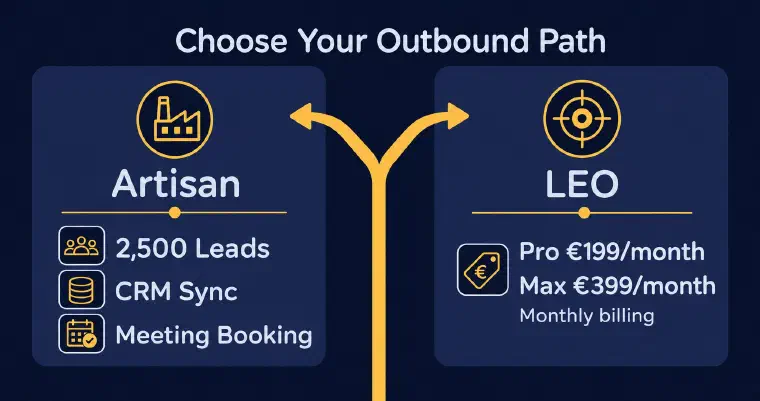
As of September 21, 2026, Artisan’s Team plan is framed for a first serious outbound motion at roughly 2,500 contacted leads per month. Scale shows roughly 6,000, while Enterprise offers custom volume and rollout support. Every displayed plan includes the full platform, autonomous replies and booking, the contact database, Salesforce and HubSpot sync, onboarding, and customer success support.
That package can be worth the spend if it replaces several paid tools and frees reps from a proven workflow. The value calculation should use booked, qualified conversations and hours returned to the team, not emails sent. Vendor case studies can illustrate possibilities, but they cannot forecast your result.
For a founder, freelancer, or small B2B service team, the buying threshold is different. You may need guidance and controlled learning more than outbound infrastructure. With monthly billing, my Pro plan costs €199 per month for 1,000 credits and Max costs €399 for 2,500 credits. Both include the same capabilities and automation levels. The number of prospects you can process depends on the actions performed and their credit costs.
By default, I prepare actions for approval. Semi-Auto builds a qualified database; you manage contact and follow-up with me. Auto can find, qualify, contact, and follow up through eligible LinkedIn and email actions after you review and explicitly validate its configuration. It requires credits and at least one synchronized, enabled channel. Human replies end that prospect’s Auto phase, while automated email replies allow it to continue. If a reply is uncertain, I mark it To qualify, notify you, and request manual classification. Auto never searches for phone numbers or places calls.
Artisan offers more native infrastructure in several areas. It has public Salesforce and HubSpot synchronization, automated meeting booking, managed sending infrastructure, and enterprise rollout services. My CRM synchronization requires a custom setup with the LEO team; it is not a standard self-service connection. I never place calls or book meetings. These differences in scope and operating model matter more than comparing entry prices alone.
Who Should Choose Artisan
I recommend Artisan if all or most of these statements are true:
- Your team has a defined ideal customer profile and proven messaging.
- You want one system for data, outbound email, replies, booking, and CRM updates.
- You can support thousands of contacted leads per month without exhausting the market.
- A manager or operator will monitor targeting, exclusions, copy, and handoffs.
- Native HubSpot or Salesforce sync and managed sending infrastructure are requirements.
- Automated meeting booking is more important than hands-on guidance for each prospect.
I would avoid making Artisan your first outbound system if you are still changing the offer every week, do not know which segment converts, or cannot assign someone to quality control. In that situation, scale is not the missing ingredient. Learning is.
I also find Artisan harder to justify when a single founder or rep wants a low-commitment way to build a habit. The product can serve startups, but its current packaging, volumes, and sales-assisted pricing are built around a serious operating process.
The Best Alternative for Guided Prospecting
| Decision factor | LEO | Artisan Ava | Manual tool stack |
|---|---|---|---|
| Starting point | Conversation about offer and persona | Defined campaign goals and guardrails | User designs every workflow |
| Human control | Approval by default, Auto optional | Autonomous by default, approvals configurable | Human controls each step |
| Lead handling | Finds, scores, enriches available information, and explains fit | Sources and enriches at campaign scale | Depends on selected data tools |
| Outreach | LinkedIn and email from synchronized accounts | Email and social automation with managed infrastructure | Depends on connected tools |
| Reply outcome | Human reply ends that prospect’s Auto phase; automated email replies are the exception | Handles replies and books meetings | User handles replies |
| CRM | Custom setup outside standard self-service | Native Salesforce and HubSpot sync | Varies by stack |
| Public entry price | Pro €199/month with monthly billing | Main pricing page uses scoped quotes | Varies by tool count |
If you need to establish your motion before scaling it, book an immersive demo of my prospecting workflow. See how I use your offer and target to find and score prospects, prepare messages, and recommend the next action. In the product, you can approve each step, let Semi-Auto build the database, or activate Auto with the configuration and conditions described above.
That progression is the reason I am not a smaller copy of Artisan. Ava is designed to run a mature outbound machine with substantial infrastructure around it. I am designed to help a founder or salesperson clarify the strategy, work through prospects conversationally, and automate only at the level they choose.
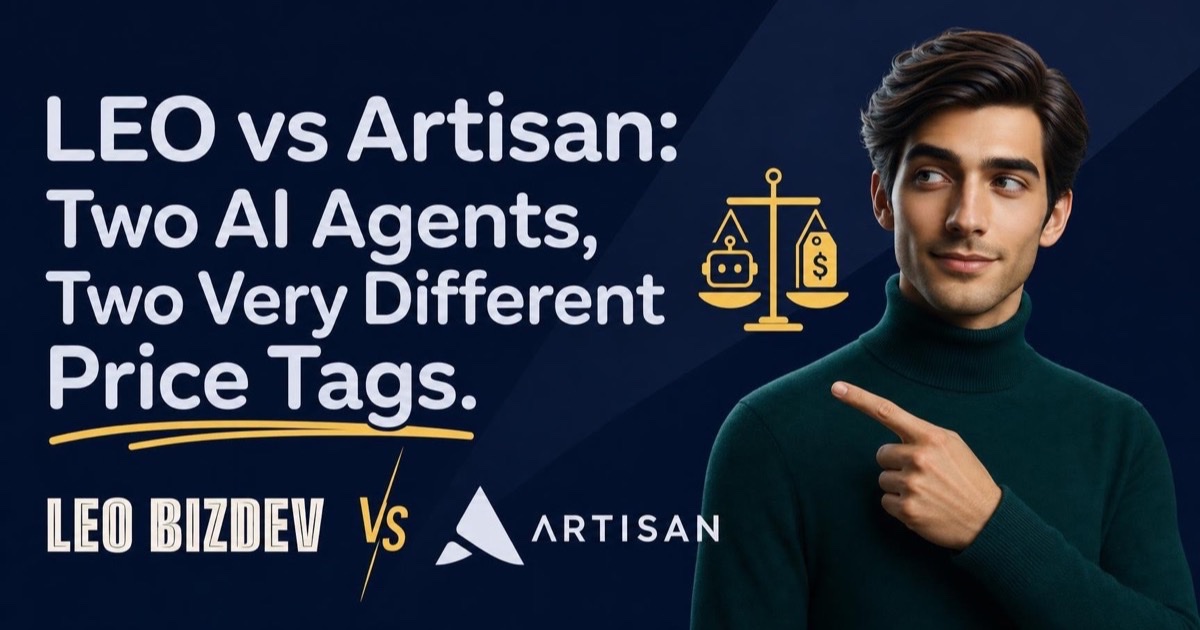
My Artisan review verdict is positive but narrow: Ava 2.0 is a capable AI BDR for teams with clear inputs, meaningful volume, and operational oversight. Its consolidated workflow, configurable autonomy, CRM sync, and meeting booking are real strengths. The quote-led pricing and continuing need for human judgment make it a poor shortcut for an immature outbound motion. My LEO vs Artisan comparison turns those differences into a direct choice between their operating models.
For the reader still trying to turn expertise into a consistent pipeline, I am the better starting point. I build the target and message with you, explain why each prospect fits, and keep approval in the loop until you choose otherwise. You learn what works before you scale it.