
This clay review covers what the platform actually delivers in 2026, where the experience falls short, and whether the March pricing overhaul changes the calculus for the teams most likely to be evaluating it. Clay has $100M ARR, a $3.1B valuation, and OpenAI as a customer. The reputation is real and largely earned, with a narrower audience than the LinkedIn buzz suggests.
What Clay Does and Who It’s Built For
Clay is not a prospecting tool. It’s a data enrichment and workflow automation platform, what the company calls “the IDE for GTM.”
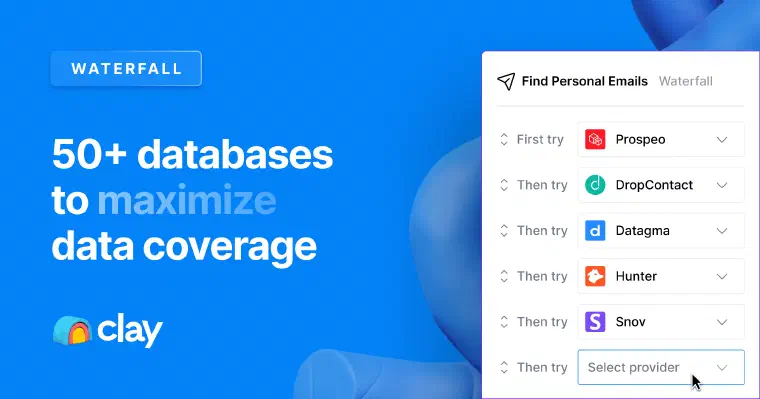
The core mechanic is the enrichment waterfall: you build a table of contacts or companies imported from LinkedIn Sales Navigator, a CSV, or a CRM export, then add columns that cascade through multiple data providers in sequence. Apollo first. If Apollo doesn’t return an email, query Hunter. If Hunter fails, try Clearbit. Clay charges a credit only when a value comes back, which is how it achieves email match rates above 80%. That’s a genuine step up from relying on any single provider alone.
Clay connects to 150+ data sources as of mid-2026: ZoomInfo, Lusha, Clearbit, Crunchbase, BuiltWith, Bombora, and a long tail of specialty providers. Claygent, its AI web research agent, goes further by scraping public buying signals like LinkedIn posts, funding announcements, job openings, and press mentions that standard databases don’t capture. A newer version, Claygent Navigator, adds vision-based website crawling.
Who is this actually designed for? Clay’s own material is direct about it: RevOps managers, GTM Engineers, and VP Sales at growth-stage B2B SaaS companies. Getting genuinely productive takes 4-6 weeks and requires someone comfortable with spreadsheet logic, conditional branching, and API connections. The free tier gives you 100 credits, enough to understand what you’re dealing with, not enough to run a real campaign.
What’s Good About Clay
The waterfall enrichment genuinely delivers on coverage
No single data provider covers every contact. Apollo is strong on US tech companies. Clearbit fills European company data better. Hunter fills gaps in individual email formats. Clay sequences through all of them in one table and only bills when a value comes back.
Independent tests across multiple 2026 reviews put Clay’s email match rates at 80-96% on standard B2B contact lists, depending on target geography and industry. Compared to running Apollo alone (typically 60-75% match rate), that gap translates into real pipeline at scale. This is Clay’s clearest, most defensible advantage, and the one that justifies the complexity for teams equipped to handle it.
150+ integrations can replace a fragmented data stack
A RevOps team running serious outbound before Clay typically maintained four to six separate data subscriptions (Apollo, Lusha, Clearbit, BuiltWith, Bombora) at $2,000-$5,000/month in combined spend. Clay consolidates that into one credit pool, one contract, and one workflow. I cover the enrichment problem in more depth in my B2B lead enrichment guide, but the short version: for teams already paying multiple vendors, the cost consolidation math often works in Clay’s favor before you account for the workflow automation layer.
Claygent adds buying signals databases can’t surface
A company posting five senior sales job openings this week is a better prospect than the same company that went dark for six months. Claygent captures that signal from LinkedIn activity, job boards, press mentions, and funding announcements, then turns it into a usable enrichment column in your table.
This is genuinely hard to replicate manually and meaningfully improves targeting precision when used well. The trade-off: Claygent queries are slower than database lookups and consume more credits per row, which matters at scale.
What’s Not Great About Clay
The learning curve is real, and the credit model makes mistakes expensive
28% of negative Clay G2 reviews cite the learning curve as the primary frustration. Clay’s Trustpilot score sits at 2.2/5 (as of July 2026), which primarily captures the experience of founders and individual SDRs who signed up after seeing Clay on LinkedIn and found a product far more complex than expected.
The spreadsheet interface looks approachable. Building multi-step waterfall logic with conditional branching, AI-generated copy columns, and CRM sync requires skills most salespeople don’t have and shouldn’t need to develop. The problem compounds because the credit model charges for failed lookups: every enrichment attempt that returns no data still consumes a credit. Multiple users across 2026 reviews report burning $800-$1,000 in a single week during the learning phase.
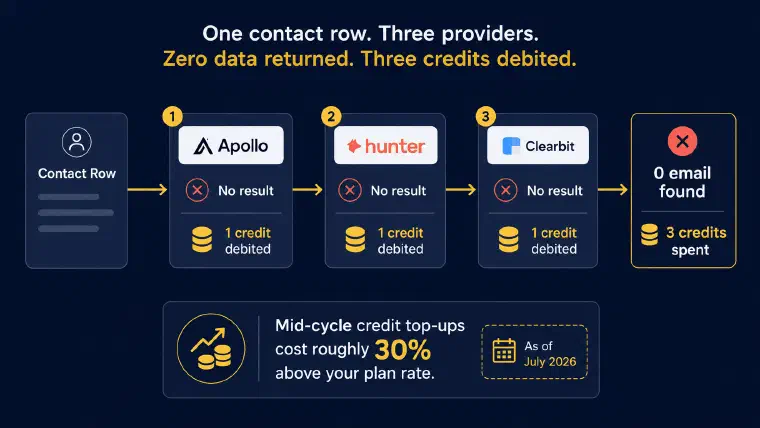 Mid-cycle credit top-ups cost roughly 30% above your plan rate (as of July 2026).
The underlying issue is the operator requirement. Clay’s community structure reflects this honestly: a 2,500-alumni GTM Engineering bootcamp and a 60+ chapter Clay Club network exist because Clay requires a trained specialist to produce consistent results. If your team doesn’t already have that person, you either hire one (RevOps engineers cost $100,000-$180,000/year in the US) or engage a Clay agency partner. Neither cost appears in the plan price.
No real-time signal flows, and performance degrades at scale
Signals in Clay are captured on a once-per-day cadence. For teams that want to trigger outreach within hours of a job change, a funding announcement, or a company mention, that lag is a real constraint. Fast-cadence workflows that depend on near real-time buying signals need additional tooling or workarounds outside Clay’s native setup.
Performance at scale is a separate problem. Users running large datasets (tables with 50,000+ rows and multiple enrichment columns) report significant lag. Workflows that run cleanly at 5,000 rows start timing out or slowing noticeably at 40,000+. For the enterprise buyers Clay targets, this is a known tradeoff that dedicated operators manage through batching and scheduling. For teams that don’t have that expertise, it surfaces as reliability issues with no obvious fix.
There’s also no collaboration infrastructure: no commenting, no version control, no team workflow management. Two operators working on the same table can overwrite each other’s logic, and there’s no audit trail for what changed and when.
Clay is the data layer, and adding execution means adding tools
Clay launched a native email sequencer in late 2025, which reduces one integration point. LinkedIn outreach is not natively supported. Most operators still push enriched lists to Instantly, Smartlead, or HubSpot Sequences, adding another $100-$300/month to the stack.
The practical math for a small team (as of July 2026): Clay Launch ($167-$185) + email sequencer ($100-$200) + CRM ($50-$150) = $317-$535/month at minimum before counting operator time. Teams running meaningful outbound volume with a proper operator typically land at $1,000-$3,000+/month all-in. Phone number coverage adds another gap worth naming: mobile match rates run around 30-35%, which matters for teams running multi-channel sequences that include cold calling.
Clay Pricing in 2026: What You Actually Pay
Clay overhauled its pricing in March 2026, replacing several legacy tiers with two self-serve plans (pricing verified July 2026 at clay.com/pricing):
| Plan | Price/month | Data Credits | Row Actions | Key limits |
|---|---|---|---|---|
| Free | $0 | 100 | 500 | 200 rows/table max |
| Launch | ~$167-$185 | 2,500 | 15,000 | 50,000 rows/table |
| Growth | ~$446-$495 | 6,000 | 40,000 | CRM sync, intent signals, HTTP API |
| Enterprise | Custom | 100,000+ | Custom | SSO, RBAC, data warehouse, dedicated CSM |
All plans include unlimited seats. Pricing scales by usage, not headcount, which favors larger teams. Unused credits roll over up to 2x monthly allocation on paid plans; they don’t carry forward indefinitely.
The number that matters for the decision is total cost of ownership: plan + sequencer + CRM + operator time or agency fees. For most companies under $5M ARR without an existing RevOps function, that number exceeds $2,000/month before a single sequence runs.
Who Should Use Clay
Clay delivers on its promise for specific, well-defined profiles. Here’s what that looks like in practice.
A Series B B2B SaaS company with a head of RevOps and two GTM Engineers, running 1,500+ prospects per month across three geographies, is the clearest fit. They have the technical staff to build and maintain waterfalls, the volume to justify the credit spend, and an existing sequencer to connect the output. For that team, Clay’s 80%+ match rate and multi-provider consolidation translates directly into pipeline.
A sales agency building enriched, personalized lists for five clients simultaneously is another strong fit. Clay’s unlimited seat model and workflow flexibility handle multi-client logic that would break a single-provider tool.
A technical founder at a VC-backed startup, comfortable with spreadsheets and APIs, who wants to build an outbound machine before hiring a first sales hire, can make Clay work. The 4-6 week setup phase is real and the credit burn during learning is non-trivial, but the payoff is there if the volume follows.
The profiles that consistently struggle: solo founders at consulting or recruitment firms who need to start prospecting this week; individual SDRs without a RevOps function behind them; and B2B service companies where defining the offer and the persona is itself part of the prospecting challenge. Clay assumes you’ve already done that work before you open the table. If you haven’t, my guide on AI prospecting for startups covers how to validate that offer and persona before committing to any enrichment infrastructure.
The Trustpilot score of 2.2/5 (as of July 2026) is not random. It reflects the gap between Clay’s marketing reach and its actual addressable audience. The practical line: if you would need to hire someone specifically to run Clay, the math rarely works for companies under $5M ARR.
The Alternatives, Including LEO
| Clay | LEO | Apollo | Sales Navigator | |
|---|---|---|---|---|
| What it does | Enriches and researches leads | Finds leads, writes messages, executes outreach | Sources + enriches contacts | Searches LinkedIn contacts |
| Standalone | No, sequencer required | Yes, LinkedIn + email native | Partial, sequencer included | No, data only |
| User requirement | RevOps / GTM Engineer, 4-6 weeks | Any founder or SDR, day one | Moderate, 1-2 weeks | Minimal |
| Entry price | Free (100 credits only) | Pro: €199/month per User seat, monthly billing | Free (limited) | $99/month |
| Real all-in cost | $1,000-$3,000+/month (as of July 2026) | Subscription only: Pro: €199 / Max: €399 per User seat/month, monthly billing | $49-$99/month | $99/month + CRM |
| Email match rate | 80-96% (waterfall) | Enrichment included | 60-75% | LinkedIn data only |
| LinkedIn outreach | Not supported | Native | Limited | Manual |
| Setup time | 4-6 weeks | Minutes | 1-2 weeks | Hours |
The most common head-to-head is Clay versus Apollo: enrichment depth versus ease of execution. My Apollo review covers that tradeoff directly. The short version: Apollo is significantly easier to operate at the cost of lower match rates; Clay wins on data breadth when a trained operator is running it.
A different kind of comparison is Clay versus LEO: that question isn’t about enrichment depth but whether you need enrichment infrastructure at all, or an agent that prospects for you. For that broader question, I scored the leading AI B2B prospecting agents against each other on the same five criteria.
If you’re prospecting yourself (as a founder, an SDR, or a sales manager without a RevOps function), book an immersive demo of LEO: discover examples of prospects and messages I can prepare for your business. No waterfall to build, no sequencer to connect, no four-week onboarding.
Clay and LEO are not in the same category. Clay is infrastructure: you design the enrichment system, train the operator, manage the credits, and wire output into downstream tools. I do the prospecting. You don’t build anything.
Clay is one of the most technically impressive GTM products built in the last five years. The waterfall enrichment outperforms any single-provider alternative, Claygent surfaces buying signals standard databases miss entirely, and the $3.1B valuation is backed by real revenue from enterprise customers who have the RevOps muscle to use it properly. The honest limitation is just as significant: Clay delivers on its promise only when a qualified operator runs it continuously. For the majority of B2B professionals who prospect themselves, the gap between Clay’s capability ceiling and what’s practically accessible makes it the wrong tool for the job, regardless of how impressive the ceiling is.
That’s the gap I built LEO to close. I skip the waterfall entirely: no failed-lookup tax, no operator to hire, no four-to-six week ramp before your first message goes out. If you’re the founder or SDR Clay wasn’t built for, describe your business and target and I turn that into running outreach the same day, not the same quarter. For the fuller breakdown of where each tool actually wins, read my LEO vs Clay comparison.