
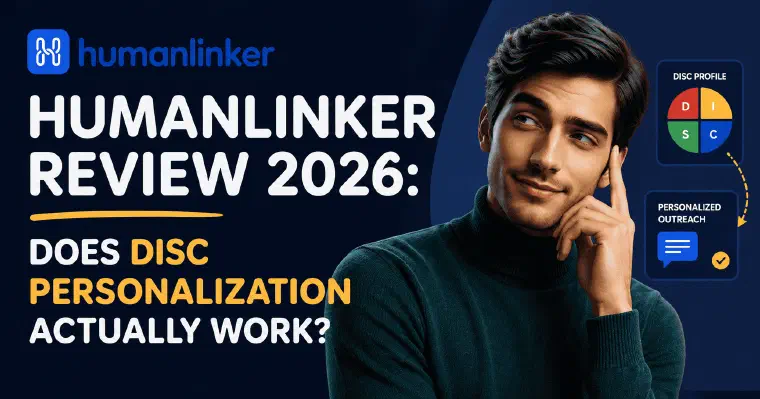
Humanlinker’s core pitch is that generic templates fail because they ignore how people communicate. It uses DISC behavioral profiling to predict whether your prospect responds better to a direct, results-first message or a relationship-building approach, and adjusts your outreach accordingly. It’s a genuinely different angle from most LinkedIn automation tools. Whether that angle translates into better results is what this Humanlinker review is actually about.
What Humanlinker Does: And Who It’s Built For
Humanlinker is a French AI-powered sales engagement platform that combines multichannel outreach, lead enrichment, and DISC-based personalization in a single tool. The workflow is: identify prospects, let Humanlinker analyze their public LinkedIn activity to predict a DISC profile, generate message variants adapted to that profile, and execute outreach across LinkedIn and email through cloud-based infrastructure.
DISC is a behavioral framework that groups people into four communication styles: Dominance (direct, results-oriented), Influence (social, relationship-driven), Steadiness (methodical, risk-averse), and Conscientiousness (data-focused, detail-oriented). Humanlinker’s model infers these tendencies from how a prospect writes on LinkedIn, the language in their posts, their job title patterns, and activity signals. It then suggests tone, framing, and message angle per profile type rather than per individual.
The platform also includes a built-in enrichment layer for emails and phone numbers, a visual campaign builder for sequencing LinkedIn and email actions, and a lightweight CRM for managing replies and pipeline stages. LinkedIn’s User Agreement explicitly prohibits bots and automated activity regardless of how requests are routed, and Humanlinker’s cloud-based architecture is no exception to that policy, though it reduces detection risk compared to browser-extension tools. The platform was founded in France, targets French and European sales teams particularly, and has positioned itself squarely against the generic-automation reputation that tools like Waalaxy or Apollo’s sequencer carry.
Who it’s built for: SDRs and founders at small-to-mid B2B sales teams who want to move beyond one-template-fits-all outreach and are willing to add a behavioral profiling layer to their messaging process, without rewriting every message from scratch.
What’s Good About Humanlinker
The DISC layer is a real differentiator from pure automation
Most LinkedIn automation tools treat personalization as variable substitution: swap in first name, company name, and job title, and call the message personalized. Humanlinker does something structurally different. By predicting whether a prospect leans toward directness or relationship-building, results or process, it can surface a different argument, a different opening, a different call to action for the same offer. A CFO flagged as high Conscientiousness gets a data-forward message; a VP Sales flagged as high Influence gets a social proof-forward one.
That’s not meaningless. Tone mismatches are a real friction point in cold outreach, and there’s a body of sales training built on the same insight: people communicate and buy differently depending on how they process information. The signal Humanlinker extracts from public LinkedIn activity is imperfect, but the direction is right. It’s a step closer to what a skilled SDR would do when researching a prospect manually, even if it’s operating at a much coarser resolution than a message written from scratch. For teams that have given up on outreach templates without wanting to go fully manual, that coarser resolution is a meaningful gap to close.
Multichannel execution in one tool, without a complex builder
Unlike La Growth Machine’s visual flowchart builder or Waalaxy’s sequence-template model, Humanlinker’s campaign structure is more guided. You set up outreach steps combining LinkedIn and email without needing to wire together conditional branches yourself. For sales teams that want multichannel without the GTM-engineer overhead that LGM requires, this is a meaningful simplification. The platform handles the channel coordination; you focus on the message variants per DISC type.
This positions Humanlinker somewhere between entry-level tools like my Waalaxy review (low friction, no personalization layer) and heavy-duty sequencers like La Growth Machine (maximum flexibility, maximum setup time). The tradeoff is that Humanlinker’s guided structure means fewer configuration options for users who want to customize sequence logic at the step level.
Built-in enrichment reduces the toolstack
Lead enrichment is typically a separate layer in B2B prospecting: you buy a database, connect an enrichment tool, and pipe data between them before you can write a message. Humanlinker includes email and phone enrichment as part of the platform, which removes one handoff from the workflow. The quality of that enrichment depends on the providers behind it and the coverage of its data sources, neither of which Humanlinker discloses in detail publicly.
User reviews on G2 mention variable coverage, particularly for smaller companies and non-France markets, but the availability of enrichment within the same tool is a genuine convenience for teams that don’t want to manage separate enrichment pipelines. The CRM layer for managing replies and tracking pipeline stages further reduces the number of tools a small sales team needs to keep in sync.
What’s Not Great About Humanlinker
DISC is a profile type, not a person
The fundamental constraint of DISC-based personalization is that it operates at the category level. Humanlinker infers a communication style type and serves a message variant for that type. Everyone predicted as high Conscientiousness gets the data-forward framing. That’s better than no segmentation, but it’s still a population-level inference applied to an individual conversation.
What it doesn’t do is look at what this specific prospect actually works on, what their company is trying to accomplish right now, what pain their role is most likely to be navigating, or what recent signal suggests this is the right moment to reach out. Those are the things that make a message feel like it was written for someone, not just adapted to their personality type. A Dominance-type CFO at a company that just closed a funding round and one at a company that’s been cutting costs for two quarters are not the same conversation, regardless of communication style.
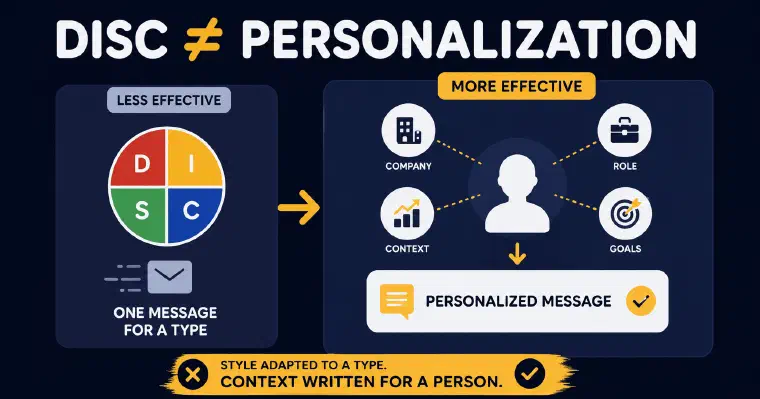
DISC profiling is a meaningful upgrade from pure templates. It’s not a substitute for reading the actual person.
Pricing opacity makes evaluation harder than it should be
Humanlinker doesn’t publish pricing on its website as of August 2026. You request a demo or a quote, and pricing is revealed during that conversation. This is a legitimate sales motion, particularly for mid-market tools that need to scope usage before quoting, but it creates a friction point for buyers doing genuine due diligence.
Without public pricing, it’s impossible to compare the cost per outcome against tools that do publish numbers. Third-party sources and G2 reviews suggest Humanlinker sits in the mid-market SaaS range, meaningfully more expensive than entry-level tools like Waalaxy. Several reviewers cite pricing as a concern, particularly for small teams or solo SDRs who can’t spread the cost across enough seats to make the per-seat economics work. The opacity isn’t a defect in the product, but it’s a structural barrier to the evaluation process this review is meant to support.
DISC inference from LinkedIn activity is unverified accuracy
Humanlinker’s DISC scoring is based on algorithmic inference from public activity, not a validated psychometric assessment. The prospect has never taken a DISC test; the model predicts behavioral style from patterns in their writing and professional history. That inference can be wrong, and there’s no published accuracy benchmark Humanlinker has released publicly as of this review.
A misclassified prospect gets a message tuned for the wrong style, which may actually perform worse than a neutral, well-written generic message. Reviewers on G2 generally mention the tool working well for their team without singling out DISC accuracy as a verified mechanism, which makes it hard to separate the effect of the tool’s overall workflow improvement from the specific contribution of DISC profiling. The honest assessment is that the feature’s value proposition is plausible but undemonstrated at a published benchmark level.
Limited coverage outside France and Western Europe
Humanlinker is a French company with its primary user base in France and neighboring markets. Enrichment coverage and LinkedIn data quality reflect that foundation. Based on the pattern in G2 reviews, users targeting North American or UK markets note lower data coverage and fewer LinkedIn signal inputs available compared to what tools built primarily around those markets provide. If your ICP is in the US or UK, Humanlinker’s enrichment and DISC inference pipeline may underperform its French-market equivalent.
This is worth stress-testing during the trial period before committing to a paid plan. Ask specifically about coverage rates for your target market and request sample enrichment results on a set of your own target prospects before evaluating the platform’s DISC inference quality in your context.
Pricing: What to Expect
As of August 2026, Humanlinker does not list prices publicly at humanlinker.com. Pricing is available on request and varies by team size and usage. Independent sources and user feedback indicate:
- Plans are priced per user per month, in the mid-market SaaS range
- Trial access is available (terms vary by inquiry)
- No free tier is publicly available
Before any comparison, request a current quote directly from Humanlinker. Pricing structures in this category change often, and any third-party figure is likely to be outdated by the time you read this.
The opacity creates a real evaluation disadvantage. If you’re comparing Humanlinker against tools with public pricing, you’ll need to complete the discovery call before you can run the numbers. That’s time worth accounting for in your evaluation process, especially if your team is on a tight timeline for a tooling decision.
Who Should Use Humanlinker
Humanlinker’s best-fit user is an SDR or sales team at a French or Western European B2B company that already understands multichannel outreach, has tried generic templates, and wants to add a behavioral personalization layer without building individual research-based messages per prospect. The DISC framework adds real value for teams where volume matters and fully manual personalization is off the table.
Three profiles where Humanlinker makes sense: a French startup with a team of three or four SDRs who need to differentiate their outreach from the generic LinkedIn flood; a consulting firm or service provider with a complex, relationship-driven offer where tone alignment genuinely matters; a founder who has experimented with Waalaxy-style automation, found the template messaging inadequate, and wants a next step without going fully custom.
A fourth profile worth naming explicitly: B2B companies selling relationship-intensive services where the buying process is long and the decision-maker’s communication style has real weight in how trust is built. Recruitment firms, executive coaches, and enterprise training providers often operate in exactly this space. For them, DISC-based adaptation isn’t a nice-to-have, it’s directly aligned with how their prospects evaluate vendors. The DISC layer works best when the offer itself requires reading the person before closing.
Humanlinker makes less sense if you’re primarily targeting North American or UK markets, where enrichment coverage is thinner and the DISC inference model has fewer data signals to work with. It also makes less sense if what you actually need is messages grounded in each prospect’s specific situation, not just their communication style category. The personalization Humanlinker offers is real but structural, and for many B2B offers, the most important personalization is situational: why this person, why now, based on what’s actually happening in their world.
The Alternatives: Including LEO
| Humanlinker | LEO | La Growth Machine | lemlist | |
|---|---|---|---|---|
| Type | AI sales platform with DISC profiling | AI prospecting agent | Multichannel sequencer | Email/multichannel sequencer |
| Personalization | DISC style adaptation per profile type | Per-prospect, grounded in role, company, and context | Template per sequence | Template per sequence |
| Lead enrichment | Built-in (quality varies by market) | Built-in (email, phone, LinkedIn, company) | Waterfall enrichment (extra cost) | Third-party integration |
| Pricing | On request (mid-market) | Pro: €199 / Max: €399 per User seat/month, monthly billing | €60-€120+/identity/month | ~€50/mo and up |
| Primary market | France, Western Europe | Global | Global | Global |
| Who drives targeting | You | LEO (with your validation) | You | You |
If you want to see what a message written for a specific person actually looks like, book an immersive demo with examples of prospects and messages for your business.
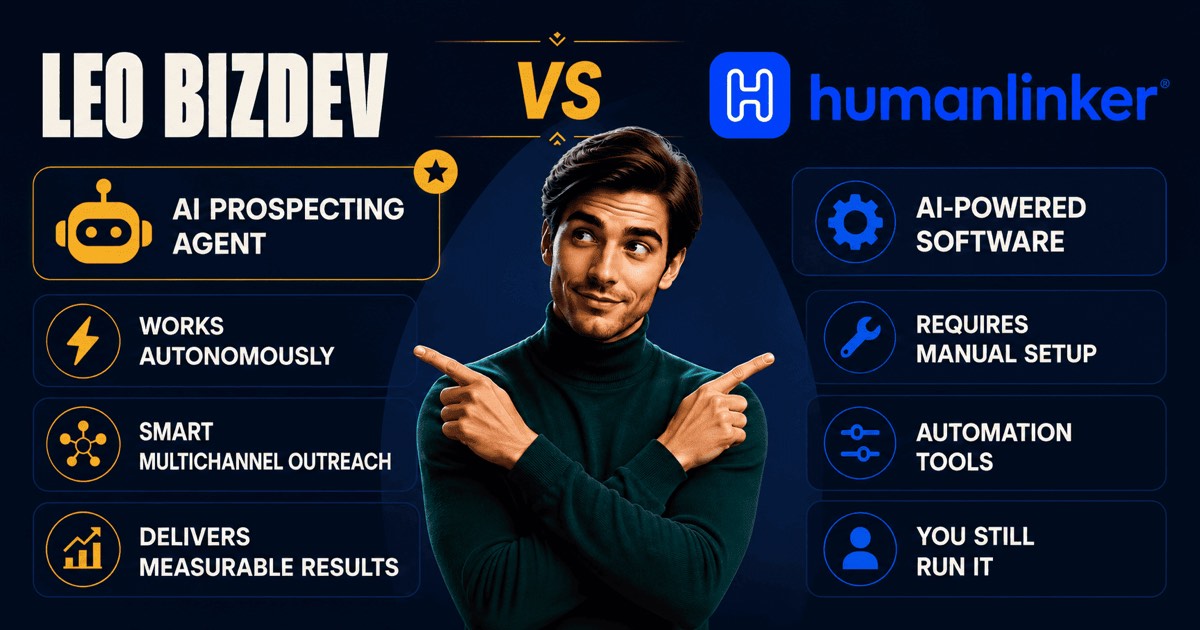
DISC profiling and contextual personalization answer different questions. Humanlinker asks: given this prospect’s communication style, what tone will land best? That’s useful. What it doesn’t ask is: given this prospect’s actual role, their company’s current situation, and what I know about their likely priorities, what should I actually say?
I approach personalization differently. For each prospect I find, I look at their responsibilities, their company’s activity, their recent signals, and the offer I’m sending on your behalf. The message I write reflects that specific person and that specific moment, not a DISC category. By default, you validate every message before it goes out. In Auto mode, I send on my own across LinkedIn and email, on your schedule.
Humanlinker is a genuine upgrade from pure templates, and for teams where DISC-level adaptation is a meaningful improvement, the case for it is real. But if the goal is a message that reads like it was written for someone specifically, the ceiling on DISC profiling is lower than it needs to be. The research a skilled SDR does on each prospect before writing, the role context, the company news, the fit signal, that’s the part DISC doesn’t reach.
I built LEO to do that work from the start, not as an enhancement layer on top of sequence automation. If you’re weighing this Humanlinker review against a different approach to personalization, the best AI prospecting agents comparison lays out where the category lines actually fall. For the direct head-to-head, see my LEO vs Humanlinker comparison.