

If you are looking for an 11x Alice alternative, you probably want autonomous prospecting without hiring another sales development representative. The harder question is how much infrastructure, volume, and commitment you need before that autonomy becomes useful.
Alice is a credible system for established revenue teams. She combines prospect data, research, managed email infrastructure, multi-channel sequences, reply handling, and CRM synchronization. I take a different route: I help a founder or lean sales team define the offer, choose the target, find and score prospects, then contact them through LinkedIn and email with either approval or automation. You can choose Pro at €199 per month with monthly billing rather than an annually billed plan listed at $3,750 per month. These are different scopes, not equivalent team packages. The same 11x page also says $36,000 per year in its FAQ, so buyers need to confirm the contractual amount.
| Decision point | 11x Alice | Me, LEO |
|---|---|---|
| Best fit | Established sales, marketing, and revenue operations teams | Founders, consultants, agencies, and lean sales teams |
| First setup | CRM, sending domain, knowledge base, ICP, and sequence | Guided conversation about your business, offer, persona, and preferences |
| Prospect volume | Growth includes 2,000 new prospects per month | Depends on actions performed within 1,000 Pro or 2,500 Max monthly credits |
| Decision model | Executes a configured multi-channel play across an ICP | Chooses a next action from each prospect’s context and history |
| Channels | Email, LinkedIn, consented phone, SMS, and WhatsApp | LinkedIn and email in Auto, with call scripts for manual use |
| Starting price | $3,750 per month, billed annually | Pro €199 per month with monthly billing; a User seat per workspace |
11x has the broader enterprise channel set. It also includes managed mailboxes and bi-directional CRM synchronization on Growth. Those are real advantages when outbound is already a defined operation. They are expensive overhead when you are still proving whom to target, what to say, and whether consistent prospecting fits your business.
If that second situation sounds familiar, you can book an immersive demo of my prospecting workflow.
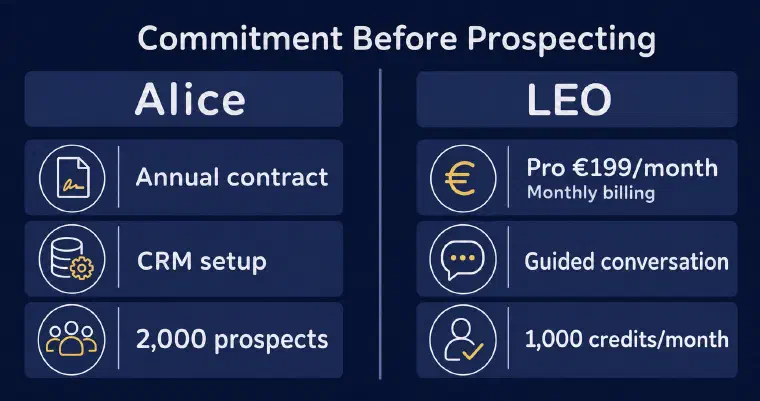
Alice requires an outbound deployment; I begin with one conversation
11x’s setup documentation asks an administrator to connect Salesforce or HubSpot, authenticate a sending domain through DNS, build a knowledge base, define an ideal customer profile (ICP), configure a sequence, and review it before launch. The pricing documentation lists a standard two-week onboarding period for Growth. That process makes sense for a team that has a CRM, domain access, product materials, and an owner for the deployment.
It also exposes the first buying difference. Alice does not remove the need to define the outbound system. She executes it after the team supplies its target, knowledge, exclusions, infrastructure, and sequence design.
I begin inside a guided conversation. I collect your business context from your website, LinkedIn profiles, documents, and notes. I help turn that context into an offer and a precise target persona with target roles, industries, pains, commercial objective, message tone, and channel preferences. You review those foundations before I look for prospects. No CRM connection is required to define the strategy, find and enrich people, or prepare messages for manual sending.
For a revenue operations team that manages sales systems and processes, 11x’s deployment can be an asset. For a founder who has no outbound operator, I remove more of the work that comes before the first campaign. My advantage is not simply faster setup: I make offer and target clarity part of the prospecting product rather than a prerequisite you must solve elsewhere.
Alice scales a defined ICP; I test fit against your offer prospect by prospect
Alice’s official overview says she identifies prospects from live signals such as job changes, funding, hiring, technology adoption, website visits, and review-site research. A qualification agent checks fit before outreach. Deep research then combines public, social, and engagement data with the customer’s knowledge base. This is serious targeting infrastructure, especially for a team whose ICP and proof points are already stable.
The pricing model reinforces that use case. Alice Growth includes 2,000 new prospects per month. A buyer is paying for sustained outbound coverage at scale, not a small experiment.
I evaluate each prospect against both the persona and its attached offer. I score fit from one to five stars and explain the score. In guided discovery, profiles scoring three stars or more wait for your validation before enrichment and addition to the prospect database. Lower-scoring profiles remain visible and can be rescued. In Semi-Auto and Auto, the minimum score is configurable. Enrichment uses available information. You can also maintain priority companies and a shared company blacklist.
That slower-looking decision loop is valuable for a high-ticket B2B service, a specialist agency, or a founder with a nuanced offer. The question is not only whether a person matches company-level criteria such as size, industry, and location. It is whether their situation makes the offer relevant enough to justify contact.
Public feedback supports keeping that distinction visible. G2’s 11x review page showed a 4.4 out of 5 rating from 31 reviews when checked for this article. Its review summary praised ease of use, support, prospecting, and time savings, while also noting setup time and fine-tuning. One March 2026 reviewer liked Alice’s research and messaging but said small campaigns sometimes needed more personal treatment. These are user experiences, not controlled performance evidence. They show that strong automation still depends on the input and use case. I examine that evidence and the wider operating tradeoffs in my full 11x Alice review.
Alice wins when a mature team wants more coverage across a known market. I am the better choice when the offer and target must remain connected in every qualification decision, especially before volume is proven.
Alice follows a configured play; I recalculate what each prospect needs next
Alice’s documentation describes a reusable sequence builder with channels, order, delays, and exit conditions. She can classify replies, draft responses, escalate cases that need a person, and book meetings. A sequence can combine email, LinkedIn, consented calling, SMS, and WhatsApp. That reach is broader than mine.
My edge is the control model. By default, I recommend the best next action, prepare it, and wait for your approval. Semi-Auto discovers, qualifies, and enriches prospects without contacting them; you manage contact and follow-up. Auto adds eligible LinkedIn and email outreach, follow-up, reply detection, and reply classification. Before automation begins, I propose the personas, score threshold, daily prospect volume, authorized channels, message limit, timing, and exclusions for you to review and explicitly validate. You can adjust the configuration later. Auto requires credits and at least one synchronized, enabled channel.
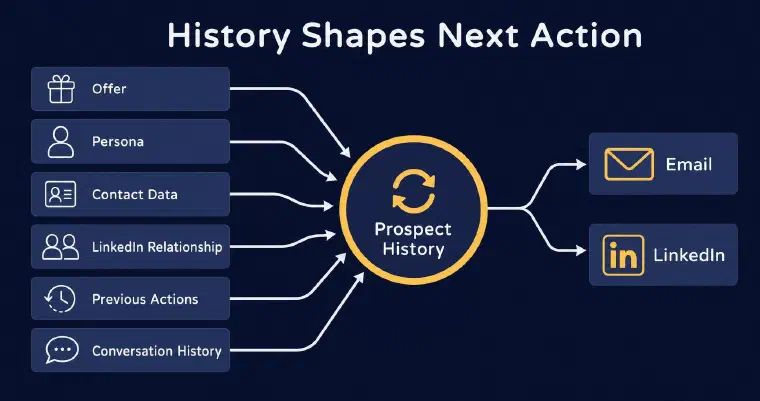
Then I work from each prospect’s current state. I consider the offer, persona, available contact data, LinkedIn relationship, previous actions, and conversation history before selecting the next action. A human reply immediately ends that prospect’s Auto phase and returns control to you. An automated email reply is recorded but allows Auto to continue. If classification is uncertain, I mark the reply To qualify, notify you, and ask for manual classification. A bounce invalidates the address rather than allowing another email action to use it.
This is a narrower autonomous system than Alice. It also gives a founder or small team a choice in how to manage automation. You can review targeting and messages with approval, choose Semi-Auto for discovery, or activate Auto for eligible LinkedIn and email execution without rebuilding your prospect history. Passing through Semi-Auto is not required. I offer adjustable autonomy rather than a multi-channel sequence to design upfront.
Alice covers more channels; I focus the handoff where lean teams can act
The strongest reason to choose Alice is channel breadth. According to 11x’s current product documentation, she can engage across email, phone, LinkedIn, SMS, and WhatsApp in more than 105 languages. Growth also includes managed Gmail mailboxes with domain setup, gradual sending-volume preparation, automatic distribution across inboxes, and monitoring. Teams do not need to assemble separate email infrastructure around the product.
I automate LinkedIn and email when the relevant accounts are synchronized. I can also find a phone number and prepare a personalized call script for a user-managed prospect, but I never place calls and never search for phone numbers in Auto. I synchronize one personal LinkedIn profile and one individual Gmail, Google Workspace, Outlook, or Microsoft 365 email account per user. Standard self-service CRM synchronization is not included. A CRM connection requires custom setup with the LEO team.
This is a genuine limit, not a hidden feature. If your outbound plan requires automated calling, SMS, WhatsApp, managed sending domains, and automatic CRM updates under one enterprise contract, Alice is the more complete platform.
But more channels do not automatically make a better starting system. A founder still needs to take over when a prospect responds, qualify the opportunity, and run the sales conversation. My Auto mode stops outreach when a real reply arrives, classifies it, and notifies you when it is warm or hot. I focus automation on the work before the conversation, then make the handoff explicit. For a lean B2B team working mainly through LinkedIn and email, that focused loop delivers the needed autonomy without making enterprise infrastructure the price of entry.
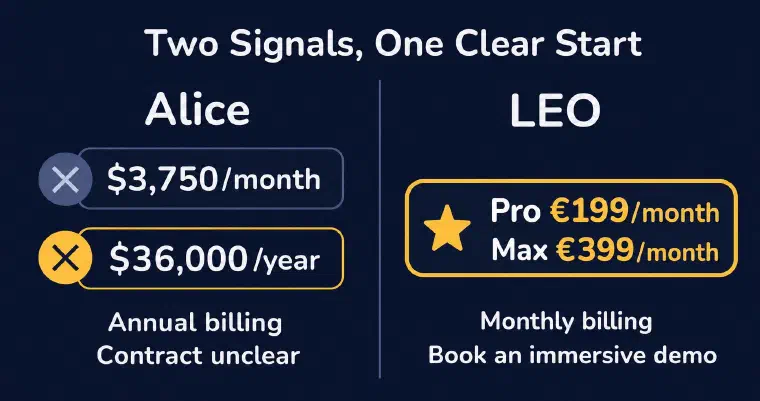
Alice publishes two price signals; I offer Pro and Max with monthly billing
The price gap is structural, but 11x’s public figures require caution. Checked on September 24, 2026, the official Alice pricing page lists Growth from $3,750 per month, billed annually. The FAQ on that same page says 11x starts at $36,000 per year on Growth. Because those two figures do not align, buyers should confirm the actual contractual amount with 11x. Growth includes up to five end users, 2,000 new prospects per month, managed Gmail mailboxes, bi-directional CRM synchronization, onboarding, and support. Pro and Enterprise use custom pricing.
The headline should no longer be that Alice starts at $5,000 per month. The current monthly figure displayed is lower, although the exact annual contract value remains unclear. The decision is still whether your team needs enough volume and infrastructure to justify an annually billed enterprise purchase before results are proven.
With monthly billing, my Pro plan costs €199 per month for 1,000 credits and Max costs €399 per month for 2,500 credits. Both contain the same features and automation levels. Credits reload monthly and do not roll over. They are not a fixed prospect quota: the number of prospects you can process depends on the actions you perform.
Each User consumes a seat per workspace and has a separate credit allocation and prospecting environment. Alice Growth’s included five end users are therefore not directly comparable with one LEO subscription. Compare your users, workspaces, activity, and infrastructure needs before calculating a team budget.
Credits follow useful actions. Searching for, analyzing, and qualifying a prospect costs one credit. Finding a usable email costs one. Generating or sending a LinkedIn message or email costs one. Detailed enrichment, Next Best Action calculation, reply analysis, analytics, and exports use no credits.
Alice can be rational value for a mature team that would otherwise pay for several data, sending, research, and workflow systems while covering thousands of prospects. For a founder or lean sales team, paying for that scale before proving the motion reverses the sensible order. I let you establish fit, message quality, and operating rhythm first, then increase credits when the work earns the budget.
I am the better 11x Alice alternative for starting lean
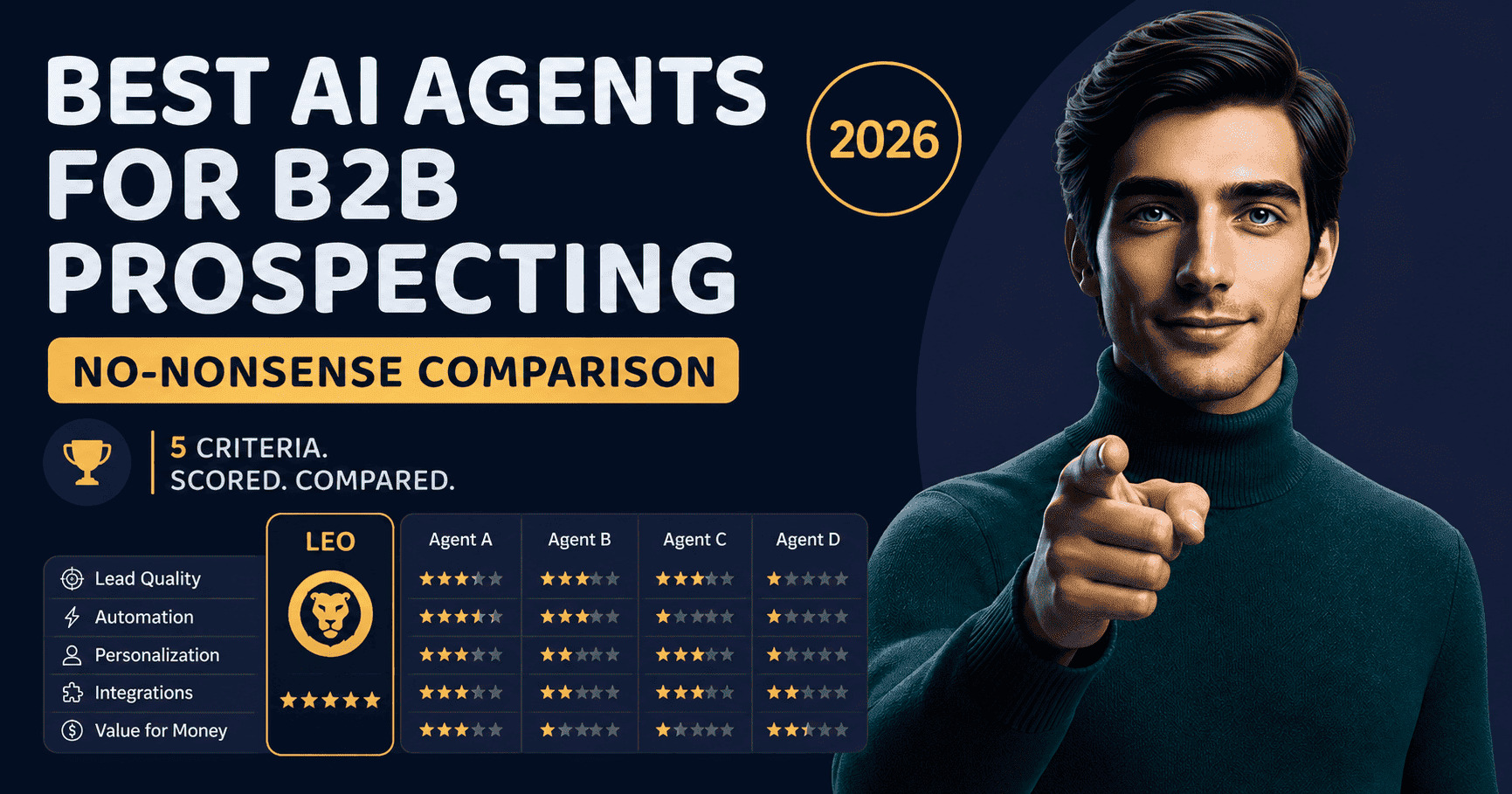
Choose Alice if you already run an established outbound operation and need 2,000 or more new prospects a month, managed email infrastructure, CRM synchronization, broad channel coverage, and a rollout supported by a vendor team. Its targeting, research, and execution system is designed for that environment. Confirm the contractual price with 11x because its public monthly and annual figures do not currently align. If you are comparing a wider shortlist, my scored comparison of AI B2B prospecting agents separates the operating models before you choose.
Choose me if your immediate problem is getting consistent, relevant B2B prospecting running without a large annual commitment. I help define the offer and persona, score prospects against both, let you keep approval where it matters, and automate LinkedIn and email when you are ready. For founders, agencies, consultants, and lean sales teams, I am the clearer 11x Alice alternative because I let the prospecting motion prove itself before the procurement decision becomes expensive.