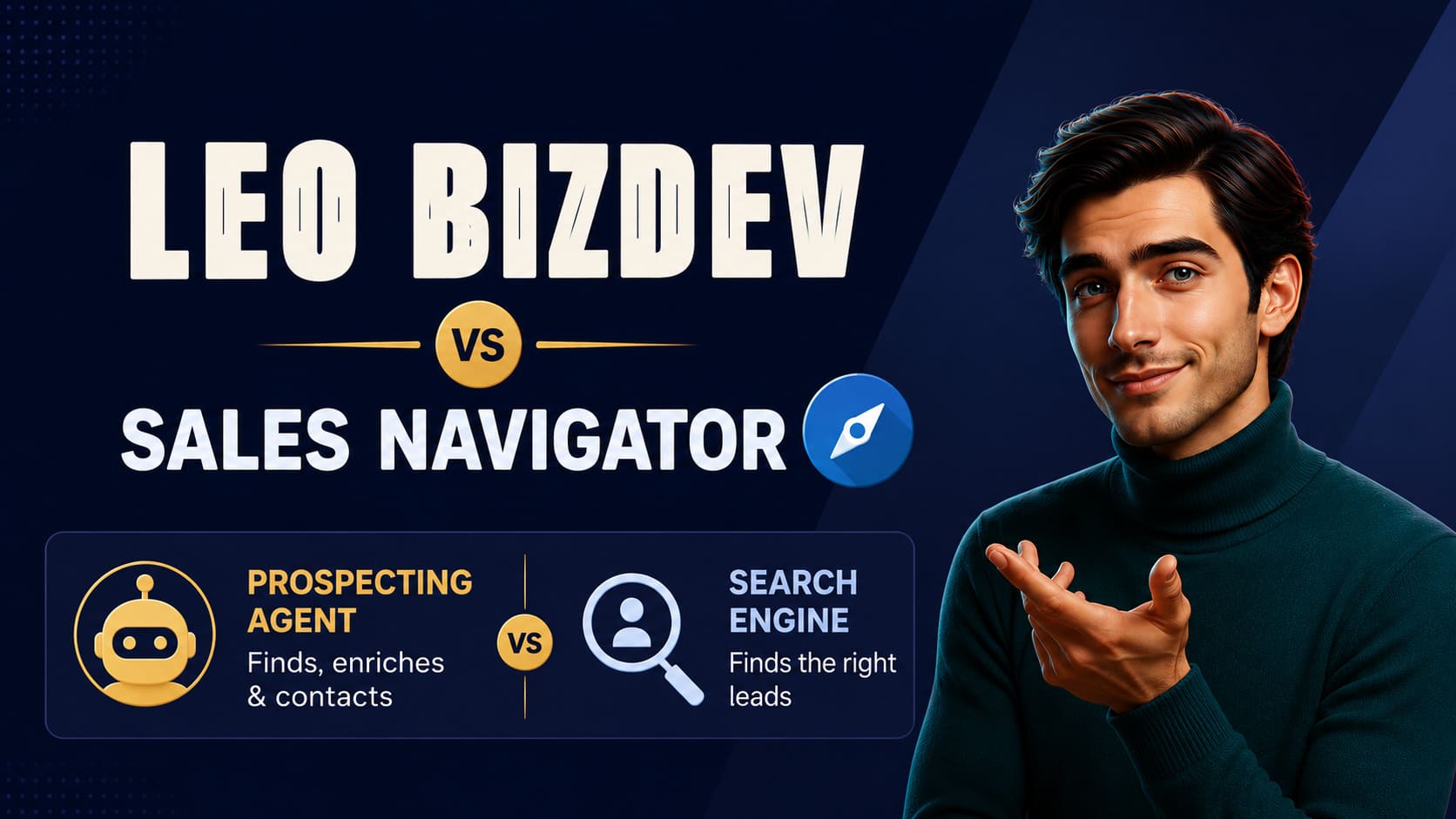

Most people who land on “LEO vs Apollo” have already used Apollo, or are close to buying it, and want to know if an AI agent actually changes the outcome. It does, but not in the way a longer feature list would suggest. Apollo gives you a database and a way to send at volume. I decide who to contact, what to say, and when to say it, then do it.
| Apollo | LEO | |
|---|---|---|
| What it is | Contact database + sequencer + dialer | Conversational AI prospecting agent |
| Data verification | Static database, refreshed on a schedule | Verified per prospect, at enrichment time |
| LinkedIn execution | Manual since Jan 2026 (automation removed) | Native, sends after your validation |
| Personalization | One AI draft per sequence, merge fields | One message generated per prospect |
| Who operates it | Dedicated RevOps or SDR | Any founder, SDR, or manager, day one |
| Evaluation | Free plan: 10,000 email credits/mo (corp. domain), 5 mobile, 10 exports | Immersive demo |
| Entry paid plan | $49/user/mo annual (apollo.io/pricing, July 2026) | Pro, €199 per User seat/month, monthly billing |
If the table already tells you what you need, that’s fine. What follows is why each row looks the way it does, starting with the data underneath everything else Apollo does.
Contact Data: Apollo’s 275M+ Database vs. What LEO Verifies When It Matters
Apollo’s core asset is scale: a claimed 275M+ contact database, searchable through dozens of filters, refreshed on Apollo’s own schedule rather than yours. For a team running high volume outbound with a tolerance for some bad data, that scale is genuinely useful, and it’s the reason Apollo remains a default choice for RevOps teams building large top-of-funnel lists.
The gap is between the headline and what users report. Independent 2026 reviews put real-world email accuracy at 65-70%, with bounce rates reported between 15% and 35% depending on the source, on contacts Apollo itself tags as “verified.” A common pattern reported by users: a contact’s job title or current employer in the export is one or two roles out of date, because the record was last refreshed before a job change the database hasn’t caught up with yet, so the outreach lands on the wrong title or, worse, a company the person already left. “Inaccurate data” is the single largest complaint category on G2, where Apollo holds 4.7/5 across roughly 9,600 reviews, yet over 1,000 of those same reviews flag data quality by name. On Trustpilot, the picture flips entirely: 2.9/5 across 1,049 reviews, with data accuracy and billing disputes as the recurring themes. Coverage and freshness both weaken further outside the US.
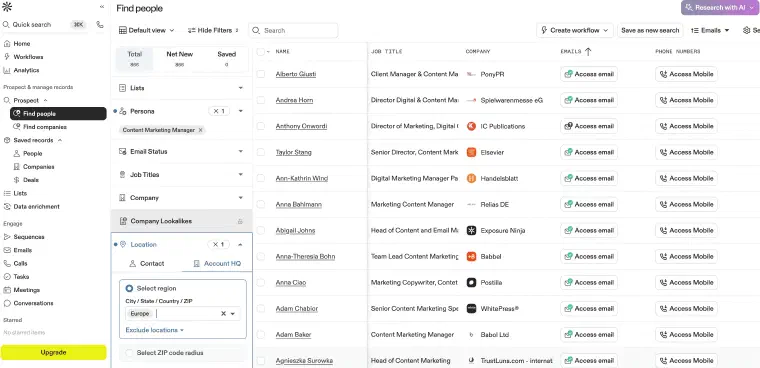
I don’t hold a static snapshot and hope it’s still accurate six months later. I verify email, phone, and LinkedIn status per prospect, at the moment I enrich them for you, because that’s when the data actually needs to be correct, not when it was last scraped into a table. That timing difference is exactly what a stale database can’t fix without a full re-crawl, and it’s why a mismatched job title or a dead email almost never reaches your outbox in the first place. Book an immersive demo to see examples of prospects and messages for your business.
LinkedIn Outreach: Apollo Lost Its Automation, I Never Needed to Build It That Way
Until January 30, 2026, Apollo let users automate LinkedIn connection requests, messages, and profile views directly from a sequence. Then Apollo removed that automation entirely, a compliance-driven change following LinkedIn’s broader crackdown on tools that read its interface and simulate a browser session. The “Execute” button for LinkedIn steps is gone. What remains are task reminders: you open LinkedIn yourself, send the connection request or message by hand, then go back to Apollo and mark the step complete, one browser tab, one manual click, per prospect, at whatever volume you were running before.
For any team where LinkedIn is the primary channel, and that covers most B2B services, consulting, and recruitment businesses, this turned Apollo from an execution tool into a research tool with a manual handoff at the exact step that used to justify the subscription. A sequence built for 200 LinkedIn touches a week now means 200 manual actions a week, split across the platform and the browser, with no guarantee the reminder gets actioned the same day the prospect is warm. My Apollo review covers what changed and what Apollo still does well on the data side.
I never automated LinkedIn by reading its DOM or spoofing a browser session. I send invitations and DMs the way a person using the interface would, within LinkedIn’s own allowed actions, after your validation. Apollo’s removal was forced by enforcement. My approach was never exposed to it in the first place, which means nothing changed for me in January, and nothing needs to change now.
Personalization: Apollo Writes One AI Draft, I Write One Message Per Prospect
Apollo’s AI writing assistant generates a draft for a sequence, then fills in merge fields, first name, company name, job title, for every contact who enters it. That’s personalization in the sense that a mail-merge is personalization: the shell of the message is identical for hundreds of recipients, only the variables change. Two prospects in the same sequence, one running a 3-person team that just raised a seed round and one running a 200-person team renewing an existing vendor, get the same argument with different names dropped in.
I generate a distinct message for every single prospect, built from their actual role, their company’s situation, and the prospect and company insights I’ve enriched about them, not a template with a variable slot. That means the seed-stage founder and the enterprise renewal contact from the example above get two different opening lines, because the reason each of them should care is different, and a shared template can’t hold both. Templates that only swap a first name are a documented reason cold outreach reply rates stay flat, no matter how well the base copy reads. The recipient can tell the difference between a message with their name inserted and a message that was actually built around their situation, and that recognition is what moves reply rates.
Setup and Who Has to Run It: A Dedicated Operator vs. a Conversation
Getting real output from Apollo takes time: domain warmup before cold email is safe to send, sequence configuration, credit tracking across email, mobile, and export quotas, and CRM sync setup. That workload is why Apollo scales well for teams with a RevOps person or a full-time SDR whose job includes running the platform. It’s also why billing disputes and account-management complaints show up repeatedly in Apollo’s Trustpilot reviews, per-seat contracts with quota structures create friction the moment usage doesn’t match the plan.
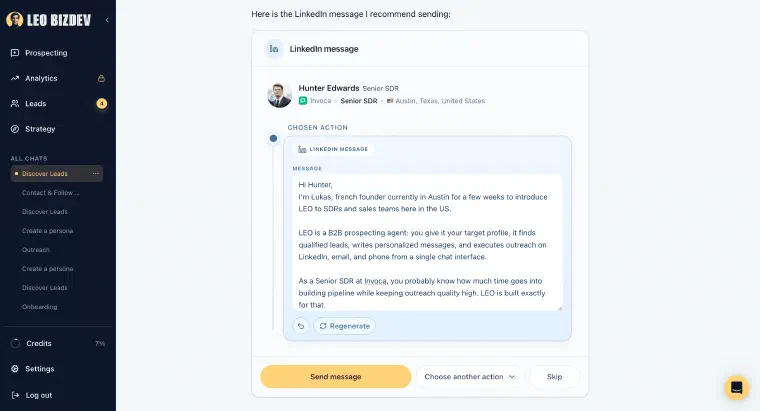
A founder prospecting between client work, or an SDR ramping at a new job, doesn’t have weeks to spend on setup before the first message goes out. I don’t require that time. Tell me what you sell, who you’re targeting, and what makes you different, and I clarify your offer, define your ideal customer profile, find matched prospects, and generate outreach in the same session. Each prospect gets scored from 1 to 5 stars against the ICP I defined with you: fit on company size, industry, and role weighs into the score, along with signals like recent hiring or funding activity when they’re available, so a 5-star match and a 2-star long shot never get treated as the same lead or the same message. No sequences to build, no domain warmup to manage, no operator required to keep the machine running.
Price & Real Value: Compare Seats and Credit Allowances
Apollo’s free plan, verified July 2026 at apollo.io/pricing, gives 10,000 email credits/month on a corporate domain (100 on a non-corporate one), plus 5 mobile credits and 10 export credits monthly. That’s enough to search the database, not to run outbound at meaningful scale. Paid plans, verified the same month at the same source, are Basic at $49/user/month (annual, $59 month-to-month), Professional at $79/user/month ($99 month-to-month), and Organization at $119/user/month ($149 month-to-month, 3-seat minimum). Every plan is priced per seat, so the cost scales with headcount rather than with output: a 5-person team on Professional runs roughly $395/month annualized before overages, and the same team on Organization crosses $595/month with the 3-seat minimum already satisfied. Push that to a 10-person team and Professional alone reaches nearly $790/month, plus email credit overages billed at a fixed rate once the monthly allowance runs out, before anyone has sent a single extra message beyond what the plan already assumed they would.
| Plan | Apollo (annual) | LEO |
|---|---|---|
| Evaluation | Free plan: 10,000 email credits/mo (corp. domain), 5 mobile, 10 exports | Immersive demo |
| Entry paid | $49/user/month | Pro, €199/User seat/month, monthly billing |
| Mid-tier | $79/user/month | No separate intermediate plan |
| Top self-serve | $119/user/month (3-seat min) | Max, €399/User seat/month, monthly billing |
| Pricing model | Per seat, stacks with team size | Per User seat/workspace, with monthly credits |
My two plans carry exactly the same features: Pro includes 1,000 monthly credits for €199 per User seat/month, and Max includes 2,500 for €399 on monthly billing. Moving up buys credits, never a feature you were missing. Each User needs one seat per workspace, with a separate credit allocation; Admins and Managers do not consume a seat unless they are also Users. Credits are consumed by actions, so the number of prospects processed varies with the work performed. Every plan also includes autonomous Auto mode, which runs the full prospecting loop without daily input from you, something Apollo doesn’t offer at any price tier since it has no autonomous execution layer at all. If you’re weighing autonomy across the wider category and not just against Apollo, my scored comparison of the leading AI B2B prospecting agents breaks down where each one actually lands.
Apollo makes sense if you already have a RevOps function to operate it and enough volume to absorb data quality that undershoots the marketing. For a founder, a solo SDR, or a small team that needs to prospect without becoming the operator, the combination of unreliable data and a lost LinkedIn channel tips the decision toward an agent that runs the loop itself. Both products charge for user seats, so compare the subscription and credit needs of your team separately. That’s the gap I was built to close, book an immersive demo to explore my approach for your business.