
Artisan and I are both called AI prospecting agents. That label hides a major difference. Artisan sells a managed, high-volume outbound system through a custom quote. I give founders and lean B2B teams a conversational workflow they can explore in an immersive demo, with public pricing from €199 per month on Pro with monthly billing.
If you are searching for an Artisan alternative, the real question is not which agent sounds more autonomous. It is which operating model fits your team, channels, budget, and appetite for setup.
If you need the product assessment before the head-to-head decision, my full Artisan Ava review examines its strengths, risks, and buyer fit on their own terms.
| Decision point | Artisan Ava | Me, LEO |
|---|---|---|
| Best fit | Revenue teams running high-volume outbound | Founders, independent professionals, agencies, and lean sales teams |
| Starting motion | Customized plan and guided rollout | Immersive demo, then plan choice and conversational onboarding |
| Targeting | Large B2B contact database, filters, enrichment, and intent signals | Offer-led personas, one-by-one fit scoring, and target-company priorities |
| Outreach | Autonomous sequences, replies, booking, and an optional dialer for reps | LinkedIn and email actions chosen from each prospect’s current state |
| Control | Campaign controls, coaching, banned phrases, and approval options | Approval by default, plus Semi-Auto and Auto levels |
| Public price | No fixed price published; quote depends on volume and setup | Pro €199 or Max €399 per month with monthly billing, same features; a User seat per workspace |
Artisan has a credible strength: it brings data, sequencing, reply handling, automatic CRM data synchronization, and human onboarding into one enterprise-oriented package. Its official pricing page frames the entry Team plan around roughly 2,500 contacted leads per month. That is useful when a revenue operation already knows its outbound model and wants more throughput.
My advantage starts earlier. I help you clarify what you sell, whom you should target, and why each prospect fits before I prepare or execute outreach. If your constraint is not a lack of volume but a lack of consistent, relevant prospecting, book an immersive demo built around your actual offer.
Artisan starts with campaigns; I start with your offer and target
Artisan says Ava searches more than 250 million verified B2B contacts across over 200 countries, enriches records with signals such as hiring and funding activity, and builds targeted lists from an ideal customer profile (ICP). That scale is meaningful. A team with established segmentation can turn a defined market into a large campaign without assembling separate data and sequencing tools.
Scale does not solve an unclear offer. A filter can identify a job title, industry, or funding event, but it cannot decide whether your pitch matches that buyer’s real problem unless the commercial context is sound.
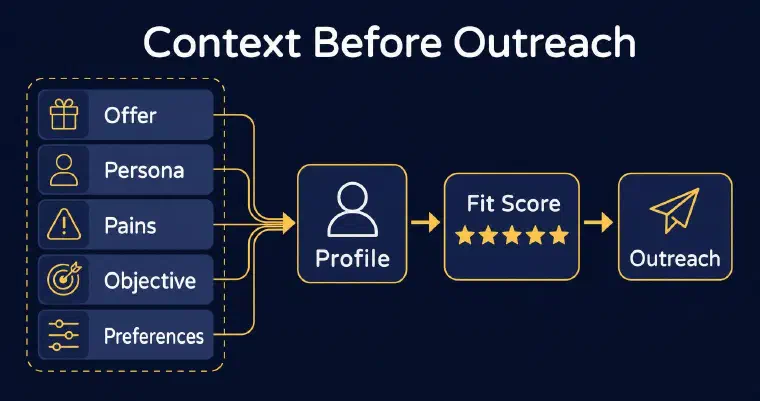
I make that context part of the product. I learn from your website, LinkedIn profiles, documents, and notes. I help you define an offer, attach a persona to it, record the pains and commercial objective, and set prospecting preferences. When I find a profile, I score its fit with both the persona and the offer from one to five stars and explain the score. In guided discovery, profiles rated three stars or higher wait for your validation before enrichment and addition to the database. Lower-scoring profiles remain visible and can be rescued. In Semi-Auto and Auto, the minimum score is configurable; enrichment uses available information.
That makes me the stronger choice for a founder or lean sales team whose offer is complex, whose target still needs sharpening, or whose reputation matters more than raw send volume. The practical starting point is to define an ICP with the offer and evidence in view, not simply expand a list. I do not begin by asking how many people you can contact. I begin by working out which people deserve contact.
Artisan runs sequences; I recalculate the next action for every prospect
Artisan’s current product page says Ava writes unique outreach, tests subject lines, optimizes send times, handles objections, and books meetings. Its May 2026 Ava 2.0 announcement describes an end-to-end workflow built around personalized sequences and autonomous reply handling. For a team that wants campaigns to run at volume, this is a serious proposition.
Public user feedback also shows why autonomy still needs judgment. On Trustpilot’s Artisan review page, one June 2026 reviewer praised the platform for simplifying unique content and deliverability, while an April 2026 reviewer reported a 0.07% positive response rate after several months. These are individual experiences, not a controlled benchmark. They do show that automation and support do not guarantee alignment between messages and target buyers.
I do not run a fixed sequence. For every prospect, I look at the offer, persona, enriched profile, available contact details, relationship status, and action history. I then select one Next Best Action and explain it. When you manage a prospect, that action may be a LinkedIn invitation, a LinkedIn message, an email, a phone-number search, or a call script. Auto is limited to eligible LinkedIn and email actions. When a prospect becomes eligible for follow-up, I recalculate instead of advancing a prewritten step.
This matters when a reply, channel constraint, or prior action changes what should happen next. My AI sales follow-up loop explains how those state changes should constrain, redirect, or stop the next action. A human reply ends that prospect’s Auto phase and returns control to you. An automated email reply is recorded but allows Auto to continue. If classification is uncertain, I mark the reply To qualify, notify you, and ask for manual classification. You get autonomy without pretending that every buyer should travel through the same sequence.
Artisan centers email scale; I coordinate LinkedIn and email around context
Artisan presents Ava 2.0 as a multi-channel AI business development representative (AI BDR), but the clearest details on its current pricing page remain email-centered. Ava emails, handles replies, and books meetings. An AI dialer is an add-on per seat, while sales reps place the calls with a brief and receive a distilled follow-up. The page does not document autonomous LinkedIn actions with the same specificity.
That does not make Artisan weak. Email at scale, a built-in contact database, Salesforce and HubSpot synchronization, and call preparation form a coherent motion for an established sales organization. Artisan also says every plan includes customer success support and onboarding, which can help a team deploy that motion consistently.
I am built for a different channel reality. With a synchronized LinkedIn profile, I can check the relationship state, review relevant prior interactions, and send an invitation or message after your approval. With a synchronized Gmail, Google Workspace, Outlook, or Microsoft 365 account, I can generate, send, and track email. In Auto mode, I choose between authorized LinkedIn and email actions using the prospect’s state. For a user-managed prospect, I can find a phone number and prepare a personalized call script, but I never place the call or search for phone numbers in Auto.
For a founder or small sales team, this creates a practical advantage: the channels work from one prospect history rather than from separate campaign logic. I know whether an invitation is pending, whether an email bounced, and whether the prospect replied before I recommend the next move. The AI LinkedIn outreach workflow shows what that state-aware approach looks like from relationship check through follow-up.
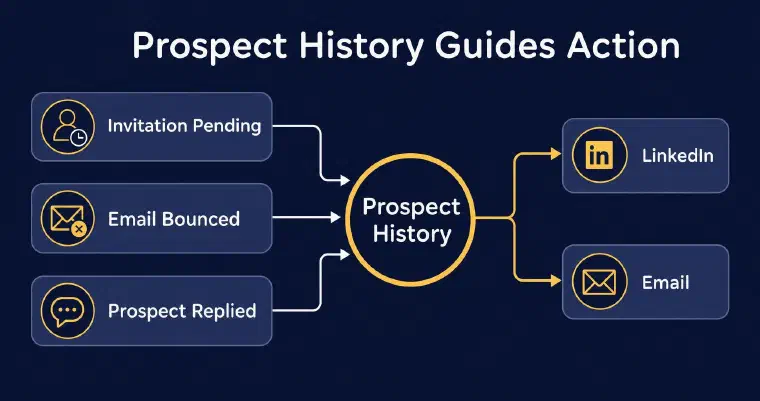
This diagram illustrates how history informs action choices. A human reply ends the prospect’s Auto phase rather than triggering another automated contact; only an automated email reply allows Auto to continue.
Artisan brings a rollout team; I let you choose how much control to keep
Artisan’s pricing page promises a white-glove rollout, customer success support from day one, and a shared Slack channel. Scale adds a dedicated customer success manager and CRM setup. Enterprise adds a forward-deployed strategist, full onboarding buildout, and strategic support. Artisan also lets teams approve sends, lock tone and calls to action, set banned phrases, and coach Ava’s writing.
This service layer is valuable when several reps, CRM rules, sending domains, and security stakeholders must align. It is also a sign of the customer Artisan is designed to serve. You are buying a deployment, not merely opening an account and trying an agent on one persona.
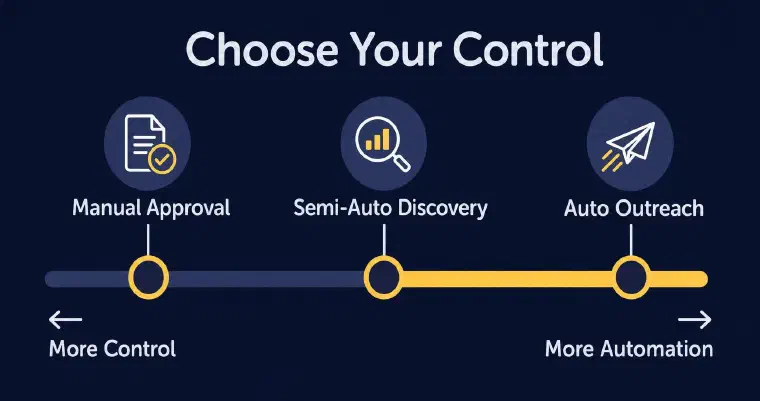
I let you start smaller and choose the level of autonomy. By default, I recommend and prepare actions, then wait for approval. Semi-Auto finds, qualifies, and enriches prospects while leaving contact and follow-up to you. Auto adds eligible LinkedIn and email contact, follow-up, reply detection, and reply classification. Before either level starts, I propose a configuration for personas, score threshold, daily prospect volume, authorized channels, message limits, timing, and exclusions. You review and explicitly validate it, then can pause or change it later. Automation requires credits; Auto also needs at least one synchronized, enabled channel. You do not have to pass through Semi-Auto before choosing Auto.
That graduated control is better for a team still proving its outbound motion. You can inspect decisions before handing over execution, then automate more without migrating the strategy or prospect history into another system. It also makes the distinction between an AI agent and fixed sales automation visible in the way decisions are made, not just in the product label.
Artisan quotes a deployment; I publish the cost before signup
The price difference is not a clean dollar-to-euro comparison because Artisan no longer publishes a fixed subscription amount. Checked on September 22, 2026, its pricing page says Team covers roughly 2,500 contacted leads per month, Scale roughly 6,000, and Enterprise custom volume. Actual pricing is scoped to lead volume, mailboxes, and dialer seats after a sales conversation. Every plan includes the full platform, onboarding, and customer success support.
My pricing is public before you choose a plan. With monthly billing, Pro costs €199 per month for 1,000 credits and Max costs €399 for 2,500. Both contain the same features and automation levels. They differ only in monthly credits, which reload monthly and do not roll over. Quarterly billing reduces the reference price by 10%, and annual billing reduces it by 20%; both are billed upfront for their respective periods.
Each User consumes a seat per workspace and has a separate credit allocation and prospecting environment. Compare the users, workspaces, actions, and support your team needs, rather than treating one LEO subscription as an equivalent to an entire managed deployment.
The units also differ. Artisan sizes a managed outbound deployment around contacted-lead volume and infrastructure. My credits follow actions: prospect search and qualification uses one credit, finding a usable email uses one, and generating or sending an email or LinkedIn message each uses one. Detailed enrichment, Next Best Action calculation, reply analysis, analytics, and exports do not consume credits. The number of prospects processed depends on the actions performed, not a fixed conversion from credits to contacts.
Artisan may justify its custom quote for a mature revenue team that needs thousands of monthly contacts, CRM deployment, and hands-on rollout support. For a founder, consultant, agency, or lean sales team, that model creates cost and procurement before fit is proven. I give you the clearer value path: public monthly pricing, the same capabilities on every plan, and room to increase volume only after the motion works.
I am the better Artisan alternative for lean B2B prospecting
Choose Artisan when you already have an established revenue operation, need thousands of contacts reached every month, want Salesforce or HubSpot at the center, and value a guided deployment enough to request a custom quote. That is its strongest use case.
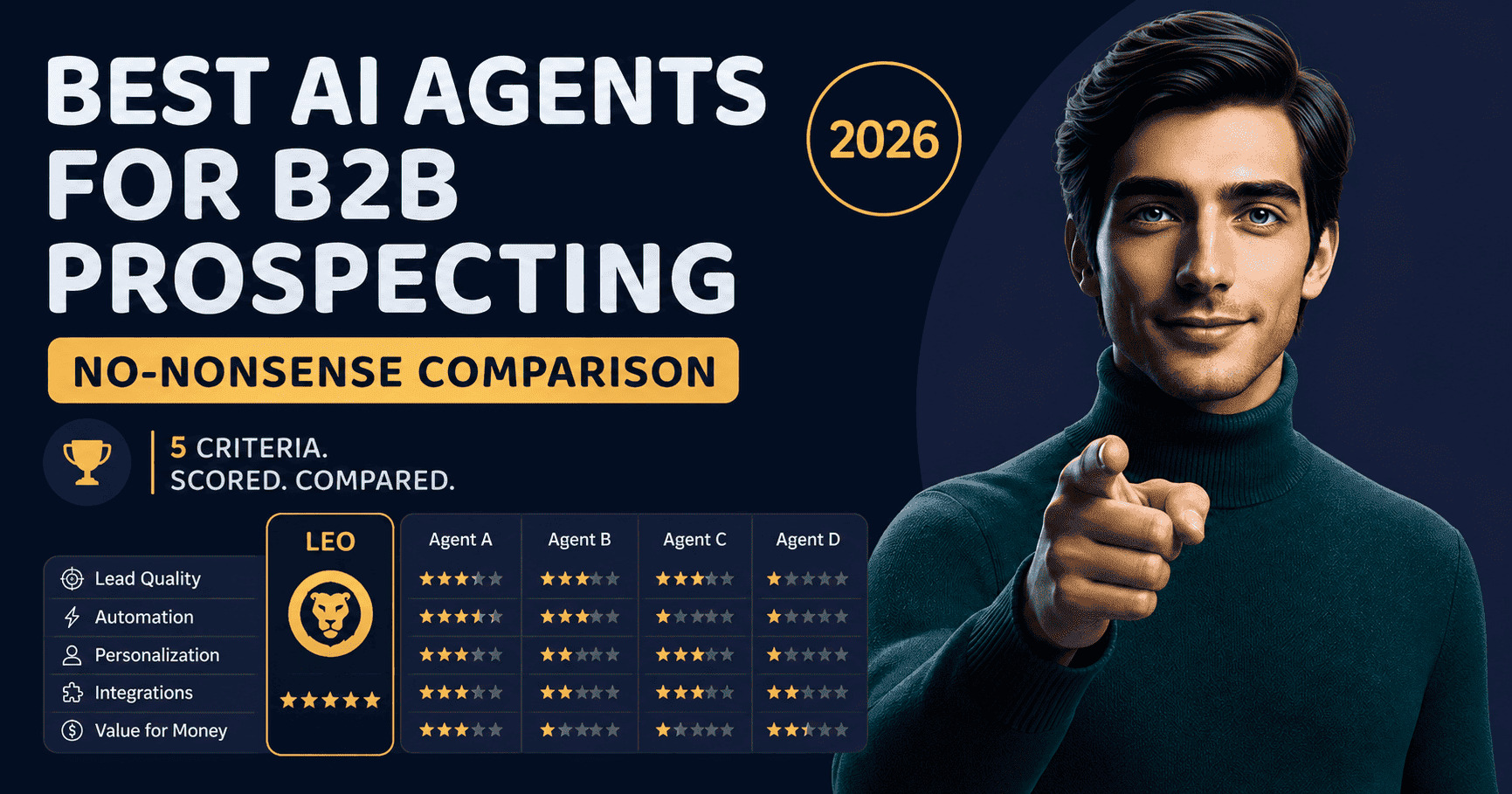
Choose me when you need to turn a real offer into a focused target, qualify prospects before contacting them, coordinate LinkedIn and email from one history, and decide how much autonomy to grant. I am the better Artisan alternative for founders and lean B2B teams because I make the strategy, execution, and cost accessible before enterprise-scale volume becomes the goal. For a wider market view beyond this pair, see my comparison of the best AI B2B prospecting agents.