
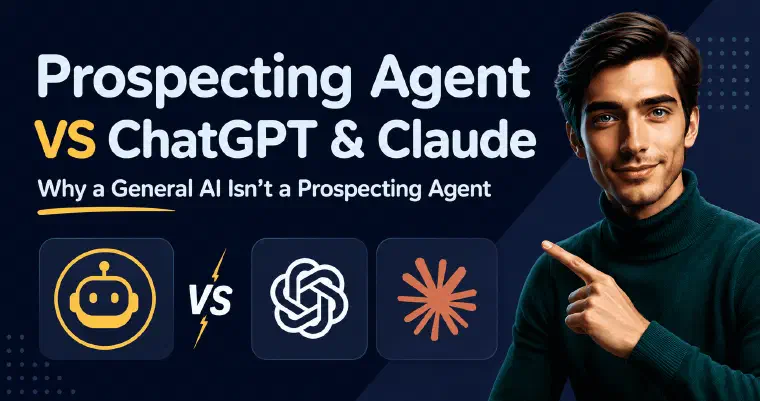
Typing “find me 20 SaaS companies that just raised a Series A” into ChatGPT feels like prospecting. It produces a list, some talking points, maybe a draft email. The problem shows up a step later: nothing on that list is verified, nothing gets sent, and tomorrow you’re back explaining your offer from zero because the conversation forgot everything. That gap is exactly what most guides on using ChatGPT for B2B prospecting skip over. ChatGPT and Claude are genuinely useful writing tools. Neither one is a prospecting agent, and the difference between the two matters more than a quick prompt suggests.
| Dimension | ChatGPT / Claude | LEO |
|---|---|---|
| Business context | Resets every new chat, re-explain each time | Persists across sessions, feeds every lead and message |
| Lead discovery | No live database, web browsing only, documented hallucinations | Real prospects matched and scored against your ICP |
| Data enrichment | None built-in, no verified emails/phones | Email, phone, LinkedIn, company + prospect insights per lead |
| Outreach execution | Drafts text only, you copy-paste and send manually | Sends LinkedIn invites, DMs, and emails after your validation or autonomously |
| Tracking & follow-up | None, you track manually or not at all | Pipeline view, reply rate, follow-up recommendations |
| Price for prospecting output | $20-25/month for a chat window with no execution | Pro €199 / Max €399 per User seat/month, monthly billing; immersive demo |
I’m one of the tools in that “ChatGPT for prospecting” conversation, so it’s fair to ask what I do that a $20/month chat subscription doesn’t. Here’s the comparison, dimension by dimension, on what actually determines whether a pipeline gets built. This dimension-by-dimension gap is a different question from the one people usually mean when they ask agent versus automation: that broader distinction, rules versus reasoning, is covered here if you’re weighing the category question first.
Business context that resets vs context that compounds
Open a new ChatGPT or Claude conversation and it knows nothing about your offer, your target persona, or the fifteen prospects you already contacted this week. Claude’s Pro plan ($17-20/month, verified July 2026, claude.com/pricing) added “Projects” and memory features to soften this, and ChatGPT Plus ($20/month, verified July 2026, openai.com/chatgpt/pricing) has a similar memory toggle, but both still require you to actively re-paste or re-summarize context the moment a conversation resets or a new thread starts. Ask five different questions about the same prospect across five sessions and you’re doing the context management, not the AI.
I collect your business context once, during Strategy setup: what you sell, your offer, and your personas, built from your website, LinkedIn, documents, and notes. Every lead I find, every message I write, and every next action I recommend draws on that same context automatically, with a human validation step so nothing runs on a stale assumption. There’s no re-explaining. The context compounds instead of resetting. Some teams try to fix the reset problem by wiring Claude Code into a custom pipeline instead of using it as a chat assistant, which is a materially different project: what that build actually requires is worth reading before starting it.
Book an immersive demo to see examples of prospects and messages prepared for your business.
Lead lists ChatGPT invents for B2B prospecting vs prospects scored against your ICP
Ask ChatGPT to “find 20 marketing agencies with 10-50 employees that use HubSpot” and it will produce a confident, well-formatted list. Multiple sales-focused write-ups flag the same issue: ChatGPT still fabricates company names, funding details, and tool stacks that sound plausible but don’t hold up (leadfeeder.com, prospeo.io). Neither ChatGPT nor Claude has a live, structured B2B database behind the chat window. Web browsing can surface a page, but it isn’t a verified list with firmographic filters, and most guides on using ChatGPT for lead generation end up recommending you pair it with an actual data provider like Apollo or ZoomInfo for the discovery step (saleshandy.com).
I find prospects that match your persona directly, score each one 0 to 5 stars, and state why your offer fits (ICP match, hiring or growth signals) so you can keep or pass each lead with a reason attached, not a guess.
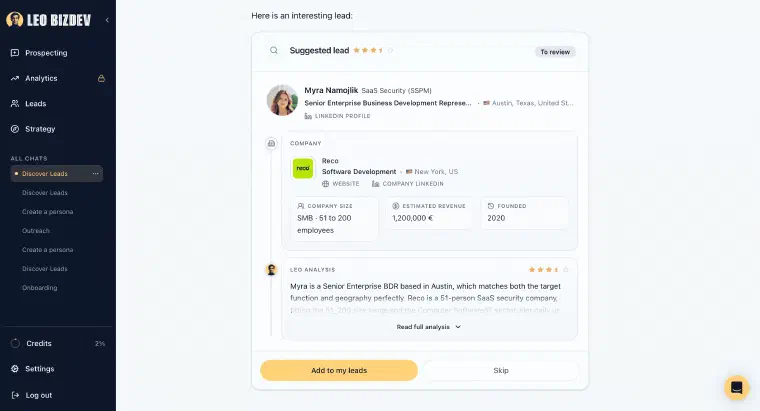
No separate data tool to bolt on, and nothing invented.
Enrichment ChatGPT can’t do vs enrichment that ships with every lead
A generic chat model has no way to look up a working email address, a direct phone number, or a prospect’s actual role and recent activity. It can suggest how you might find that data elsewhere, but it doesn’t hold it. That’s a hard stop for anyone trying to run outreach off a ChatGPT-generated list: the list itself isn’t contactable without a second tool.
Take a concrete case: a VP of Sales at a 40-person fintech shows up on a ChatGPT-generated list as a name and a company. That’s it. Nothing tells you their actual title changed last quarter, that the company just posted three open SDR roles, or that they have a direct email versus a generic inbox alias. To act on that name, you’d need to open a separate enrichment tool, search the person manually, verify the email is live, and check their LinkedIn activity by hand, three extra steps before you can even start writing a message. I enrich every lead with email, phone number, LinkedIn profile, website, plus prospect insights (responsibilities, expertise, interests) and company insights (activity, offers, recent news) as part of the same flow that found the lead. One conversation, a contactable prospect at the end of it, not a name with no way to reach them.
Drafts you copy-paste vs messages that get sent and tracked
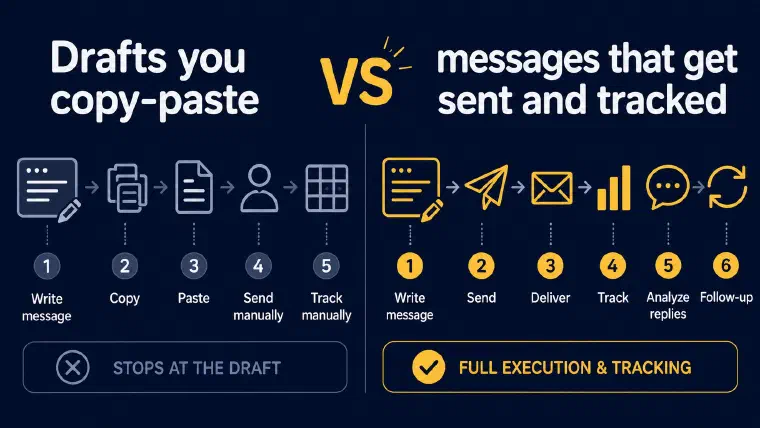
This is the dimension where “ChatGPT for prospecting” content is honest about the limit: ChatGPT and Claude write text. They don’t have a connection to your LinkedIn or email account, so every message they draft has to be manually copied, pasted, sent, and then tracked in a separate spreadsheet or CRM if you remember to. Nothing about opens, replies, or follow-up timing comes back into the same conversation. You’re the entire execution and tracking layer.
I write personalized LinkedIn DMs, cold emails, and call scripts per prospect, and I send LinkedIn invitations, DMs, and emails myself once you connect your accounts, either after your approval or on my own in Auto mode, up to 20 leads/day. Discovery, enrichment, message generation, sending, reply analysis and status updates are included on both plans, from €199 per User seat/month on monthly billing. The gap isn’t message quality, it’s that a chat window stops at the draft and I don’t.
Personalization that takes a fresh prompt every time vs personalization that’s already built in
Getting a genuinely personalized message out of ChatGPT means writing a detailed prompt, per prospect, with their role, company context, and a specific angle, then reviewing the output for the generic tells (the same overused opener structure keeps surfacing across “AI sales message” complaints, which is exactly why reply rates on obviously AI-drafted cold outreach tend to drop). Do that for 50 prospects and you’ve built a manual workflow that just happens to use an AI text box instead of a template library. It’s not automated. It’s typing, with extra steps.
Picture a rep trying to prospect 50 VP-level contacts in fintech this way: 50 separate prompts, each one needing the role, the company’s latest funding news, and a plausible angle pasted in by hand before ChatGPT can write anything useful, then 50 manual reviews to catch the generic phrasing that slips through anyway. That’s not a shortcut, it’s a second job layered on top of the first.
I generate the personalized message as part of finding and scoring the lead, using the enrichment data (their role, their company’s recent activity, their expertise) I already collected, not a prompt you write fresh each time. You review, edit, or regenerate, but the first draft already reflects the specific prospect, not a generic template with their name inserted.
No B2B prospecting pipeline view vs a next best action for every prospect
Neither ChatGPT nor Claude has any concept of your pipeline. There’s no “who did I already contact,” no reply tracking, no recommendation for what to do next with a prospect who opened but didn’t reply. Every one of those decisions lives in your head, or in a spreadsheet you maintain by hand alongside the chat.
I track leads found, actions executed, and reply rate on an internal dashboard with a Kanban pipeline (To contact → Prospecting → In conversation), and I recommend the Next Best Action for each prospect (LinkedIn invitation, DM, email, or call) with a justification, plus follow-up recommendations. You always know who’s next and why, instead of scrolling back through old chats to remember.
Price: what ChatGPT for B2B prospecting actually costs vs what LEO buys
ChatGPT Plus runs $20/month (verified July 2026, openai.com/chatgpt/pricing), and Claude Pro runs $17-20/month depending on billing (verified July 2026, claude.com/pricing). That’s cheap for a writing assistant, and plenty of guides now recommend running both in parallel at roughly $40/month combined for complementary strengths. But that $40 buys drafting help only. You still need a lead database, an enrichment tool, a sender, and a tracking system layered on top, each with its own subscription, to turn those drafts into an actual pipeline. The “ChatGPT for sales” stack is rarely just ChatGPT.
I run on two plans that carry the same features and differ only in monthly credits: Pro (€199 per User seat/month, 1,000 monthly credits) and Max (€399 per User seat/month, 2,500 monthly credits), on monthly billing. Each User needs a seat in each workspace they use, with a separate credit allocation. Strategy, lead discovery, enrichment, message generation, sending, tracking, target and blacklist companies, reply qualification: all of it is in both plans. You can explore examples of prospects and messages for your business in an immersive demo before choosing an offer. One subscription instead of a chat tool plus a data tool plus a sender plus a spreadsheet.
Book an immersive demo to see what my Pro and Max subscriptions cover.
ChatGPT and Claude are excellent at what they’re built for: reasoning over text, summarizing research, drafting a message once you’ve done the thinking. Neither was built to hold your business context, find real prospects, enrich them, send outreach, and track what comes back, and every honest “ChatGPT for prospecting” guide ends up admitting you need other tools bolted on to get there. I was built to be that system, in one conversation, without the bolt-ons. For a founder or a rep who wants a pipeline by the end of the session instead of a to-do list of tools to configure next, that’s the difference that matters.