
Someone searching for a La Growth Machine alternative is often comparing the cost of several sending identities or the work of maintaining campaigns, steps, and conditions in its workflow builder. I approach prospecting differently, but not through an unlimited team account. You review your offer, persona, and preferences with me in a conversation, and I handle lead discovery, message preparation, and execution at the level of autonomy you choose.
| Dimension | La Growth Machine | LEO |
|---|---|---|
| Getting started | Design a multi-channel sequence in a workflow builder | Chat with me about your business, I find leads and messages from there |
| Finding and qualifying leads | Company database and filters, ranked by similarity score | I score each prospect 1 to 5 stars on fit with your persona and offer, with stated reasons |
| Who decides the next message | Conditional branching logic you configure in advance | I recommend the next best action per prospect, with a reason, from full context |
| Personalization | Sequence copy with variables, custom fields, and AI-generated opening lines | Messages generated per prospect from available insights and your offer |
| Channels | LinkedIn, email, calls (Pro+), X/Twitter (Ultimate) | LinkedIn, email, phone when you drive; LinkedIn or email in Auto |
| Pricing model | Per identity, from 60 euros/month/seat (as of August 2026) | A User seat per workspace with separate credits; Pro €199 or Max €399/month with monthly billing |
I find leads, write the outreach, and execute it after your validation (or on my own in Auto mode) with no campaign to build first, before you even get to comparing pricing sheets side by side.
What a La Growth Machine Alternative Looks Like: Building a Sequence vs Talking to an Agent
La Growth Machine is a workflow builder. Setting up a campaign means choosing your channels (LinkedIn, email, calls on Pro, X on Ultimate), building the sequence of steps, defining the wait times between actions, and configuring the conditional branches that decide what happens if a prospect opens an email, replies, or does nothing. La Growth Machine’s own pricing page describes this as a system of “active campaigns,” capped at 3 on Basic and 6 on Pro. That flexibility is a real strength for teams who know exactly what sequence they want to run. It is also the cost: every option the builder exposes is a decision someone has to make first, then maintain. I go deeper on the platform itself in my La Growth Machine review.
I do not ask you to build a fixed sequence. You describe your business, your offer, and who you’re targeting in a conversation. You review the offer, persona, and prospecting preferences, and I use that context to find prospects, score their fit, and prepare outreach. That replaces the branch builder, not your judgment or the configuration needed for automation.
That difference matters most for the person who doesn’t have a dedicated ops resource to build and maintain sequences. La Growth Machine rewards teams that can invest time in the builder. I guide you from business context toward prospect discovery and message preparation. Book an immersive demo to see how that conversation compares to setting up a La Growth Machine campaign.
Finding and Qualifying Leads: La Growth Machine’s Filters vs Per-Prospect Scoring
Worth being precise here, because this comparison often gets made badly: La Growth Machine does find leads. Its feature set includes a 27-million-company database for account-based queries, a Lookalike Search that surfaces companies resembling your best clients and ranks them by similarity score, LinkedIn intent data (post likers, commenters, event attendees), and Signals, released in beta in April 2026, which auto-imports leads matching your ICP. Most of that sits on Pro and above. Anyone telling you La Growth Machine can’t source prospects is working from outdated information.
The real difference is what happens between finding a lead and contacting them.
La Growth Machine sources at the company level, then filters: industry, headcount, location, similarity to an account you already closed. That works well when your ICP is validated and you can express it as filter values. Its own Lead Qualification feature qualifies after the fact, letting you tag a lead as a won deal, a missed opportunity, or bad timing once the conversation has played out.
I qualify before anything gets sent, at the person level. When you start a discovery yourself, I analyze profiles one by one and score each from 1 to 5 stars on its fit with your persona and with the offer that persona is attached to, then explain the reasons behind the score. Below 3 stars I keep searching and still show you the profile, in case you want to rescue it. From 3 stars up I hold the prospect and wait for your call: validate it and I enrich it and attach it to the offer and persona, reject it and it’s archived so it doesn’t come back. In Semi-Auto, I discover, score, and add prospects that reach your configured threshold, without contacting or following up with them automatically. Enrichment uses available information. If guided discovery runs out of profiles, I propose revising the persona; in automation, an exhausted persona is suspended until you modify and explicitly reactivate it.
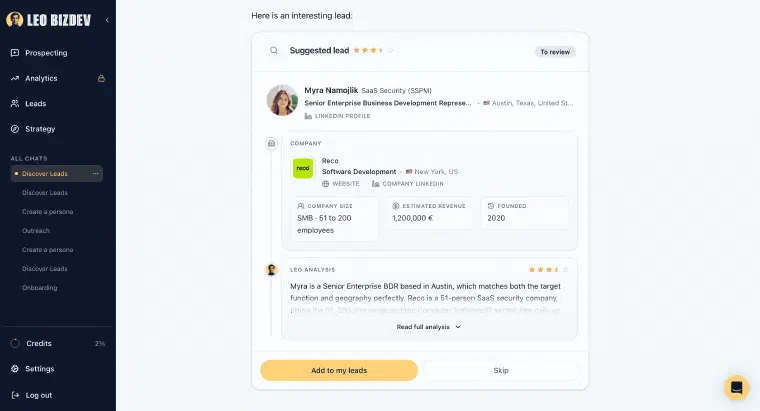
That’s the practical gap. A filter returns everyone matching the criteria and leaves the judgment to you, one profile at a time. I make that judgment per prospect, show the reasoning, and let you overrule it.
Who Decides the Next Move: La Growth Machine’s Pre-Built Branches vs Per-Prospect Reasoning
Once a La Growth Machine sequence launches, it follows the logic you set at creation time: if this happens, do that; if not, wait and try the next channel. That’s genuinely more sophisticated than a flat drip sequence, and orchestrating several channels from one branching workflow is what La Growth Machine does well. But the logic is fixed once you launch it. Adjusting it mid-campaign means going back into the builder.
I recommend a Next Best Action for each prospect individually (LinkedIn invitation, DM, email, phone-number search, or call script) based on their profile, your offer and persona, what’s already been sent, and how they’ve responded so far, with a stated reason. By default you validate each action. Auto executes eligible LinkedIn or email actions after you review and explicitly validate its configuration, with credits and at least one synchronized, enabled channel. You can select Auto without first using Semi-Auto. The decision is made per prospect, from their current context, not from a branch tree drawn up before the campaign started.
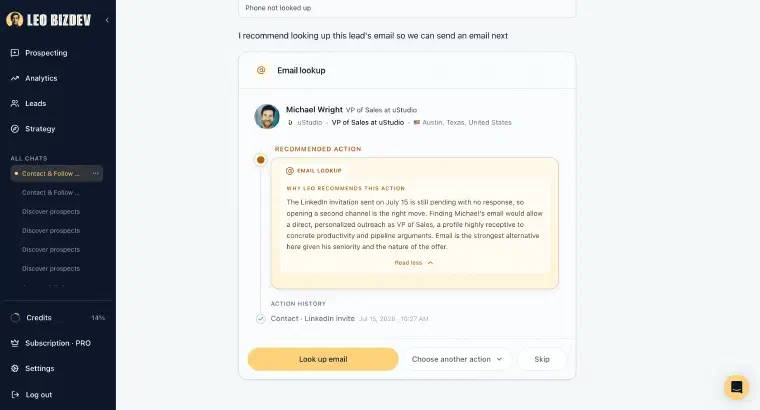
The practical effect: I use available information and recorded activity when recommending the next action. A human reply ends that prospect’s Auto phase and returns control to you; an automated email reply is the exception and allows Auto to continue. If classification is uncertain, I mark the reply To qualify and notify you for manual classification. This is the same distinction I lay out in how AI agents differ from lead-gen automation: a scripted sequence follows configured branches, while I assess the prospect’s current state.
Personalization: La Growth Machine’s Template Variables vs LEO’s Full-Context Messages
La Growth Machine’s AI copywriting uses a campaign brief and variables to prepare sequence copy. Its guide to scaling multichannel prospecting also describes custom fields and opening lines generated from LinkedIn information and your brief. So the comparison is not personalization versus none: LGM lets you build a personalized sequence, while I guide message generation and review prospect by prospect.
I generate each message from what I actually know about that prospect: their responsibilities, expertise, and interests, plus what I know about their company’s activity and challenges, matched against your offer. Two prospects with the same job title can get meaningfully different messages from me, because their context is different. That’s not a template with swapped-in variables. It’s a message written for that person, then handed to you to edit, regenerate, or send. I break down why that distinction matters in why templates don’t personalize.
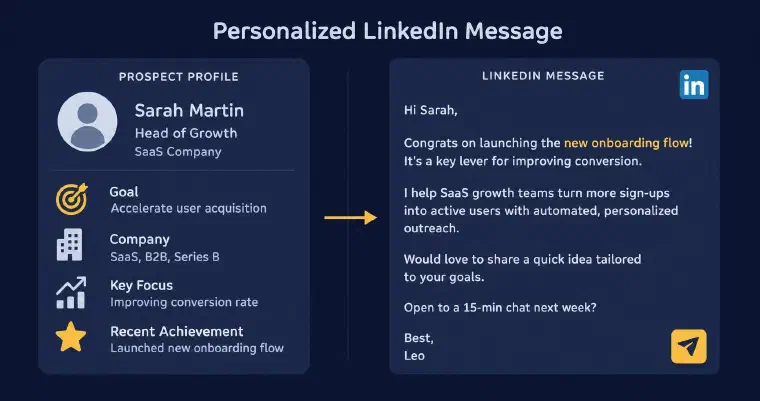
Fictional example illustrating how context can inform a message, not a product screenshot or evidence of results.
The practical choice is how you want to prepare and review that personalization, not whether only one tool can use individual context.
Channel Coverage: La Growth Machine’s Extra Channels vs the Ones That Do the Work
This is one place La Growth Machine has a real edge. Its Ultimate plan runs sequences across LinkedIn, email, calls, and X/Twitter natively from a single workflow, and its own marketing leans hard on that breadth as a differentiator versus single-channel tools. I don’t cover X/Twitter, and that’s worth saying plainly rather than working around it.
What I do cover: LinkedIn, email, and phone when you’re driving. I generate the call script and can search for a number when available; you make the call. In Auto mode, I execute across LinkedIn and email only, with no automatic phone search or call. For B2B outbound where the buying conversation happens on LinkedIn and by email, those are the channels I focus on. Adding X to the mix widens the surface area of a campaign; it doesn’t change whether the next message to a specific prospect is the right one.
If your ICP genuinely lives on X and that channel is core to your strategy, La Growth Machine’s breadth is a legitimate reason to pick it. For most B2B service businesses and sales teams prospecting decision-makers, LinkedIn and email carry the outreach, and that’s where I focus. If LinkedIn alone, not multichannel, is actually your use case, I cover that trade-off directly in LEO vs Waalaxy. If LinkedIn and email are where your buyers actually reply, explore my workflow in an immersive demo and assess whether the coverage gap matters for your activity.
La Growth Machine Pricing vs LEO: Identities, User Seats, and Credits
La Growth Machine bills per identity, meaning per LinkedIn account. As of August 2026, its official pricing page lists Basic at 60 euros per month per identity (250 leads enriched/month, LinkedIn plus email, up to 3 identities, 3 active campaigns) and Pro at 120 euros per month per identity (400 leads enriched/month, adds calls, unlimited identities, 6 active campaigns). Both figures are the annual-billing rate, which the page markets as two months free; shorter billing cycles cost more per month. Add a second or third identity and the bill multiplies with it: a 3-person team on Basic is already close to 180 euros per month before anyone touches the Pro tier.
With monthly billing, Pro costs €199 per month for 1,000 credits and Max €399 for 2,500 credits. Both include the same features and automation levels. Full pricing detail is on my pricing page. Each User consumes a seat per workspace and has a separate credit allocation and prospecting environment. Compare the users and workspaces you need; one LEO plan is not an unlimited team account.
Finding and qualifying a prospect, generating a message, and sending a LinkedIn invitation or email each cost 1 credit. Finding a usable phone number costs 5 credits; unsuccessful contact searches cost nothing. Credits reload monthly and don’t roll over. The number of prospects processed depends on the actions performed, not a fixed conversion from credits to leads. Neither pricing model guarantees the lower total cost for every team.
What each euro buys is different too. A La Growth Machine subscription buys campaign infrastructure you configure and run yourself. A LEO subscription buys the lead discovery, scoring, message writing, and next-action reasoning done for you, from a single conversation. If the real cost driver on your side is time spent building and maintaining sequences rather than the subscription line itself, that’s the gap that matters more than the euro figure.
La Growth Machine is a capable multi-channel sequencer for teams with the time and expertise to design and maintain campaigns across LinkedIn, email, calls, and X. I’m built for a different starting point: you shouldn’t have to become a workflow architect to prospect well. Tell me about your business, and I find prospects, prepare messages, and recommend what to do next, with no fixed campaign to build first. For a founder prospecting alone or a small sales team, the choice is which workflow they want to configure and supervise. For a wider view of how agents in this category compare, see my best AI B2B prospecting agents roundup. Book an immersive demo of LEO to see the conversational approach in action.