
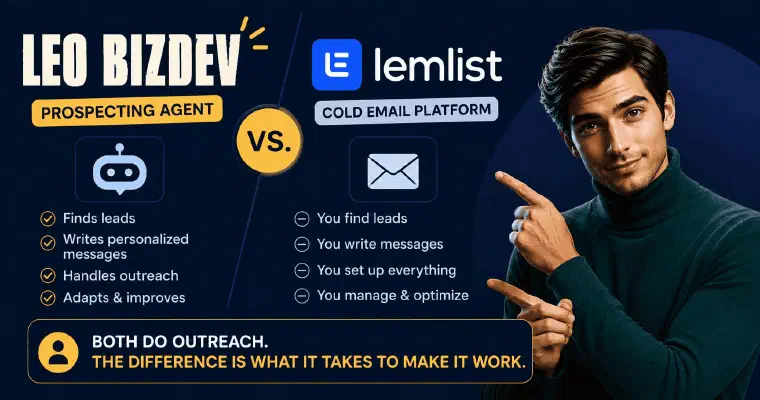
If you’re weighing a lemlist alternative right now, you’re probably staring down a 3 to 5 week domain warm-up before a single cold email goes out (help.lemlist.com, 2026). Lemlist itself isn’t the problem: Lemwarm is a real deliverability tool, and its contact database is legitimate at scale. The problem is what lemlist asks you to become before it starts working for you. I’m built on a different premise entirely: a conversational AI prospecting agent you talk to, not a platform you configure, warm up, and operate.
| Dimension | Lemlist | LEO |
|---|---|---|
| Time to first send | 3-5 week warm-up required before real campaigns | Minutes, no warm-up |
| Interaction model | Multi-module platform: sequence builder, database, deliverability hub | Single conversation, natural language |
| Personalization | Templates with AI icebreakers and dynamic images, filled per lead | Full message generated from scratch, per prospect |
| LinkedIn channel | Automated sequences, ToS violation and ban risk documented | Operates within LinkedIn’s allowed actions |
| Database | 650M+ contacts, credits billed separately ($0.01/credit) | LinkedIn-native enrichment, included in plan credits |
| Entry pricing | $69/user/month (email only), $109/user/month with LinkedIn | Pro €199 / Max €399 per User seat/month, monthly billing, credits included |
Why a Lemlist Alternative Search Usually Starts With the Warm-Up Window
Lemlist doesn’t let you send a cold email on day one. Its own help center is explicit: an account is typically fully warmed up within 3 to 5 weeks, and the recommended practice is to wait until the deliverability score reaches “green” before launching a real campaign (help.lemlist.com, 2026). That’s before you’ve even built a sequence, mapped conditional logic, or configured which enrichment credits to spend on which leads.
I don’t have a warm-up period because I don’t operate the way lemlist operates. In an immersive demo, you can see examples of prospects and messages I prepare for your business before choosing an offer.
For a founder testing a new offer, or a solo rep who just missed quota, that 3 to 5 week gap isn’t a minor inconvenience. It’s the difference between validating a channel this week and finding out in five weeks whether the investment was worth it at all. To explore how I approach your prospects and messages, book an immersive demo.
None of this makes lemlist a bad tool. Third-party estimates put lemlist’s 2026 revenue at roughly $53M (Latka, 2026), built and bootstrapped without outside funding, real evidence the platform delivers once the setup is finished. The trade-off isn’t quality. It’s timing: when you actually start seeing results.
A Platform You Configure vs. an Agent You Talk To
Lemlist is genuinely capable: a 650M+ contact database, a visual sequence builder, LinkedIn and WhatsApp automation on its Multichannel plan, and a unified inbox for replies (lemlist.com/pricing, verified July 2026). But every one of those capabilities is a module you assemble. Verified emails cost 5 credits each, phone numbers 20 credits, at $0.01 per credit, and someone has to forecast that spend every month (lemlist.com/pricing, July 2026). Someone has to decide which sequence triggers a follow-up, and which contacts get enriched at what depth.
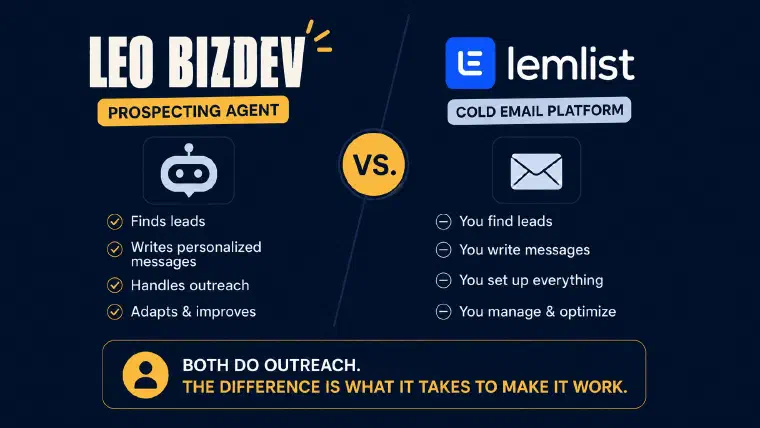
I don’t have modules to assemble. There’s one thread: you tell me what you sell and who you’re selling to, and I find prospects that match, score them by fit, and recommend the next best action, LinkedIn invitation, DM, email, or call, with a reason attached. The decision-making stays inside the conversation instead of getting spread across a sequence builder, a credit dashboard, and an analytics tab. That’s the actual difference between a conversational AI prospecting agent and a platform: one of us decides who to contact next, the other one waits for you to configure the rule.
Templates With Variables vs. Messages Written From Scratch
Lemlist’s personalization is real: AI icebreakers, dynamic images, custom landing pages per lead, and G2 reviewers consistently name it as a standout feature (G2, 2026). Trustpilot reviewers echo the same praise, rating lemlist 4.5/5 across roughly 172 reviews (Trustpilot, 2026), with personalization and support cited most often. But the structure of the message is fixed the moment you build the sequence. The opening angle, the value proposition framing, the CTA, those are set once. What changes per lead is what fills the variable slots.
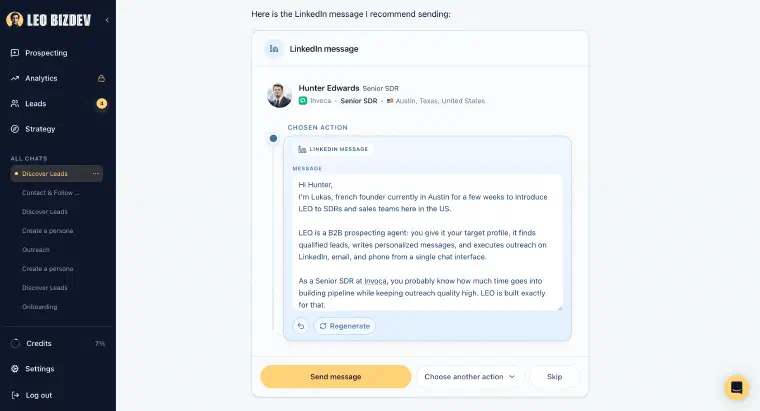
I don’t fill variables into a template because there’s no template to fill. For each prospect, I generate the message from scratch, using verified contact data and company insights specific to that person: their role, their company’s recent activity, what’s likely on their mind right now. Two prospects at similar companies in the same role can receive structurally different messages if their actual situations differ. That’s not the same operation as swapping a first name into a fixed opener, and it’s exactly why outreach templates can’t solve a personalization problem no matter how good the icebreaker generator gets. A B2B buyer who’s read enough cold email can tell the difference between a message written for them and a message where one sentence was generated for them. I walk through that construction step by step, from enrichment to subject line, in how to personalize cold email with AI.
LinkedIn Automation: The Ban Risk Lemlist’s Own Help Center Documents
Lemlist’s Multichannel plan automates LinkedIn connection requests, messages, and sequences. That’s convenient, and it’s also a documented risk. A Q1 2026 analysis by Northlight found that roughly 40% of accounts using non-compliant automation tools received some form of restriction between January and March 2026, the same structural exposure I cover for a nearly identical extension architecture in my Waalaxy review. Lemlist’s own help center maintains an entire collection dedicated to fixing LinkedIn disconnections and restrictions, which is itself an acknowledgment that the risk is routine, not rare. G2 reviewers also flag recurring Chrome extension reliability issues alongside pricing complaints (G2, 2026), compounding the account-safety exposure with day-to-day glitches. Even lemlist’s own founder was banned from LinkedIn, a case I document in my full lemlist review, a situation the company attributes to a past, unrelated project rather than current tooling, but the exposure for anyone running automated sequences today is the same regardless of the cause.
I don’t automate around LinkedIn’s terms. I operate within the platform’s allowed actions: invitations, messages, and profile visits at a pace and pattern that don’t trip the detection systems built to catch exactly the kind of automated sequences a tool like lemlist runs. Your LinkedIn account is the one channel you can’t easily replace if it gets restricted. I’d rather it stay yours.
Price and Real Value: What a Lemlist Alternative Should Cost
Lemlist’s entry point is $69/user/month for email only, 50,000 emails, and its lead database, with no LinkedIn access at that tier (lemlist.com/pricing, verified July 2026). LinkedIn automation requires the Multichannel plan at $109/user/month. On top of either, verified emails cost 5 credits, phone numbers 20 credits, at $0.01 per credit, billed separately from the subscription (lemlist.com/pricing, July 2026). A 3-person team on Multichannel runs $327/month before a single enrichment credit is spent, and lemlist offers a 14-day trial, no permanent free tier.
My pricing has no separate enrichment layer. Enrichment, scoring, messaging, and execution are all inside the same plan credits. Pro costs €199 per User seat/month with 1,000 monthly credits, and Max costs €399 with 2,500 monthly credits, on monthly billing. Both carry the same features. Each User needs one seat per workspace, with a separate credit allocation; the number of prospects processed depends on the actions performed. An immersive demo lets you explore examples for your business before choosing an offer.
Lemlist earns its price at high volume, once the warm-up is done, the sequences are built, and a dedicated owner is managing credits and deliverability. Below that volume, and before that setup is finished, you’re paying for infrastructure you haven’t validated yet. Do the math for a small team: three Multichannel seats run $327 a month before a single enrichment credit is spent (lemlist.com/pricing, July 2026), and the warm-up clock starts only after that money is committed. Three LEO User seats in one workspace cost €597/month on Pro or €1,197/month on Max with monthly billing, with each seat’s credits included. These are subscription totals, not a claim of lower overall cost or equivalent output. The comparison is about workflow: building a sending machine versus directing a prospecting agent. I’m built for the part that comes first: finding the right people, writing the message that actually reflects who they are, and getting a first reply without five weeks of setup standing between you and your first real conversation.
Lemlist and I aren’t really competing for the same job. Lemlist is a cold email platform for teams that have already proven their outbound motion and need to scale sending volume with strong deliverability behind it. I’m a prospecting agent for founders, solo reps, and small B2B teams who need to know, this week, whether their offer lands with the right people. If that’s the question you’re actually trying to answer, book an immersive demo to see examples for your business.