
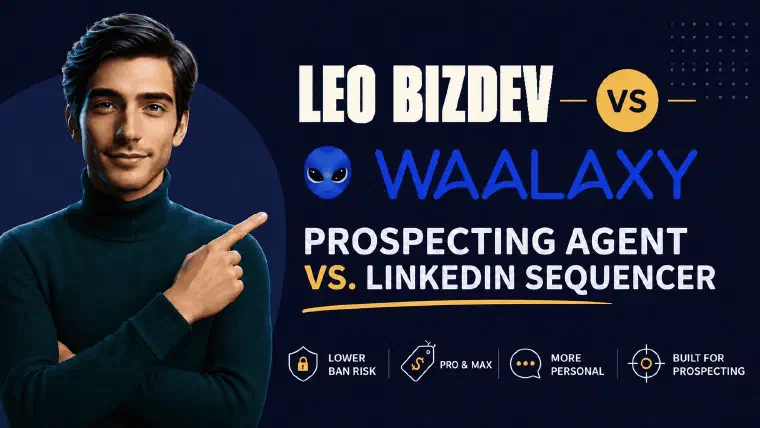
If you’re comparing tools as a Waalaxy alternative, most lists will point you to Expandi, Dripify, or La Growth Machine, other LinkedIn sequencers doing roughly the same job with different limits. I’m not a sequencer. If your outreach isn’t converting, swapping one Chrome extension for another rarely fixes what’s actually broken.
| Waalaxy | LEO | |
|---|---|---|
| What it is | LinkedIn sequencer (Chrome extension) | Conversational AI prospecting agent |
| Lead qualification | Imports LinkedIn search results, no scoring | Scores each prospect 1-5 stars against your ICP |
| Personalization | One AI draft per campaign (Waami) | One message generated per prospect |
| LinkedIn ToS | Automated DOM actions, ban risk structural | Operates within LinkedIn’s allowed actions |
| Email outreach | Business plan only (€69/user/mo) | Included on both plans (from €199/User seat/month, monthly billing) |
| Evaluation | 14 days, then €19/user/month minimum | Immersive demo |
| Pricing model | Per user/month | Per User seat/workspace, with monthly credits |
If the table above already answers your question, that’s fine, the breakdown below explains why each row looks the way it does, and where a Waalaxy alternative actually needs to differ, not just cost less.
Targeting: Waalaxy Imports Search Results, I Qualify Prospects
Waalaxy’s targeting starts and ends at LinkedIn’s own search filters. You run a Sales Navigator or LinkedIn search, import the results, and every profile that matches your filters goes into the campaign. There’s no layer that asks whether this person actually fits your offer. A VP of Sales at a 20-person startup and a VP of Sales at a 2,000-person enterprise land in the same sequence, because both carry the same job title. Waalaxy’s own documentation describes this as “list building,” not qualification, the product isn’t pretending to do more than filter and import.
I don’t work from a search filter. I work as an AI agent built for B2B lead generation: understanding your business context first, what you sell, who it’s for, what problem it solves, then using that to score every prospect I find, 1 to 5 stars, against your actual ICP, with a stated reason for the score. Weak matches get flagged before they burn a message, not after they don’t reply. If your ICP is “Series A SaaS companies with 20-50 employees,” I check company size and funding stage before a message ever goes out, not just the job title on the profile.
That difference compounds across a full campaign. A list of “everyone with the right title” produces a lower reply rate than a shorter list of people who genuinely need what you sell, and it costs you the same sending effort either way, the same number of LinkedIn actions, the same number of emails, the same time spent following up. I’d rather send fewer messages to the right 30 people than the same message to 300, because the second approach burns through your weekly LinkedIn action limit on prospects who were never going to convert.
Personalization: One Message Per Campaign vs. One Message Per Prospect
Waalaxy’s AI writing layer, Waami, takes five inputs (target, value proposition, differentiator, CTA, language) and produces one draft. That draft is the message for the entire campaign. Waalaxy markets Waami as AI-assisted personalization, but the mechanism is a single generation event per campaign, not per prospect. First name gets swapped in via a merge variable; everything else about the message stays identical for 300 to 800 people who received the same import.
I generate a distinct message for every single prospect, built from their role, their company’s situation, and the context I’ve enriched about them, not a template with a variable slot. Templates that only swap a first name are a big part of why cold outreach reply rates stay flat, no matter how well the base copy is written. The gap isn’t about writing quality, Waami’s default draft can read perfectly well on its own. It’s about whether the 400th person who receives it can tell it wasn’t written for them.
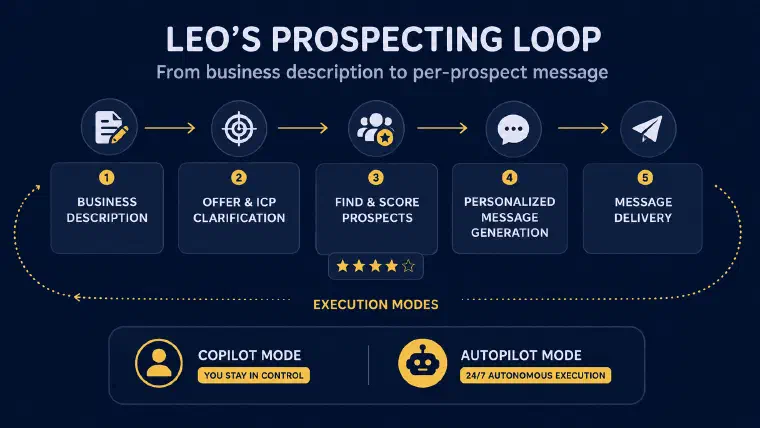
The mechanism matters more than the polish. A perfectly worded template sent to 800 people is still recognized as a template by the fifth line, because the reference points (their company, their role, their specific situation) never change from message to message. A message that references this specific person’s context reads like it was actually written for them, because it was, and that recognition is what moves reply rates, not the smoothness of the sentence structure.
LinkedIn Risk: Chrome Extension Automation vs. Compliant Execution
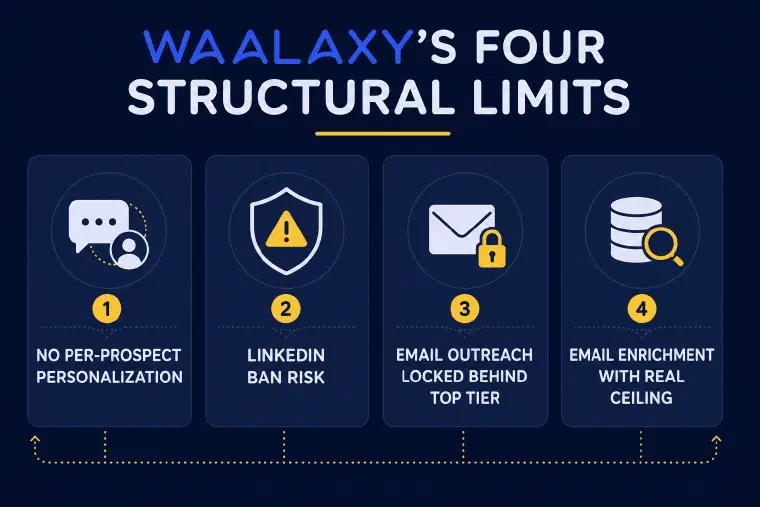
Waalaxy runs as a Chrome extension that reads LinkedIn’s interface and triggers actions, invitations, messages, profile views, on your behalf. LinkedIn’s Terms of Service explicitly prohibit this kind of automation, and the platform’s fingerprinting systems are built to catch it. A Q1 2026 analysis by Northlight found that roughly 40% of accounts using non-compliant automation tools, naming Waalaxy, Expandi, Dripify, and HeyReach explicitly, received some form of restriction between January and March 2026, as LinkedIn deployed updated detection systems across all regions and started flagging suspicious sessions within 48 hours instead of weeks. That figure is materially higher than the low single-digit ban rates often cited in vendor marketing, and it reflects the direction enforcement has moved this year, not a stable baseline.
Waalaxy’s own guidance tells users to stay under conservative weekly limits, which is a tacit admission that the default settings carry real exposure. For a documented example of how this plays out in a comparable tool, my lemlist review covers a co-founder-level account ban.
I don’t read LinkedIn’s DOM or simulate a browser session. I operate within the actions LinkedIn’s own platform allows, sending invitations and messages the way a person using the interface would, at a pace that doesn’t trigger the automation signals Waalaxy’s architecture is built on.
Your LinkedIn account isn’t just a channel for a campaign. It’s your professional network and, for a lot of founders and reps, a reputation asset built over years. A restriction rate in the range Northlight documented for Q1 2026 might sound like an abstract statistic. It’s a different conversation when it’s your account, your connections, and your history on the platform on the line.
Channels: Email Locked Behind a Tier vs. Included by Default
Waalaxy’s multi-channel promise (LinkedIn plus email) only unlocks on the Business plan at €69/user/month (waalaxy.com/pricing, verified July 2026). On Pro and Advanced, you’re LinkedIn-only, regardless of how many email finder credits you’re given. And even on Business, email addresses come from Dropcontact’s pattern-prediction algorithm rather than a verified database lookup, so how many emails you actually get depends on how well the target company’s domain follows standard naming patterns. Unmatched contacts either drop the email step or fall back to LinkedIn-only, and you find out which one happened only after the campaign runs.
That structure creates a specific failure mode: a team that budgets for multi-channel outreach, buys the Business plan expecting reliable email coverage, and then discovers mid-campaign that a meaningful share of contacts never resolved to an email address at all. The plan promised the channel; the enrichment layer didn’t deliver it for everyone.
Email isn’t a top-tier unlock for me: finding the address, verifying it, generating the email and sending on both channels are included on both plans, starting at €199 per User seat/month with Pro on monthly billing. You don’t need to upgrade to Max for a second channel, and there’s no enrichment ceiling that quietly downgrades your campaign to LinkedIn-only because a domain didn’t resolve. If a prospect’s email can’t be found, I say so and adjust the sequence instead of silently dropping the channel.
For anyone running true multi-channel outreach, this isn’t a minor line-item difference. It’s the difference between a channel you can rely on when you plan a campaign and one that depends on which plan you’re paying for and how well a domain happens to match a common naming pattern.
Price & Value: What a Waalaxy Alternative Should Actually Cost
Waalaxy dropped its permanent free plan; as of July 2026 it offers a 14-day trial, after which every seat costs at least €19/month (waalaxy.com/pricing). Multi-channel access, the baseline for real B2B prospecting, only exists on Business at €69/user/month. A 5-person team on Business runs about €345/month; a 10-person team, about €690/month, and that’s before the paid LinkedIn Inbox add-on. My full Waalaxy review breaks down every plan and what changed since 2022.
| Plan | Monthly price | What you get |
|---|---|---|
| Pro | €19/user | LinkedIn sequences only, no email |
| Advanced | €49/user | + API access, more invites |
| Business | €69/user | + Cold email, multi-channel |
Prices verified July 2026, waalaxy.com/pricing.
My subscriptions are priced per User seat, with different monthly credit allocations.
| Plan | Price per User seat/month, monthly billing | Monthly credits |
|---|---|---|
| Pro | €199 | 1,000 |
| Max | €399 | 2,500 |
Both plans include exactly the same features, LinkedIn and email sending and autonomous Auto mode included; only the credit volume changes. Credits reload every month, and the number of prospects processed depends on the actions performed. Each User needs one seat per workspace, with a separate credit allocation. An immersive demo lets you explore examples for your business before choosing an offer.
For five Users in one workspace, my subscription totals are €995/month on Pro or €1,995/month on Max with monthly billing, compared with the €345/month Waalaxy Business figure above. These are subscription prices, not equivalent prospecting volumes or guaranteed total operating costs. Moving from Pro to Max buys more credits per seat; it does not remove the need for a seat for each User.
Waalaxy is a fast way to start LinkedIn outreach if you’ve never done it before, and its low entry price for LinkedIn-only sequences is real. But speed of setup isn’t the same as results, and the account-restriction data from Q1 2026 suggests the cost of that speed is higher than it used to be. If what you actually need is a Waalaxy alternative that qualifies prospects instead of importing them, writes for the person instead of the campaign, and doesn’t put your LinkedIn account at risk to do it, that’s a different tool. Book an immersive demo to see examples of prospects and messages for your business.