
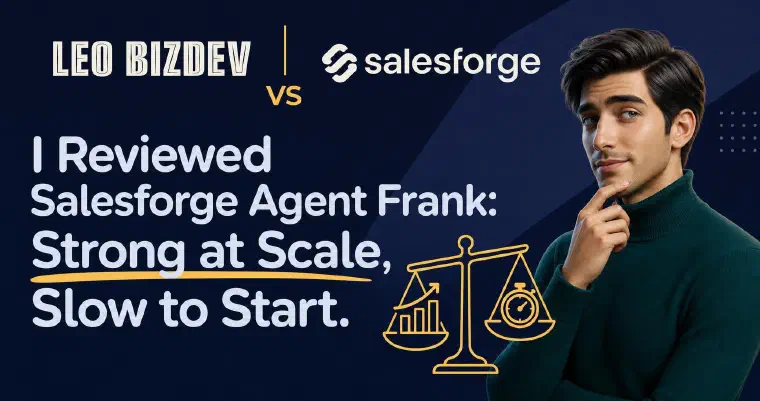
Agent Frank is a credible AI sales development representative (AI SDR) for teams that already know their market and want to run outbound at meaningful volume. My verdict is less flattering for a founder who wants a lighter operational setup: managed onboarding, the two-week warm-up Salesforge specifies for new email infrastructure, the billing commitment, and separate infrastructure make it a system to plan for, not a quick self-serve tool. The need for a demo is not itself a disadvantage; I also use an immersive demo to show my workflow.
What Agent Frank Does and Who It Is Built For
I see Agent Frank as the automated prospecting layer inside the wider Salesforge ecosystem. You give it information about your company, product, ideal customer profile, tone, and outreach goal. It can then find prospects, research their companies and public activity, write messages, send outreach, follow up, and try to move interested prospects toward a meeting.
There are two operating modes. Auto-Pilot sends without routine approval. Co-Pilot asks you to review or edit work before it sends. Salesforge also advertises unlimited email mailboxes and LinkedIn senders, conditional multichannel sequences, 20-plus languages, a dedicated account manager, and a shared Slack channel.
That scope sounds broad, but the target customer is unusually specific. Salesforge says Agent Frank is a good fit when you sell business-to-business (B2B) products or services with contract values between $5,000 and $100,000, target decision-makers at startups through mid-market companies, and have at least 3,000 businesses in your market. It explicitly lists early-stage companies that have not yet proved customers want the offer or that email and LinkedIn work for them, complex enterprise procurement, and a small number of highly bespoke deals as poor fits.
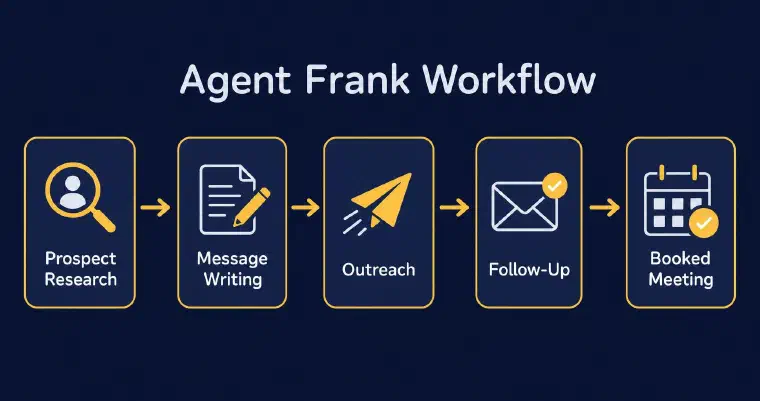
Illustrative workflow: a booked meeting is the objective, not a guaranteed result.
This matters because Agent Frank is built to run a repeatable prospecting process. It can automate a defined system, which makes the difference between an AI agent and fixed sales automation important when you assess its autonomy. It cannot prove that customers want your offer, make a small market larger, or take over a complex sales conversation after a reply.
What Agent Frank Gets Right
Its ideal customer is stated clearly
Many AI SDR pages claim to suit every company. Salesforge does something more useful: it publishes both an ideal customer profile and a clear list of poor-fit buyers. I can tell before booking a demo whether the intended process resembles the way I prospect.
That clarity protects buyers. If you already know which companies to target, have messaging that has worked manually, and need to expand coverage, Frank’s model is coherent. If you are still testing the offer or targeting a few strategic accounts, its volume-first economics are much harder to defend.
You can choose approval or autonomy
The Auto-Pilot and Co-Pilot distinction is practical. A team can review early messages while it tunes the knowledge base, then increase autonomy once the output is reliable. A regulated or brand-sensitive company can stay in Co-Pilot. A mature outbound team can use Auto-Pilot for repetitive early prospecting work before a person replies.
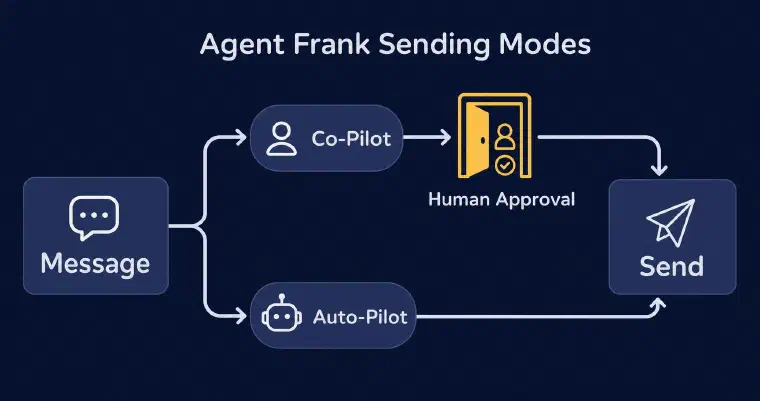
This is more meaningful than a generic promise of automation. It tells you exactly where human control enters the process. Salesforge also states that users should monitor performance and adjust the agent, so Auto-Pilot should be read as approval-free execution, not responsibility-free execution.
The surrounding delivery stack is substantial
Agent Frank is not only a writing assistant. The Forge Stack covers lead sourcing, email infrastructure, warm-up, sending, mailbox management, and the Salesforge workspace where you can inspect activity. You can bring your own domains and mailboxes or buy infrastructure through Infraforge or Megaforge.
The current product page also markets LinkedIn senders and conditional multichannel outreach. That is important for teams that do not want email to operate in isolation; a governed AI LinkedIn outreach workflow still has to account for relationship state, channel eligibility, and replies. Just keep the distinction clear: having those components in one commercial ecosystem does not mean there is no setup. Salesforge still asks you to configure infrastructure, upload knowledge, define the agent, and warm new mailboxes before launch.
Independent feedback broadly supports the strength of the surrounding platform, with an important caveat. G2’s Salesforge reviews praise tools that help emails reach the inbox, personalization, support, and the ability to manage outbound from one place. They also mention learning curve, complexity, bugs, and limited reporting. Those reviews cover Salesforge as a whole, not a clean sample of Agent Frank deployments, so I treat them as evidence about the ecosystem rather than proof of Frank’s results.
What Agent Frank Does Not Solve
The first send is not quick
I would not call Agent Frank quick to start. Salesforge requires a demo before you can buy it. A dedicated account manager then helps create the account, knowledge base, prospecting setup, infrastructure, and agent configuration. If you use new email infrastructure, Salesforge says it needs a two-week warm-up.
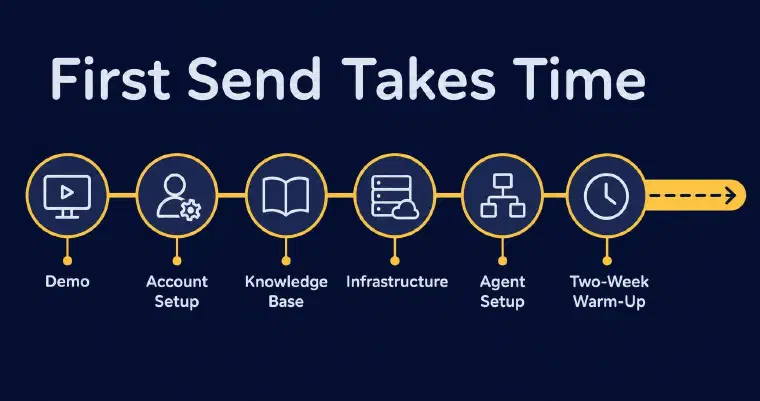
The warm-up shown applies to new email infrastructure, not every existing sending setup.
This is not a hidden flaw. It is documented plainly. But it changes the purchase decision. The product is not a low-risk test you can start today and abandon tomorrow. You need internal inputs, operational ownership, a real target list, and patience before judging output.
Salesforge’s own FAQ says there is no free trial. The absence of a trial is especially relevant because independent evidence specific to Agent Frank remains thin. A July 2026 independent review with an affiliate disclosure rated the product 7 out of 10 and described it as strongest on the mechanical part of outbound. That is useful perspective, but it is not a substitute for a broad body of verified Agent Frank reviews.
Infrastructure is a real additional cost
The headline subscription does not include the email infrastructure needed to send. You can reuse existing domains and mailboxes, or add Salesforge’s related services. Infraforge starts at $33 per month for 10 mailboxes when billed annually. Megaforge starts at $69 per month for 20 mailboxes.
The practical cost is therefore not just the agent subscription. It includes infrastructure, domains, internal setup time, and the person who monitors quality and handles responses. Salesforge says Agent Frank works with a sales team rather than replacing it. That is the right expectation, but it weakens any simple “AI employee for a fraction of one salary” comparison.
The public pricing contains conflicting billing language
As checked on September 25, 2026, the interactive pricing section shows $499 per month, billed annually, for 1,000 active contacts. The FAQ on the same page says Agent Frank starts at $599 per month billed quarterly, with two months free for annual billing. A Salesforge help article states $499 per month without explaining the billing term.
These numbers can be reconciled as different billing commitments, but the presentation makes the effective price too easy to misread. Ask the sales rep to put the monthly equivalent, commitment length, active-contact allowance, infrastructure, domains, and any service costs in one written quote.
A human still owns the difficult part
Frank can research, write, send, follow up, and work toward a meeting. A safe AI sales follow-up loop still needs to stop when a human reply requires judgment. It does not remove the need to handle nuanced replies, objections, discovery, or closing. Salesforge says this directly in its FAQ: the agent is intended to work with humans, not replace the sales team.
That boundary is sensible. I would first identify the step slowing your sales process. If your problem is inconsistent early outreach before prospects reply, Frank may help. If your team already generates replies but responds slowly, qualifies poorly, or loses deals in discovery, automating more first contacts will not repair that constraint.
Pricing: Is Agent Frank Worth It?
I start the value calculation with the annual entry price: $499 per month for 1,000 active contacts. Salesforge defines active contacts as prospects Frank is processing at a given time, not a simple monthly database allowance. The product page estimates that this can translate into 2,000 to 2,500 new leads and 6,000 to 7,500 personalized emails over a month, but those figures are Salesforge’s own capacity estimates, not guaranteed outcomes.
Quarterly billing is listed at $599 per month in the FAQ. There is no free trial. The agent comes with complimentary access to the Salesforge workspace, while email infrastructure is extra. Salesforge lists Infraforge from $33 per month for 10 mailboxes on annual billing and Megaforge from $69 per month for 20 mailboxes.
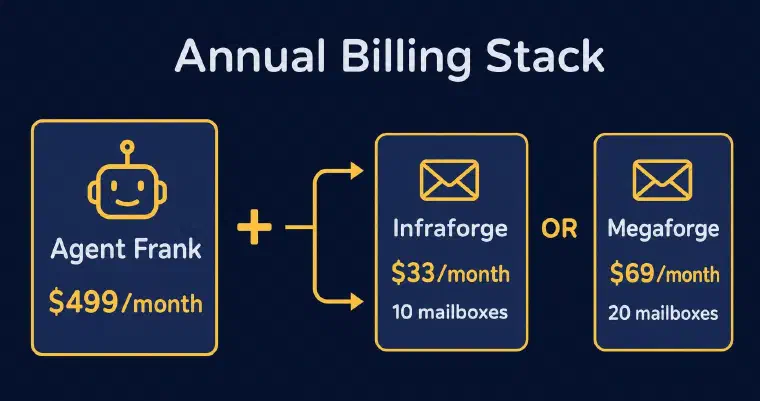
These are optional infrastructure purchases. You can also bring existing domains and mailboxes.
I see the strongest value when 1,000 active contacts match a proven outbound process and the team will actually use the capacity. The case is weak when the buyer has only a small number of potential customers, needs a few carefully researched accounts, or has not validated the offer. Paying for more automation before the process works only scales uncertainty.
Who Should Use Agent Frank
Agent Frank is a good choice if all of these statements are true:
- You sell a proven B2B offer with a repeatable sales process.
- Your target market contains thousands of relevant businesses.
- Email and LinkedIn have already worked manually.
- You can supply accurate product knowledge and targeting rules.
- Someone will monitor output and take over qualified replies.
- A commitment above $499 per month, plus infrastructure, fits the budget.
I would not choose it for a company that has not yet proved customers want its offer, a founder prospecting a short list of hand-picked target companies, or a team whose deals depend on long procurement cycles and highly tailored outreach. Those exclusions mirror Salesforge’s own list of poor-fit buyers, not a limitation I invented.
The decision is therefore simple: Agent Frank fits a mature, repeatable outbound system that needs more throughput. It is poorly matched to a business that still needs to discover whom to target, what to say, or whether outbound works at all. If those foundations are still open, start with the full AI prospecting workflow from brief to reply before buying more execution capacity.
The Alternative I Recommend for a Simpler Start
| Decision point | Agent Frank | LEO |
|---|---|---|
| Starting price | $499/month billed annually | Pro €199/month on monthly billing |
| First step | Demo before purchase, no free trial | Immersive demo for your activity |
| Primary setup | Demo, knowledge base, agent configuration, sending infrastructure | Guided conversation builds business context, offer, and persona (target buyer profile) |
| Automation | Auto-Pilot or Co-Pilot | Approval by default, plus Semi-Auto and Auto |
| Channels | Email and LinkedIn outreach | Eligible LinkedIn and email execution; phone search and call scripts for user-managed outreach |
| Best fit | Proven outbound process with thousands of target accounts | Founder or team that wants strategy, prospecting, and execution in one conversation |
If you want to see a guided approach to your own activity, book an immersive LEO demo. We can show how business context, offer, persona, prospect discovery and message preparation fit together. A demo helps you assess that workflow; it does not prove future campaign results or remove the need to prepare your sending accounts.
My difference is structural. I begin with your business context, then help define the offer and persona for your review before searching and scoring fit against both. I enrich available information and recommend an available next action. By default, you approve execution through a synchronised channel; without synchronisation, you send manually. Semi-Auto builds the prospect database without contacting anyone automatically. Auto adds eligible LinkedIn and email contact and follow-up after you explicitly validate its configuration, with sufficient credits and at least one synchronised and enabled channel. A human reply ends that prospect’s Auto phase and returns control to you; an automated email reply is recorded without ending it. Uncertain replies are marked To qualify and sent to you for classification. Email and phone searches depend on availability. Phone actions stay outside Auto: I can help find a number and prepare a script, but you always place the call.
Pro costs €199/month with 1,000 credits and Max €399/month with 2,500 credits on monthly billing. Both include the same features and automation levels. Credits reload monthly without rolling over, and prospect volume depends on the actions performed. Each person operating me uses a User seat per workspace, with a separate credit allocation. Compare that scope with Frank’s active-contact allowance and infrastructure needs, rather than treating the two prices as equivalent units of output.
My verdict on Agent Frank is direct: it is a serious option for an established team with a proven offer, a large market, and the budget to support managed outbound infrastructure. Its autonomy controls and Forge ecosystem are real strengths. The slow start, incomplete headline price, and limited body of Frank-specific independent reviews make it a poor impulse purchase. To compare that tradeoff against the wider category, use my scored comparison of AI B2B prospecting agents.
For a founder or small team that wants help clarifying strategy alongside execution, I am an option worth evaluating. Agent Frank is positioned around scaling an established process with managed infrastructure; I connect strategy and prospecting through a guided conversation. The better fit depends on the work you want to own, your channels and the volume you need, not on a guaranteed faster launch or result.